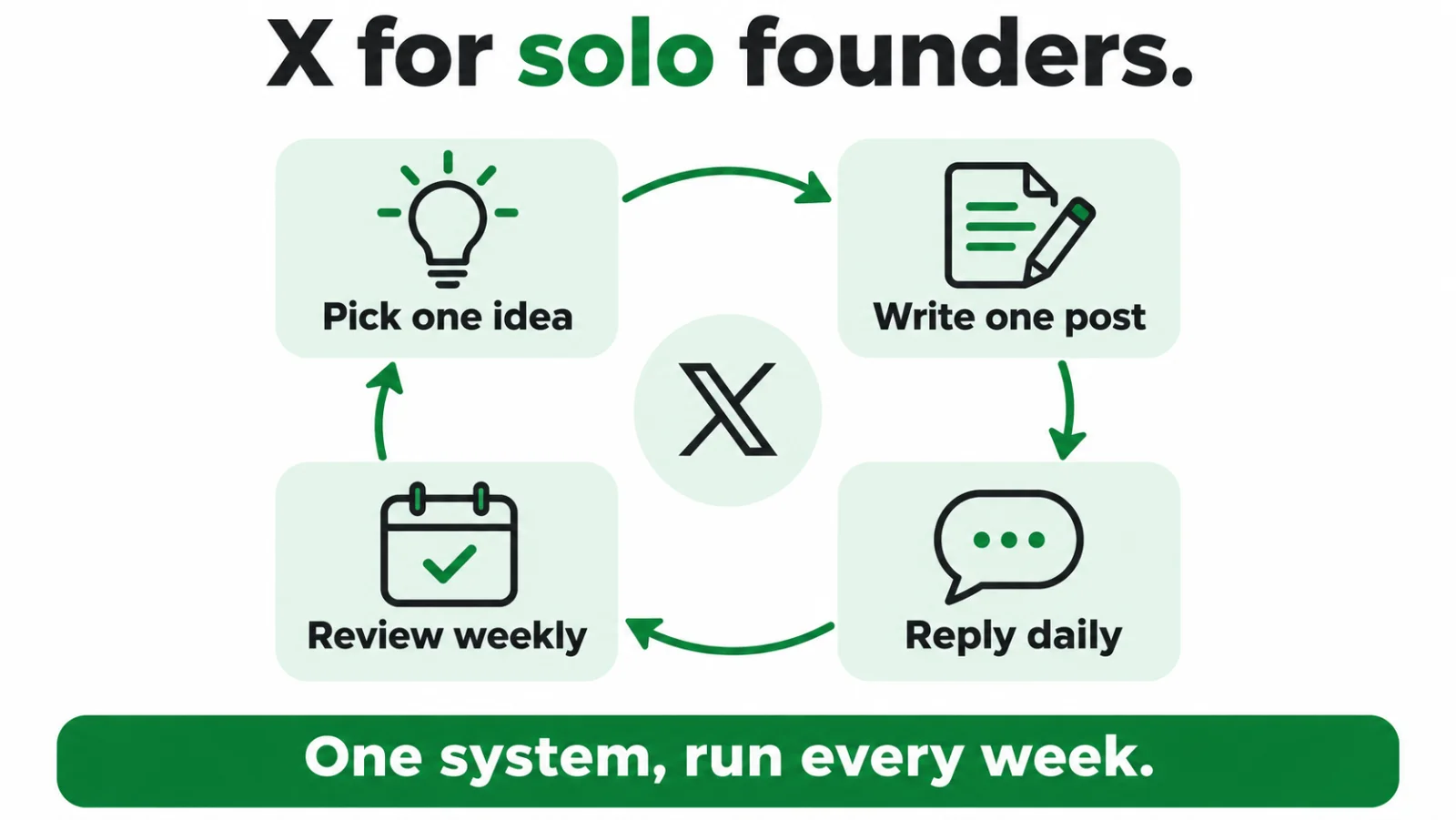
One idea per week is enough to start. Five ideas in a week is how nothing ships.
Write the post yourself first. Read every line before it goes out.
Reply in a fixed block of time, and add a point each time or skip the post.
Review the week once. Keep what got real replies and drop one habit.
As a solo founder you do not have a marketing team. You have one calendar, one set of hands and a product that still needs work. X can still be useful, but only if the routine fits inside the week you already have.
This is the routine I would start with. It is small on purpose. You can keep it on a busy week, and it still produces something worth reading. Every part is a choice between doing one thing well and doing five things badly, and I think for a solo founder the first option is the better one. The article covers the weekly routine, the tools that matter, the limits behind each post, what to skip, and how to tell when the routine is working.
Whyasmallroutinebeatsabigplan
I think marketing plans for small companies assume a team: someone to write, someone to design, someone to reply, someone to count. A solo founder has none of them. A plan that needs five hours a day will be dropped in the second week, and the account will go quiet again.
A small routine has a different job. It keeps the account visible without taking over the week. It gives you a reason to write down what you learned from the product, which is useful even if nobody reads it. And it gives you a log, so after a month you know which parts worked.
A routine you keep beats a plan you abandon. The test of any marketing habit for a solo founder is whether you will still do it in week six, when the product needs you more than ever.
Pickoneideafortheweek
Solo founders cannot cover five topics. Pick one idea each week from your product or your work. It can be a bug you fixed, a decision you made or a number you finally understood. Write down the one thing you learned from it. That sentence is the start of your post.
One idea per week is enough to start. The idea does not need to be big. Small and true beats big and vague. A post about a single fix tells a reader more than a post about the future of your category.
Where ideas come from
The ideas you need are already in your week. Look in three places:
Support messages. The question a customer asked twice is a post, and so is the answer you gave.
Your own mistakes. A change that did not work is more useful to a reader than a change that did.
Numbers you looked at. A metric you finally understood, explained in one paragraph, makes a good post.
Keep a running list in a note on your phone. Each week, pick one item from the list and ignore the rest. The list is the cheapest content plan you can keep.
How to test an idea before you write about it
Before you commit the week to an idea, answer three questions. Can you state the lesson in one sentence? Would a person who does your kind of work find that sentence useful? Can you show a detail that only you could have seen? If the answer to any of those is no, the idea needs one more day of thinking, not a longer post.
Writethepostyourselffirst
Draft the post by hand. Use drafting tools if they help, but read every line and rewrite anything that sounds like a press release. Your readers are looking for a person, not a template. In my view, a post you did not write is easy to spot.
Start with the sentence you wrote when you picked the idea. Then add the detail that makes it yours: what broke, what you tried, what you would do differently. A post with one specific detail reads better than a post with three general claims.
Check the length before you publish. Free accounts have a 280-character limit per post. Premium accounts allow up to 25,000 characters, according to X's Premium help page. Links count as 23 characters each, according to the X developer docs on counting characters, so a link-heavy post can run out of room faster than you expect.
Replyeverydayinafixedblock
Pick a fixed block of time each day for replies, and keep it short enough that you will repeat it. Find posts in your niche, read them, and reply only when you have one detail and one point. If you have nothing to add, skip the post. A missed reply costs you less than a generic one.
For a solo founder, twenty minutes after you publish is a good block. Right after posting, your own post is fresh, and the posts in your niche are still active. Use the block to read a few posts, reply to one or two, and close the tab.
PostMine's Feeds page builds a feed from up to five keywords, and you reply inline under each post. Nothing is sent without your action, and PostMine never automates comments or engagement.
X's help page on conversations says that when you reply, you can see the participants in the conversation (X Help Center: Conversations). A reply to someone else also shows the label "Replying to" on your post, according to X's help page on mentions and replies. Check both before you answer, so the reply lands in the right thread.
Schedulethepostsyoualreadywrote
Solo founders can lose a lot of X time to switching between tasks. Write the posts when you have an idea, then schedule them for a time that suits your readers. Write once, publish later, so the routine does not depend on being online at the right moment.
PostMine's Queue shows your posts in List or Calendar view, with Drafts, Scheduled, Posted and Failed views. Schedule a post for your next free slot or for a time you pick. Queue can also add up to 5 minutes of random variation to each time slot, so the schedule does not look mechanical. Nothing publishes without your explicit action or the schedule you set.
A batch habit works well here. Once a week, write three posts in one sitting, read them tomorrow, and schedule them across the week. That gives you a backlog, so a bad day does not mean a silent account. For a comparison of native tools and third-party schedulers, see schedule X posts: native vs tools.
Aweeklyroutineforonefounder
Routine
Whattodo
Howoften
Monday
Picktheideaandwritethepostbyhand
Onceaweek
TuesdaytoFriday
Replyinyourniche,thenpublishorschedulethepost
Onceaday
Lastblockoftheweek
Readthelogandchangeonething
Onceaweek
Limitsbehindeachpost
The routine has to fit a real calendar, and the platform limits set how much each post can say. The tiles below are the limits behind every post you write.
Your time is the other limit. A solo founder who spends five hours a week on X is still making product decisions in the rest of the week, so cut a block before you cut product time. Week one is slower because you are setting up the tools and the log.
Whattoskip
A solo founder cannot do everything, so the list of things to skip matters as much as the routine. Skip these:
Daily threads. A thread takes a long time to write and an even longer time to read. Post one when you have a result that needs five parts.
Reply sprees. Replying to forty posts in one sitting usually produces forty generic replies.
Automated likes, follows or replies. Automated likes are not allowed, bulk following is a violation, and automated replies are allowed only to users who opted in. The X automation rules explain what is allowed.
Copying other people's threads. A format that works for one account can look hollow when a stranger copies it.
Chasing trends you do not care about. A trend that does not match your product will bring readers who leave.
For the Do and Don't rules on automation, read the Do and Don't section of X's automation rules before you connect any tool.
Reviewtheweekonce
Read the log at the end of the week. Keep the posts that got real replies. Drop one habit that did not work. Then plan the next week's idea. A single weekly review is what keeps a solo routine from drifting.
A weekly review keeps a solo founder honest about what works. Without it, the next week can repeat the last one, including the habits that never paid off. Keep the review short. A short look at the log can be enough to decide the next idea.
Keep the log in whatever tool you already use. Write three columns: the idea, the posts that got a reply, and the habit you dropped. A month of those rows tells you more about your routine than any dashboard.
X's Post Activity Dashboard shows impressions, engagements and an earned engagement rate for each post, with the last 28 days by default (X Ads Help Center). Read it once in the weekly review for the per-post numbers, and keep the replies as the main column.
A made-up review, as an example
Here is what one week's review might look like for a founder who builds a tool for small clinics. The idea was the patient reminder step. The post about the step got two replies from clinic managers, which is a good sign. The reply block produced one useful conversation and three that went nowhere. The habit to drop was writing replies before reading the full post. The next week's idea is the form that patients abandon. The whole review took fifteen minutes. The numbers and names here are invented, and the shape is what to copy.
Works
One idea and one post each week
Replies with a point, or no reply
Scheduling the posts you already wrote
Avoid
Five topics in one week
Automated likes or follows
Judging the month by one post
Wheretheadvicedisagrees
Some advice says solo founders must post every day, because consistency is everything. Some says a small account should not post at all until it has a lot to say. Some says the founder's face is the brand, and others say the product should speak. I would not pick any of these as a rule.
My view is that the routine should match the hours you actually have. A three-post week you keep is worth more than a daily plan you abandon by Thursday. Test the frequency for a month in the log, then decide.
A builder who posted every day for 30 days reported "200K impressions. 30 followers," and the title of their r/buildinpublic thread reads "Zero real engagement." The poster says they built builtinpublic.xyz and pitch it in the thread, so that is one builder's account. It is the reason this routine counts replies and a weekly log, not the number of days a post went out.
Commonmistakes
Starting with five channels. X is enough for one month. Add another channel only when the X routine is steady.
Writing the post in the reply box. A post written in a hurry reads like one.
Judging the month by one post. One post can get lucky or unlucky. Look at the trend.
Skipping the weekly review. Without it, the routine drifts and nobody notices.
No. Start with one idea a week, one post you wrote by hand, and a short daily reply block. You can add more later if the routine works.
Free accounts have a 280-character limit per post. Premium accounts allow up to 25,000 characters. Check which one you have before you write long posts.
X's automation rules allow automated replies only to users who opted in, and AI reply bots need X's prior written and explicit approval. Read the rules before you script anything.
Scheduling posts you wrote is different from automating engagement. PostMine's Queue schedules your own posts, and nothing publishes without your explicit action or schedule.
We use cookies for product analytics to improve PostMine. With your consent we also record session replays, including the content you type and view, such as draft posts (passwords excluded), so we can see how the product is used and fix what breaks. Privacy Policy




 Yerkebulan RakhimovNov 9, 202610 min read