

Yerkebulan Rakhimov @buildwithyerke · Nov 5, 2026
Building an X growth tool:
The idea: help creators grow.
The reality: keep finding rough edges.
A founder's personal brand on X grows from specific, honest posts about the work, a profile that says what you build, and replies that show you know the subject. Here is how to build it without performing.

Key takeaways
A founder's brand on X is not a logo and a slogan. It is the sum of what people learn about how you think, what you build and how you handle a bad week. Readers do not follow a founder for a polished story. They follow for specific decisions, honest mistakes and a steady view of the problem the product solves.
This article covers how to build that brand from the work you already do. It starts with the profile, then the posts that show your decisions, the replies that show your judgement, and the line between a founder account and a company account. It also covers what to avoid, because the most common founder brand failure is a feed that sounds like a press kit.
The profile is the first thing a stranger reads. Your bio can be up to 160 characters, according to X's guide to customising your profile. Use the space to say what you build and who it is for, in plain words.
A bio like "Founder. Views are mine." says nothing about the reader. A bio like "I build a booking tool for dental clinics. I post what I learn about confirmations and no-shows" tells a stranger what to expect. The profile photo should be a clear photo of you, at the size the guide recommends, which is 400 by 400 pixels. A plain banner, or a banner that repeats the bio, is enough.
Write the bio for the reader, not for your résumé. The reader wants to know what they will learn from you.
A founder brand is built from posts that show work. The best posts describe a decision, a number or a mistake, and they say what happened next. They are not announcements. An announcement says a feature shipped. A work post says what the shipping taught you, and what you would change.
Here is a real example from the founder of PostMine, posted on the account of the author of this article. On November 5, 2026, the post read, in part: "Building an X growth tool: The idea: help creators grow. The reality: keep finding rough edges." The post is short, it names a plain truth about building, and it invites a reply from someone who has had the same experience. You can use the same pattern for your own product: one plain line about the work, and one honest line about the gap.
Yerkebulan Rakhimov @buildwithyerke · Nov 5, 2026
Building an X growth tool:
The idea: help creators grow.
The reality: keep finding rough edges.
Keep the work posts specific and dated in your own log. A founder who posts one work update a week for a quarter has a record that readers can follow and that you can learn from. For a method on writing posts that readers answer, read how to plan and write an X thread and what to post on X: an idea system for founders.
Replies are where a founder's judgement becomes visible. A reply that adds a detail from your own experience shows that you know the subject. A reply that only says "great post" shows nothing. Read the posts your readers read, reply with one point, and let the reply speak for your taste.
A reply to someone else shows the label "Replying to" on your post, according to X's help page on mentions and replies, so readers can see whose post you answered. X's help page on conversations also lists the participants in a thread, which helps you pick the right person to answer (X Help Center: Conversations).
The rule is the same as for any X account: reply when you have a point, and skip the post when you do not. A founder who replies to fifteen posts a day with generic lines builds a reputation for noise. A founder who replies to two posts a day with specific points builds a reputation for judgement.
Many founders split the account into two: a company account for announcements and a personal account for the work. That split works when each account has a clear job. The company account announces releases, changes and status. The founder account shows the decisions behind them.
The risk is hiding behind the company account. If every post is a product update, readers learn the product, not the person. If the founder account repeats the company posts word for word, it adds nothing. Keep one clear difference: the founder account says what you learned, and the company account says what changed.
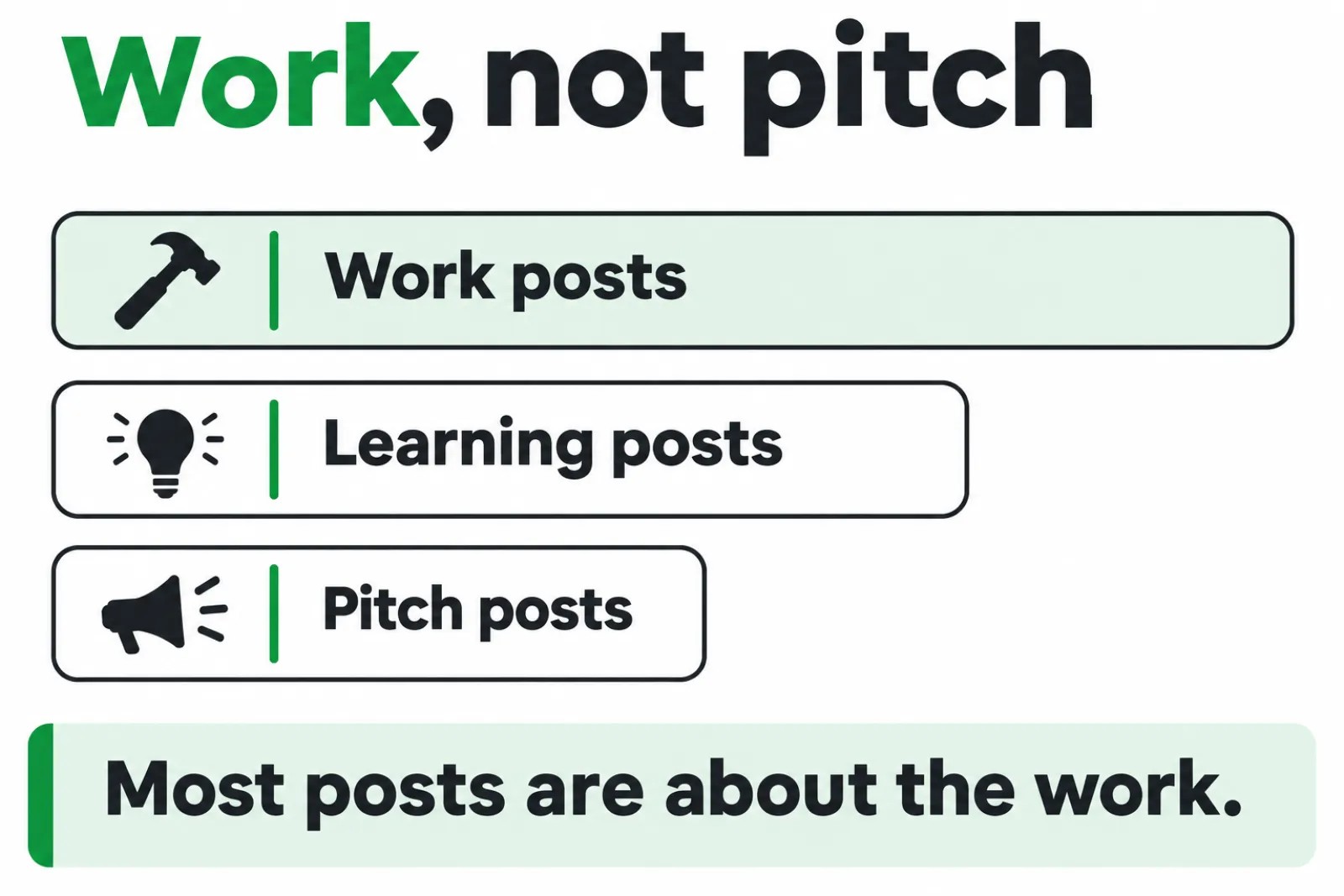
A common founder brand failure is a feed that reads like a press kit. Every post mentions the product, every reply sells, and the personal voice disappears. Readers can tell, and they stop reading. The fix is simple to say and hard to keep: in my view, most posts should be about the work, with the product as the context, not the subject.
Use a ratio you can check. In your log, mark each post as either work, learning or pitch. A healthy month has few pitch posts, and the pitch posts are the ones with a clear reason for a reader to care. If the pitch posts dominate, rewrite the next week's plan around the work.
One r/indiehackers thread shows a version of this. Its poster is the founder of ClimbX, which they promote in the thread, and they wrote "Shared real numbers, even bad ones," and added "I built the audience faster than the product." A commenter said that their post titled "here's my workflow and what went wrong" got 1.6K views, while their polished "I built X, try it" posts did worse. These are self-reported accounts from one thread, so treat them as a reason to test the honest format in your own log, not as proof.
Some advice says founders should share personal life to build trust. Some says the personal account should stay strictly professional. I think the test is whether the detail helps the reader understand the work. A story about a late night fixing a bug can help a reader trust your judgement. A story about a family matter usually does not, and you can always keep it private without losing credibility. Share what helps the reader learn, and keep the rest for yourself.
Some advice also says a founder should post every day. I would judge that by the work, not the calendar. A week with one honest work post is better than a week with five pitches.
Here is a made-up quarter for a founder who builds a tool for dog walkers. In the first month, the founder posts only announcements: a new scheduling screen, a pricing change, a bug fix. The posts get a few likes and almost no replies. The log shows that readers learned what shipped but nothing about why.
In the second month, the founder changes the mix. One post describes a decision: the team delayed a feature because walkers were not sure whether clients or walkers should confirm a booking. One post is a mistake: a reminder went out at the wrong time for a whole city, and the founder explains the fix. One post is a question about pricing per walk versus per week, with the founder's own numbers from a small test. The replies improve. A walker replies to the decision post with the way they handle confirmations, and the founder answers with one point.
In the third month, the founder keeps the same mix and adds a short learning post each week. By the end of the quarter, the log shows that work posts and learning posts start most of the conversations, and announcements rarely do. The announcements still go out, but they move to the company account, which carries the update, while the founder account carries the judgement.
The quarter shows the pattern the article describes. The founder did not become more interesting by posting more. They became more useful by showing the decisions behind the product, and the readers who matched the dog walkers' problem began to answer.
A founder brand can carry a company through a bad week, but it cannot replace the company's own record. When a founder account talks about product rules, pricing or platform changes, the facts should match what the company has published, and they should link to the source. For example, if a founder comments on a change to X's creator payouts, the post should link to the official page or a primary report, not to a rumour in a reply.
A short rule helps: before a founder post mentions a platform or program change, check the official page and copy its date into your log. If the page has changed since, write the change into the post. A founder who corrects a post publicly, with the date and the link, builds more trust than one who never mentions a mistake.
In my view, a founder brand is easy to measure badly. The follower count rises for reasons that have little to do with trust, and it falls for reasons that have little to do with the work. A better measure is the quality of the conversations the account starts, read from the log.
Views are not a measure of trust either. X counts logged-in views on any surface, according to X's help page on view counts, so a view can come from someone who never heard of the founder. Count the replies from people who match your buyer or hiring target before you count views.
For how those conversations turn into customers, partners, hires and feedback, read how founders can turn an X audience into business opportunities.
PostMine helps you keep the record and the rhythm. Writing DNA and a Style Guide can shape drafts toward your voice, but the words that go out are yours to edit.
The PostMine quickstart docs explain the current setup.
Sources, checked 2026-11-09
A founder's personal account usually carries more trust for early-stage products, because readers follow people. Use the company account for announcements, and keep the personal account for the work.
Personal enough to show the decisions and the mistakes, and not so personal that it shows family or health details you have not chosen to share. Write about the work first.
There is no fixed time. Judge it over a quarter of consistent posting and replies, and read the log for the conversations that started, not the follower count.
Yes, when the post is about what you learned building it. A post that is only a product pitch will not build a brand, because readers do not learn anything from it.
Draft in PostMine, add the one thing only you would say, then post.

A plain method for planning an X thread. One promise, a hook that stands alone, one step per middle post, one closing action, and a cold read.
Yerkebulan RakhimovNov 9, 202617 min read

A simple system for finding post ideas on X. Collect them as you work, turn one idea into one post, check for duplicates, and measure before you repeat.
Yerkebulan RakhimovNov 9, 202614 min read

An X audience becomes business value through conversations, not follower counts. Here is how to turn replies into customers, partners, hires and feedback, and how to do it without spamming your readers.
Yerkebulan RakhimovNov 9, 202613 min read
