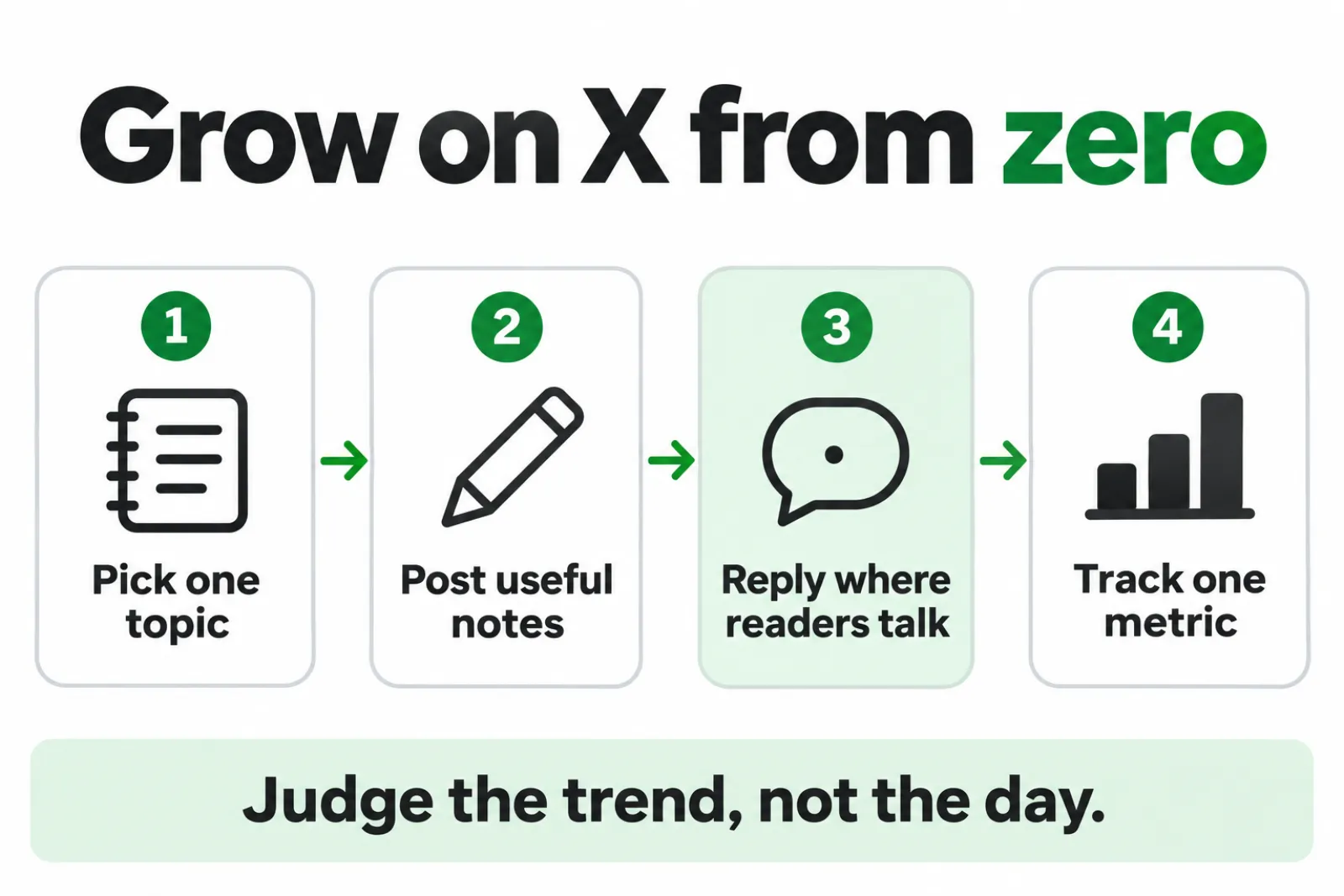
One topic you can keep posting about beats five topics you drop in a week.
Post notes written for one reader. Skip the ones written to impress.
Reply only when you have a specific detail or a point to add.
Track one metric, keep a short log, and judge the trend, not the day.
Growing on X from zero is slow, and most of the early work looks boring from the outside. A new account often gets little attention on day one. What helps is a short set of habits you repeat every day, even when the numbers do not move.
Start with four habits. Each one is small on its own. Together they give a new account something real to show, and they give you something to measure after a few weeks. This playbook covers each habit in order, then common mistakes, then a short section on what to do when the numbers stay flat.
Whyanewaccountstaysquiet
A new account has no history for the platform or for readers to judge. Nobody has seen your posts, your profile says little, and your first replies go under posts that already have hundreds of people reading them. That combination makes the first weeks feel empty.
This is normal, and it is not a verdict. It means the work you do in the first month is mostly about building evidence: a clear topic, a profile that explains it, and a record of what you posted and what people answered. Each of those can be checked, which is the reason the playbook focuses on habits you control rather than on reach you do not.
Judge the first month on the habits you kept, not on the follower count. A new account that posted on one topic every day for four weeks has more to learn from than an account that posted ten times in one day and then stopped.
Pickonetopicyoucankeeppostingabout
A new account needs a clear reason to be followed. Pick one topic you know well and will still care about in six months. Not five topics. Not your whole work. One topic.
Write it as one sentence: who the account is for, and what they get from it. If you cannot write that sentence, the topic is too wide. Narrow it until a stranger could say what the account is about after reading two posts.
Here is a made-up example to show the difference. An account that says "I post about productivity, startups, fitness and cooking" gives a stranger four reasons to leave and no reason to stay. An account that says "I post what I learn building a small invoicing tool for freelancers" tells the same stranger who it is for, what it covers and what kind of post to expect next.
This matters more than it sounds. A clear topic is easy to understand at a glance. A mixed feed asks a stranger to do too much work, so they may leave before they follow. You will also find it hard to write a second post, a third post and a tenth post if every post is about a different subject.
How to test the topic
Ask three questions before you commit to a topic for a month:
Can I write ten different posts about it without repeating myself?
Would I still enjoy writing about it if nobody replied for a month?
Can someone who works in this area tell from one post that I know what I am talking about?
If the answer to any of those is no, narrow the topic or pick a different one. Changing the topic once in the first two weeks is cheap. Changing it every week is how an account never builds an audience.
Postnotesthathelponereader
Early posts often fail when they try to impress. Write for one reader instead. Picture a person in your niche who has a specific problem, and write the post that would have helped them last month.
Keep the first posts short and specific. A small finding from your own work can beat a big opinion. "I changed the subject line and fewer people opened the email" tells a reader something. "Great emails matter" does not.
A useful post usually has one of three shapes:
A finding. You tried something, you measured it, and here is what happened.
A mistake. You did something wrong, and here is the fix you would give to someone starting out.
A choice. You picked option A over option B, and here is the reason, including what you gave up.
Each shape gives the reader a reason to keep reading and a reason to reply. A post with no finding, mistake or choice in it is usually a summary of what other people said, and readers already have access to that.
A worked example, made up
Suppose a founder builds a booking tool for barbers. A weak first post says "Scheduling is hard for small businesses." A stronger one says "I moved my onboarding from seven screens to two. Sign-ups went up, but the second week of usage dropped. I am testing whether the reminder step was doing the work I thought." The stronger post has a number, a choice, a question and a next step. A barber, or another founder who builds booking tools, can reply to it with something specific.
Do not worry about perfect posts in the first month. Worry about posts that are specific, in your topic, and clearly yours. A rough post you publish can teach you more than a polished draft you never send.
Mistakes to avoid in your first posts
Posting opinions about the whole industry. A stranger has no reason to trust your view of an industry they do not know you are in.
Writing a thread on day one. A thread asks for more attention than a new account has earned. Start with one post, then build to threads once you have a reader who wants more.
Using links in every post. A link can be useful, but a feed of links reads like an ad. Put one link in a post when the reader needs it, not as a habit.
Copying a format you like without a point. A numbered list with no finding in it is just a list.
Setuptheprofileasyourfirstpost
Before a stranger reads your posts, they read your profile. Your profile is the first thing they judge, and it is the cheapest thing to fix. Three parts matter most.
The bio. X allows a bio of up to 160 characters, according to X's guide to customising your profile. Use the space to say who the account is for and what it posts. A bio that says "Founder. Views are mine." says nothing about the reader. A bio that says "I post what I learn building a booking tool for barbers" tells the reader exactly what to expect.
The photo. The same guide gives 400 by 400 pixels for the profile photo. Use a plain photo of yourself or a clean logo. A photo that a stranger can recognise at thumbnail size makes replies easier to trust.
The banner. The banner is 1500 by 500 pixels, according to the same page. Use it for one line that says the same thing as the bio, or leave it plain. A banner that promises three things at once makes the account harder to read.
Then post one message that shows the topic. It can be a short note about what you are building, or a finding from your own work. The goal is that anyone who lands on the profile can tell quickly what they will get from it.
Replies are one of the faster ways to meet people who might follow you. A reply under a bigger post puts your name in front of people who already read that post. That is the point. You are not hunting for followers in the replies. You are joining a conversation that already exists.
The rule I follow is simple: reply only when you have a specific detail or a point to add. Skip any post where you have nothing to say. A generic reply reads as noise, and it may not earn a follow.
Find the posts. Read the accounts your readers follow, or build a feed around your keywords. PostMine's Feeds page builds a feed from up to five keywords, and you reply inline under each post.
Name one detail. Say the specific thing you noticed, in your own words.
Add one point. A short opinion you hold is enough. Keep it yours.
Read it aloud. If it sounds like a template, rewrite the first line.
Works
Reply with one detail the author wrote
Add one short opinion you hold
Reply only to posts you actually read
Avoid
Reply to every post in the feed
Paste the same line under many posts
Praise the author without adding a point
How many replies to send
I do not have a number from X for a safe reply count, and I would not trust anyone who gave you one. What I do is cap the time, not the count. Pick a fixed block of time, for example twenty minutes after you post, and reply until the block ends. If the block ends and you still have a point to add, that is a good sign. If you run out of points in five minutes, the feed is wrong, not your effort.
Early on, it is easy to watch everything and learn nothing. Pick one number to track each week. For a new account, a useful one is replies from people in your niche. That is a signal that your topic and your reply style fit together.
Be careful with views. According to X's help page on view counts, views count logged-in views on any surface. A view is a useful signal of exposure, but it does not tell you whether anyone cared. Use it for trends, not as a score for one post.
Keep a reply log. Write the date, the account you replied to, what you said and whether anyone answered. A log is the simplest way to see patterns in a few weeks of small moves. Without one, it is easy to remember only the replies that felt good and forget the ones that did nothing.
Asimplereplylog
Date
Accountrepliedto
Whatyousaid
Whathappened
Monday
Abuilderinyourniche
Apointaboutonesteptheydescribed
Theyansweredandaskedaquestion
Wednesday
Asmallcreator
Ashortexamplefromyourownwork
Noreplyyet,checkagainonFriday
Friday
Afounderinyourniche
Acorrectiontoonenumberintheirpost
Theythankedmeandlinkedtotheirnextpost
The log above is a template, not data. The tiles below are real numbers from X's documentation, the limits you will meet when you write posts and replies.
Read the log across four weeks, not a single week. A flat week is normal. What matters is whether the replies from your niche rise once you start replying with a point. If they fall, change the accounts you read or the reply style before you change anything else.
Start with a spreadsheet. The habit matters more than the tool.
PostMine's My Replies lists the replies you sent and how each performs. Keep your own note of who answered in the log.
A zero-follower account hears conflicting advice fast. One r/Twitter thread asks whether X organic growth is dead for accounts with no followers, and lists the options people suggest: paying for a Premium subscription for a reply boost, commenting on large threads all day, or paying established accounts for reposts and quotes. The thread had a score of four when I read it, and the author says of the last option, "idk if it's true." I cite it only to show the choice a new account faces. Each option is a bet on reach, and the plan in this article is a bet on conversations you can log and check.
Keepasteadypace,notaburst
Consistency usually beats bursts. Some new accounts post many times in one day and then go quiet for a week. A steady pace is easier to keep, and it gives readers a reason to check back.
Write the posts when you have an idea, then schedule them. Schedule the work so the pace holds on a busy day. PostMine's Queue schedules a post for your next free slot or for a time you pick, so the rhythm does not depend on being online at that moment. Queue can also add up to 5 minutes of random variation to each time slot, so the schedule does not look mechanical.
X's help page on scheduled posts covers Promoted-only posts in X Ads at ads.x.com, and that page lists those steps. The x.com web composer was observed to have a Schedule post button on November 9, 2026. Whichever tool you use, the habit is the same: write when you have an idea, and publish on a schedule you chose.
Judge the pace over several weeks. One quiet Tuesday says little about an account that posts steadily.
Commonmistakesinthefirsttwomonths
Common mistakes in new accounts:
Changing the topic before the first month ends. A stranger needs a few posts on one subject before they know what the account is for.
Judging by views on one post. One post with few views says very little. One post with many views may have been a lucky share.
Replying to the biggest accounts only. A big account may not read your reply. A mid-sized account in your niche may do so, and its readers may be closer to yours.
Writing for the algorithm instead of a reader. Tricks that chase reach can bring the wrong readers, and those readers may not reply.
Stopping after a quiet week. The first weeks are the hardest to judge, and they are the weeks most people quit.
Buying followers or joining follow-for-follow groups. These bring in accounts that do not read your posts, and they make the real signal harder to see.
Works
One topic for at least a month
Posts with a finding, a mistake or a choice
A log of replies and what happened next
Avoid
Five topics in one week
Judging the account on one post
Bulk follows and follow-for-follow groups
Wheretheadvicedisagrees
You will hear strong opinions about how often to post, whether to use threads, and whether to ask questions at the end of each post. Some of those opinions come from accounts that grew quickly in a different niche, and some come from people selling a tool. I would not treat any of them as a rule.
Here is what I would do with conflicting advice. Pick the advice that matches your topic and your time. Test it for four weeks in the log. Keep it if the replies from your niche rise, and drop it if they do not. That is slower than copying a rule, and it is the only way I know to find out what works for your readers rather than for someone else's.
Sometimes a month passes and the numbers barely move. Before you change everything, check three things in order:
Is the topic narrow enough? Read your last ten posts. If they do not share a reader, pick one reader and rewrite the next post for them.
Are your replies adding a point? Read the replies you sent this month. If most could be pasted under any post, the problem is the reply style, not the account.
Did you keep the pace? If you posted twice in one week and then went quiet, the account has not been tested yet. Keep the pace for another month before you judge.
Change one thing at a time. If you change the topic, the posting time and the reply style in the same week, you will not know which change mattered.
HowtoapplythisinPostMine
PostMine is built around the same habits this playbook describes. Only the features below exist today, and each one is a choice you make, not an automation.
Feeds builds a feed from up to five keywords or from people lists. In the app you can also build one from your followers, the accounts you follow, repliers or an X list. Paste an X post link to pull in one post. You read each post and reply inline with the Reply button.
My Replies lists the replies you sent and how each one performs, so your log has a starting point.
Queue schedules the posts you already wrote for your next free slot or a time you pick, and publishes each one at its scheduled time. Publish opens a review, and you confirm with Slide to publish.
PostMine does not automate comments, follows or engagement. You can read the PostMine quickstart docs for the current setup steps.
Reply to a bigger account only when you have a specific point. A reply that adds one detail gets read. A reply that only says nice post does not. In my view, mid-sized accounts in your niche can be a better first target, because their readers may be closer to yours.
Free accounts have a 280-character limit per post. Premium accounts allow up to 25,000 characters, according to the X Help Center. A short post that fits in 280 characters is the safe default. Links count as 23 characters each, so check the length after you paste one.
Not in bulk. X's automation rules say bulk or aggressive following is a violation, and apps that claim to get you more followers are prohibited. Follow people by hand, after you have read their posts.
I cannot give you a number of weeks without evidence. What I can say is that a clear topic, a profile that explains it and a log you read every week give you the best chance to see a trend when it starts. Judge the account over at least a month.
We use cookies for product analytics to improve PostMine. With your consent we also record session replays, including the content you type and view, such as draft posts (passwords excluded), so we can see how the product is used and fix what breaks. Privacy Policy




 Yerkebulan RakhimovNov 9, 202613 min read