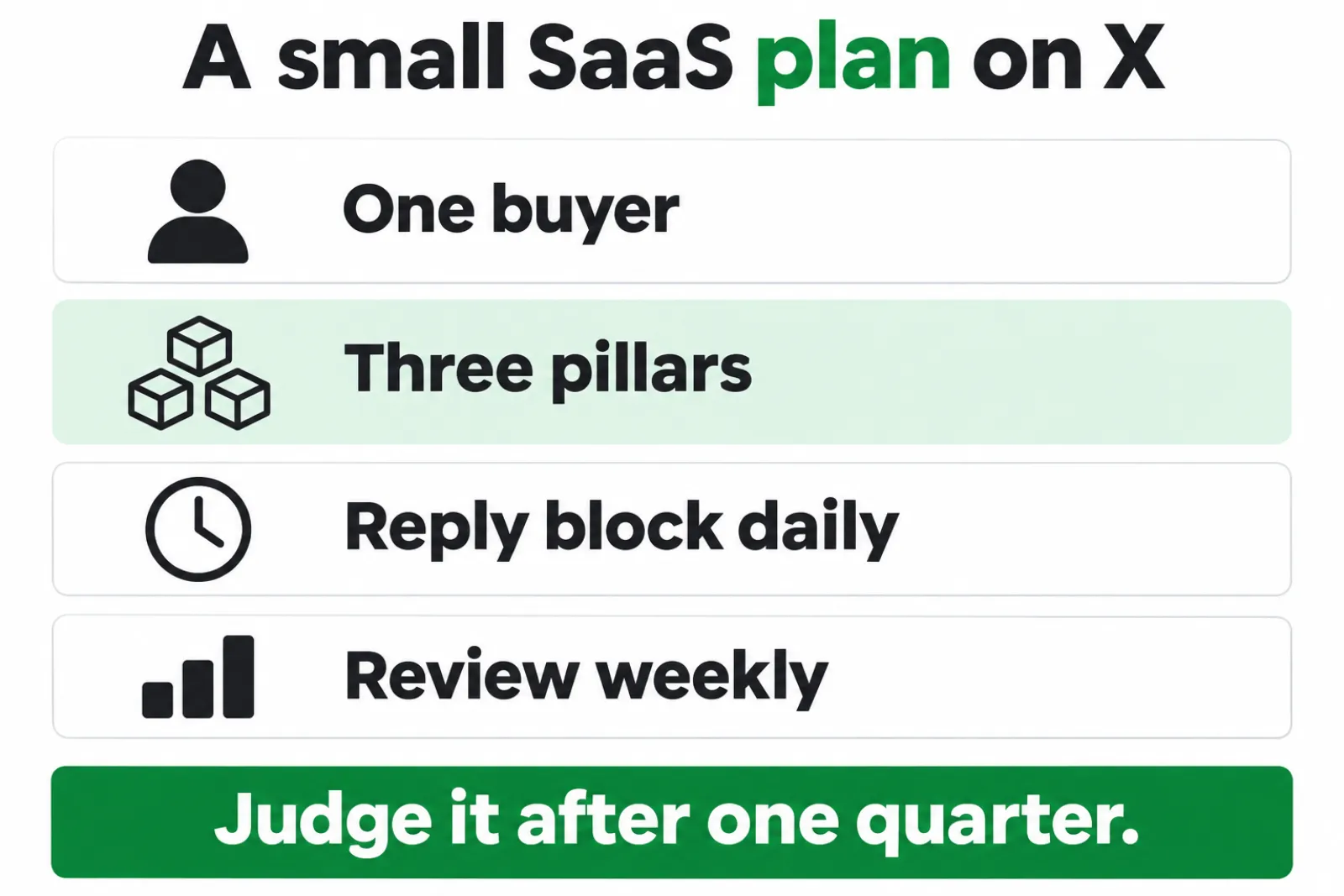
Name one buyer and write every post for that buyer's job, not for the whole market.
Three content pillars tied to problems your product solves are enough for a small team.
A fixed reply block and a weekly measurement review matter more than a posting frequency.
Judge the strategy after a quarter of consistent work, not after one launch post.
A small SaaS does not lose on X because it posts too little. It loses because the posts have no reader in mind, the replies have no point, and nobody checks what the effort produced. A short strategy fixes all three. It names one buyer, sets three content pillars, runs a reply routine on a fixed block of time, and reviews the numbers once a week.
This article builds that strategy step by step. It is written for a team of one to five people, where the founder or one marketer owns the channel alongside product work. It covers the buyer definition, the pillars, the weekly routine, the measurement loop, the mistakes that waste a quarter, and where I think the common advice is wrong for small products.
Startwithonebuyer,notamarket
I think SaaS posts fail when they are written for "small businesses" or "founders," which is the whole market. A stranger who buys software from you has one job they are trying to finish this month, and a post that speaks to that job gets read. A post for the whole market gets skimmed.
Write the buyer as one paragraph. Include the role, the team size, the tool they use today, the task that is annoying them, and the thing they would never admit to a vendor. Keep it specific enough that you could name three people who fit it. If you cannot name three people, the buyer is still too broad.
Here is a made-up example for a scheduling tool for dental clinics. "The office manager of a three-chair clinic. She books patients by phone, misses confirmations on Mondays, and has tried two reminder tools that her dentist never opened. She would not say that the reminder tool was the problem, because she chose it." A buyer like that tells you what to post about: confirmation rates, the Monday problem, and why a tool that nobody opens fails.
Once the buyer paragraph exists, every post and every reply has to pass one test: would this person stop, read the second sentence and think about their own week? If not, the post is for someone else.
Choosethreecontentpillars
A small team cannot cover ten topics. Three pillars are enough. Each pillar is a problem your product solves, described from the buyer's side, not from the feature list. The pillar gives you a supply of posts for months, because a problem produces new details every week.
To choose pillars, list the five problems the buyer complains about most, then pick the three where your product has something real to say. A pillar you cannot write about from experience will produce empty posts by week three.
Each row in the table is a pillar, not a campaign. Rotate between them so no single theme takes over the feed. If one pillar stops producing replies for four weeks, check the buyer paragraph before you drop the pillar. The problem may still be real, but the post may be speaking to the wrong person.
What a pillar post looks like
A pillar post has a finding, a detail and a question you actually want answered. It does not need a thread, a hook or a list of tips. A made-up example: "Nine of forty leads got a second message. The other thirty-one went quiet. The fix was a calendar reminder, not a new tool. What does your second message look like?" The post is short, specific and has a reason to reply.
Buildafixedreplyroutine
For a small SaaS, replies are the cheapest way to reach buyers who already read the subject. They also teach you how buyers talk about the problem, which is the best copy you can get. Keep the routine on a fixed block of time, for example fifteen minutes after each post and one block in the afternoon.
Use the same four steps as the reply method in how to reply on X without sounding like AI: find a post your buyer reads, name one detail, add one point, and log the reply. The one difference for a SaaS is the rule about your product. Mention your product in a reply only when it answers the question asked, and say that you built it. A reply that drops a link into a conversation about a different problem reads as an ad.
X's help page on conversations says that when you reply, you can see the participants in the conversation (X Help Center: Conversations). A reply to someone else also shows the label "Replying to" on your post, according to X's help page on mentions and replies. Both are worth checking before a reply goes into a buyer's thread.
Make a list of ten accounts. Include buyers you know, mid-sized accounts in your category and people who write about the problem. Update the list monthly.
Read before you reply. Open the post, read the replies under it, and only then decide whether you have a point.
Keep the point short. One sentence, one detail, no pitch. Two sentences is usually enough.
Log every reply. Note the account, the point and whether the person answered. The log is your list of conversations to continue.
PostMine's Feeds page is one way to build this list. It builds a feed from up to five keywords, and you reply inline with the Reply button. PostMine does not send replies for you, and it does not automate likes or follows.
Measuretheloop,notthefollowercount
A SaaS team needs to know whether the channel moves the business. Follower count is the easiest number to watch and the weakest signal for a product that sells to a narrow buyer. Track four things each week instead: the posts that started a conversation, the replies from people who match the buyer paragraph, the number of times someone asked a product question, and the links that reached your site.
Views deserve a careful read. X counts logged-in views on any surface, according to X's help page on view counts. A view tells you a post was shown, not that a buyer cared. Use views to spot a post that reached a new audience, then read the replies to see whether that audience matched the buyer.
Week 1
Write the buyer paragraph
Week 2
Pick the three pillars
Weeks 3 to 6
Run the reply block and the post rhythm
Week 7
Read the log and change one thing
The timeline above is the first quarter in four steps. Week seven is the first review where you can change the strategy with evidence, because the log has enough entries to show a pattern.
Scheduleforconsistency,notforhype
A small team often posts in bursts around a launch and then goes silent for months. A steady rhythm is easier to keep, and buyers who see the account over several weeks trust it more than buyers who see one burst. Write posts in a batch, then schedule them. X's help page on scheduled posts describes scheduling in the ads.x.com Composer, according to X's help page on scheduled posts.
PostMine's Queue schedules posts you wrote for your next free slot or for a time you choose, and it can add up to 5 minutes of random variation to each slot. Nothing publishes without your action or the schedule you set. For a comparison of native tools and third-party schedulers, see schedule X posts: native vs tools.
CommonmistakesinaSaaSstrategy
Posting the feature list. A list of features reads like a changelog. Buyers already have the product page for that.
Launching and going quiet. A launch post gets a spike of attention and then nothing. The routine has to continue after the launch.
Chasing a broad audience. A post that fits every founder gets likes from founders who will never buy.
Replying with a pitch. A reply that opens with your product loses the person who asked the question.
Judging after one week. A quarter is the minimum time to judge a channel for a product with a narrow buyer.
Automating engagement. Automated likes are not allowed, bulk following is a violation, and automated replies are allowed only to users who opted in. Read the X automation rules before you connect any tool that touches engagement.
Works
One buyer paragraph the team can reread
Three pillars tied to real problems
A reply block on a fixed time
A weekly review with one change
Avoid
A feature list as the content plan
A broad audience written for everyone
A launch burst with no routine after it
Judging the channel after one post
Wheretheadvicedisagrees
Some advice says a SaaS must post daily to compound. Some says a SaaS should never post about the product, only about the industry. Some says the founder's personal account should carry the brand, and the company account should stay quiet. For a small team I do not think any of these is right in general. My view is that the frequency and the voice should match what one person can sustain for a quarter. If the founder is the strongest writer, the founder's account carries more weight. If nobody on the team enjoys writing, a smaller routine with better replies is the better bet.
Mistakesthatcostaquarter
A quarter is long enough to show whether the channel works, and short enough to waste if the plan is wrong from the start. Four mistakes waste most of a quarter for a small SaaS.
The first is starting without a buyer paragraph. The team writes posts for "businesses" and gets replies from people who will never buy. The fix is to write the paragraph before the first post, and to check every draft against it.
The second is treating the reply block as optional. Posts without replies look like broadcasts, and broadcasts rarely start a conversation. The fix is a fixed fifteen-minute block each day, logged, even on a busy week.
The third is changing the pillars every two weeks. A pillar needs several posts before its replies show a pattern. The fix is to keep the three pillars for at least a month, and change one only when the log shows it has produced nothing for four weeks.
The fourth is measuring the wrong thing. Followers and views move, and they rarely tell you whether a buyer is in the conversation. The fix is to count the replies from people who match the buyer paragraph, and the follow-up questions they ask.
A team that avoids these four mistakes will have a clear quarter to review, even if the numbers are small. A team that makes them will have a busy quarter and little to learn from it.
HowtoapplythisinPostMine
PostMine covers the parts of this strategy that are about habits and records. Only the features below exist today.
Feeds builds a feed from up to five keywords or from people lists. In the app you can also build one from your followers, the accounts you follow, repliers or an X list, and you reply inline with the Reply button.
My Replies lists the replies you sent and how each one performs.
Queue schedules the posts you wrote, in List or Calendar view, and publishes each one at the time you schedule it. Publish opens a review, and you confirm with Slide to publish before a post goes out.
Analytics shows account trends, with account overview CSV import for past days and a daily export.
Choose the channel where your buyers already talk about the problem. If they are on X, a small routine there is worth more than a scattered presence on five platforms. Check the channel for a month before you decide.
Post as often as one person can write with a point. Three posts a week that each carry a specific detail beat a daily post that repeats the feature list. Keep the number you can sustain for a quarter.
Free accounts allow 280 characters per post, and Premium accounts allow up to 25,000, according to X's Premium help page. Choose the plan that fits how long your posts need to be, and check the current plan details on X's help pages.
Measure the conversations your posts start, the replies from people who match your buyer, and the links that lead to your product page. Revenue comes later, so track the leading signals first.
We use cookies for product analytics to improve PostMine. With your consent we also record session replays, including the content you type and view, such as draft posts (passwords excluded), so we can see how the product is used and fix what breaks. Privacy Policy




 Yerkebulan RakhimovNov 9, 202610 min read