Replies put your name in front of people who already read the post.
Reply where your target readers already talk, and keep the point specific.
Skip any post where you have no point. A missed reply costs less than a generic one.
Log every reply and what happened next. The log shows which conversations were worth the time.
A small account has few people who see its posts. A reply to a larger post puts your name in front of the people who already read that post. That is the reason to reply first.
The idea is not new, but it runs against the habit of posting into an empty feed. They post, wait for a reach that does not come, and conclude the topic is wrong. This article is about the other path: spend the first months in other people's conversations, write one point at a time, and let your own posts come later, once readers already know your name from replies.
Whyrepliesworkbeforeposts
A reply sits under a post that someone already chose to read. The people who see it are already interested in the subject, and some of them will read your profile. A post from a small account has to find its readers from nothing. A reply starts with an audience that is already there.
That difference is the whole argument. You are not trying to reach everyone. You are trying to reach the few people who read the post you replied to, and to give them a reason to check who you are.
X's help page on conversations describes a reply as "one of the easiest ways to join in a conversation as it's happening" (X Help Center: Conversations). A reply to someone else also shows the label "Replying to" on your post, according to X's help page on mentions and replies, so the author and the readers can see whose post you answered.
Replies borrow an audience that already exists. Your own posts have to build one.
There is a cost. A reply is public, it is short, and it has to be good. A bad reply under a popular post can be seen by more people than a weak post of your own. That is why the rules below matter.
Themethodinfoursteps
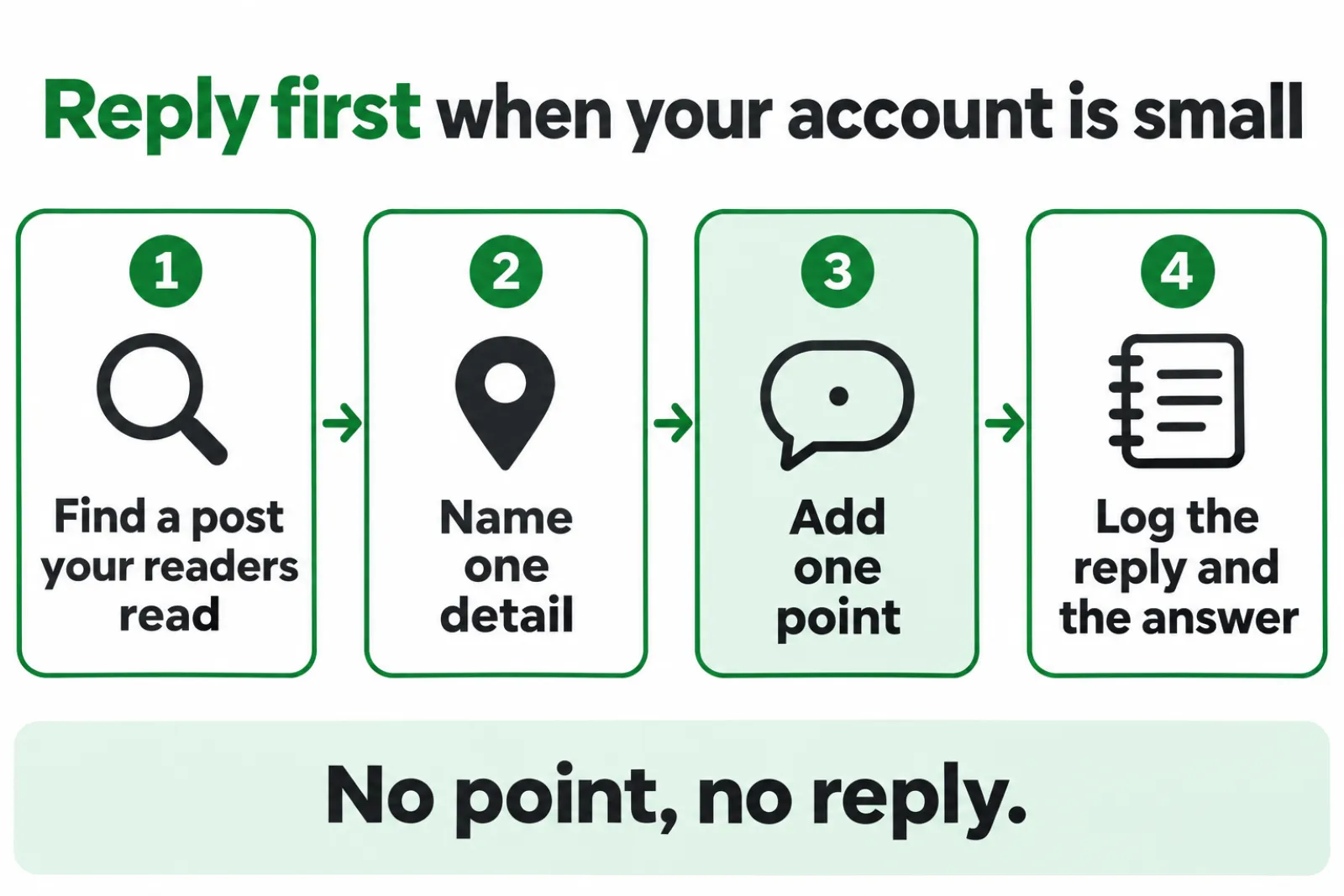
The method is simple. Pick a few posts each week from accounts your future readers follow. Read each one twice. Then decide whether you have a point.
Find the post. Choose posts from accounts your readers follow, or from a feed built around your keywords.
Name one detail. Pick a specific thing the author wrote, a number, a tool, a choice, and say what it means to you.
Add one point. A short opinion you hold, or an example from your own work. One point is enough.
Log it. Write the account, the date, what you said and what happened next.
If you cannot name one detail, skip the post. If you can name a detail but have no point, skip it too. A reply that only says nice post is worse than no reply, because it teaches the author and the readers that you are not worth reading.
PostMine's Feeds page builds a feed from up to five keywords, and you reply inline under each post with the Reply button. PostMine can draft a reply when you press Generate, and it does not send one without your action.
Whatagoodreplylookslike
A good reply is short and specific. Here is a made-up example. A founder posts that their team reduced support tickets by moving a setup video above the signup form. A weak reply says "Love this, so true." A reply that works says that the video is most useful for people who do not read help articles, and asks whether the team tested the video on mobile, where most of their users come in.
The second reply names the detail, adds a point, and asks one question the author can answer. It takes thirty seconds to write, and it is the kind of reply that starts a conversation.
Three rules keep replies in that shape:
Quote the idea, not the sentence. The author should see you read the post, not that you copied a line.
One point per reply. Two points split the attention, and the author answers only one.
Stop after one reply. A second reply belongs in the thread only when someone answers the first.
Whattoavoid
Some replies look useful and do damage to a small account. Avoid these:
Generic praise. "Great post" reads as noise, and the author knows you did not read it.
The same line under many posts. Readers notice repeats, and the authors notice too.
Links to your own product in every reply. A reply that is an advert will be ignored, and it may cost you the next reply.
Arguing with the author. Disagreement works when you add a fact or an example. A reply that only says "wrong" does not.
Replying to posts you did not read. A reply to the headline only is easy to spot, and it is the fastest way to lose a conversation.
Automation is the other trap. An r/aiagents thread with a score of 111 describes a bot that watches keywords and posts replies "within 2 minutes of original tweet going live," and its author wrote that the "entire system runs without me touching anything." X's automation rules say that "sending automated replies to posts based on keyword searches alone is not permitted." A reply with no person behind it is not a reply in this method, and it is the fastest way to lose the account's standing.
X's automation rules do not publish a reply number, and I would not trust anyone who gives you one. Cap the time, not the count. Pick a block, for example fifteen minutes each morning, and reply until it ends. If you run out of points in five minutes, the feed is wrong, not your effort. If the block is full and every reply has a point, the block is the right size.
A small account usually does best with a few good replies a day rather than a long list. The limit is what you can write with a point, not what X allows.
Areplylogforoneweek
Day
Accountrepliedto
ThepointIadded
Whathappenednext
Monday
Afounderwithasimilarproduct
AtestIranonthesamestep
Theyansweredwiththeirownnumber
Tuesday
Acreatorinyourniche
Onecorrectiontoaclaim
Noreplyyet,checkonThursday
Wednesday
Asmallagencyowner
Aquestionabouthowtheysetuptheironboarding
Theyrepliedandaskedafollow-up
Thursday
Abuilderinyourniche
Anexamplefrommyownwork
Theylikedthepointanddidnotreply
Friday
Areaderwhorepliedtome
Aspecificanswertotheirquestion
TheykepttheconversationgoingonMonday
The table is a template for the log, not data. The columns matter more than the rows. The last column tells you whether the conversation continued, and that is the signal you read at the end of the month.
Thereplylogistherealstrategy
A log is the only way to know which replies were worth the time. Without one, you remember the replies that felt good and forget the ones that did nothing. Keep the log in a spreadsheet or in a notes file. Write the date, the account, the point you added and what happened next. Do this every time you reply, not once a week.
At the end of a month, read the log and mark three things: the accounts that answered, the topics that started conversations, and the replies that did not work. The first two become your list of accounts to read next month. The third becomes a rule for what to skip.
The timeline below is the four-week pace for the reply habit. The log decides which step to repeat.
Week 1
Pick accounts and read
Week 2
Check the points
Week 3
Test the timing
Week 4
Read the log and keep one habit
The first week is rarely the one that starts conversations. The count to watch is replies that started a conversation, not total replies. A falling count tells you to change the accounts you read, not to send more replies.
Whentherepliesdonotstartconversations
Sometimes a month of replies produces nothing. Before you change everything, check three things.
First, check the accounts. A large account may not read replies, and a small account may not have readers who care about your topic. Move to mid-sized accounts in your niche for two weeks.
Second, check the points. Read your replies out loud. If most could be pasted under any post, the point is too general. Make each one name a detail only the author would recognise.
Third, check the time. A reply sent six hours after the post is often buried. Try replying within an hour of the post going live, for one week, and see whether the answers change.
Change one of these at a time. If you change the accounts, the timing and the points in the same week, you will not know which change mattered.
Wheretheadvicedisagrees
Some advice says replies are a waste of time for a new account, because replies do not build followers the way posts do. Some says to reply to the biggest accounts in your niche, because a single reply can bring hundreds of views. Some says to reply in volume, because volume compounds.
The word "big" needs a definition. The original poster of an r/TwitterMarketing thread wrote in a comment: "By big I mean accounts with a decent following where your reply actually has a chance of being seen." That is the test to use when you pick accounts. A reply has to be seen, not only sent.
I do not think any of these is right for every account. My own view is that replies help most when the reader of the reply is also the reader of your posts, and that a small, specific reply to a mid-sized account usually reaches that reader better than a generic reply to a large one. Test it in the log for a month, then keep what the log supports.
One user's experience points the other way. A poster on r/Twitter said that after a week and a half of interacting in a niche they had one follower, and a commenter replied: "I have snagged a bit over 1400 followers, and I've gained most of those by engaging with really high-profile accounts." That is one account, and it contradicts the advice in this article. Keep it in the log as a test, not as a rule.
Commonmistakes
Replying to the biggest post in the feed. The reply disappears under hundreds of others. Pick posts where the conversation is still active.
Writing a reply you would not want to be seen writing. Readers judge you by the replies you leave in public.
Sending replies with no log. A month of replies without a log is a month you cannot learn from.
Judging the account by reply count. Ten replies that say thanks are worth less than two that ask a question.
Stopping after the first week. The first week is rarely the one that starts the conversations. Give the habit four weeks.
HowtoapplythisinPostMine
PostMine helps you find the posts and keep the record. It does not reply for you, and it does not send replies without your action.
Feeds builds a feed from up to five keywords or from people lists. In the app you can also build one from your followers, the accounts you follow, repliers or an X list. Paste an X post link to pull in one post, then read it and reply inline.
My Replies lists the replies you sent and how each one performs, so the log has a starting point.
Analytics shows account trends, so you can compare a month of replies with the account's wider numbers.
We use cookies for product analytics to improve PostMine. With your consent we also record session replays, including the content you type and view, such as draft posts (passwords excluded), so we can see how the product is used and fix what breaks. Privacy Policy




 Yerkebulan RakhimovNov 8, 202613 min read