A community starts with a few people who keep replying to each other, not with a large audience.
Useful conversations ask a specific question, answer one, and link people who share the same problem.
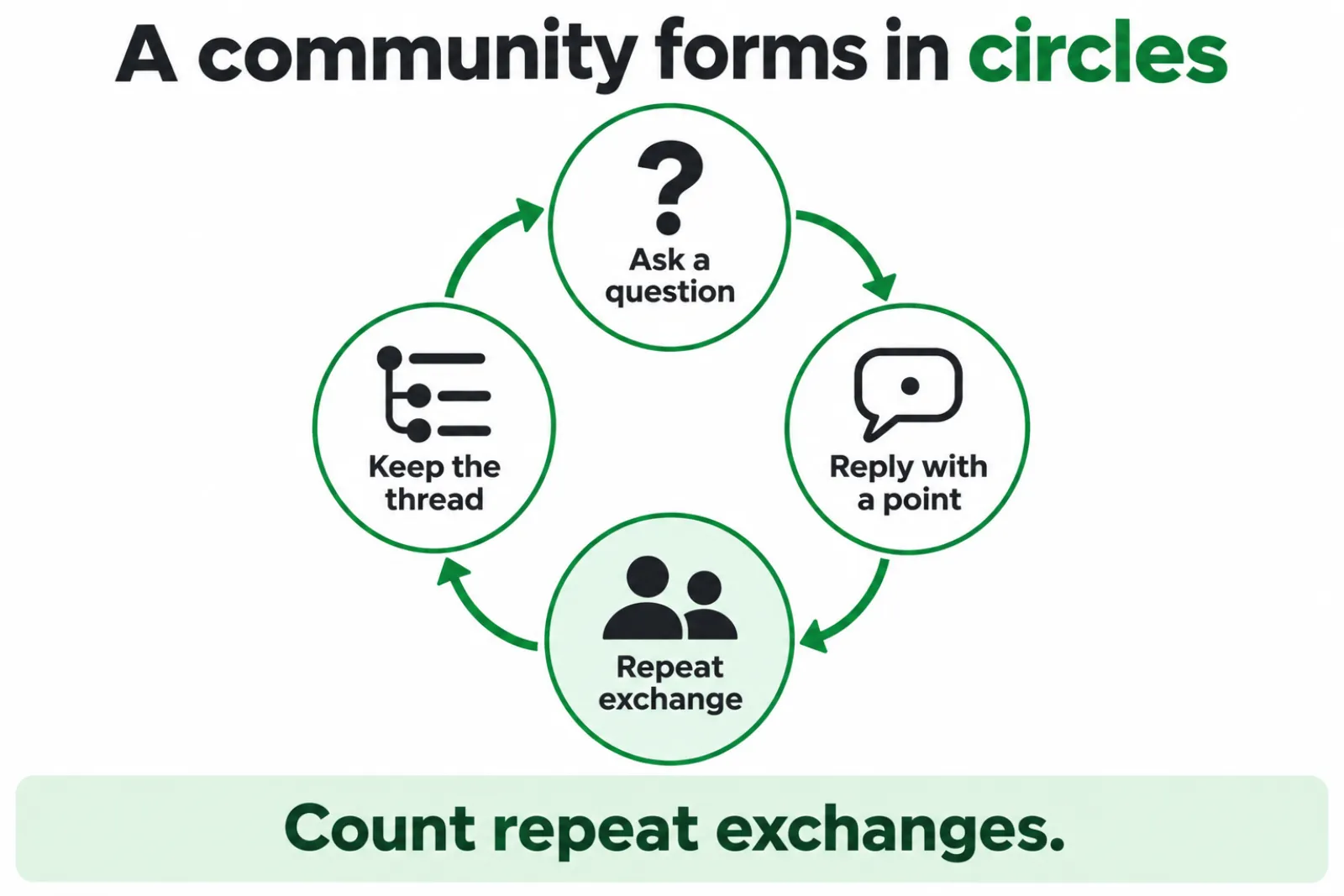
Reply to the people who keep coming back, and log the exchanges so the thread continues.
Never automate the community. Bulk following is a violation of X's rules, and automated replies are allowed only to users who opted in.
A community on X does not start with a big audience. It starts when a few people answer each other in the replies, come back to the same thread and begin to recognise each other's names. I think many accounts never get there because they measure the wrong thing. They chase followers and treat each reply as a metric, instead of treating the reply as the start of a conversation that could repeat.
This article describes how a small account can build that kind of community with a few repeat conversations, what to do with them, and how to keep the group healthy. It covers the first five people, the questions that keep a thread going, the lists you can use to follow the right accounts, and the mistakes that make a community feel like an audience you are selling to. The advice is based on practice, not on a platform guarantee.
Whatacommunityis,andwhatitisnot
A community is a group of people who talk to each other, not only to you. The test is simple: if you stopped posting for a week, would two people from the group still reply to each other? If the answer is no, you have an audience, not a community. An audience reads. A community replies, answers and brings new people into the conversation.
A large follower count can exist without a community, and a small account can have a strong community. Judge by repeat exchanges. Count how many people reply more than once in a thread, and how many of them reply to someone else's post in your conversation.
A community is measured by repeat exchanges, not by the number of followers.
Startwithfivepeople
Community building can start with five people. Find them in the replies to your posts and in the posts of accounts you read. Look for people who answer a question with a detail, disagree with a point in a respectful way, or ask you a follow-up. Those people are the start of a group.
Write their names in your log, with the topic of the exchange. Then reply to their next post with a point. The goal of the first month is not to grow a group. It is to have five people who know your name and answer your questions.
Here is a made-up example. A founder who builds a tool for independent bookkeepers posts a question about how often clients check their invoices. Three bookkeepers reply with different answers. The founder replies to each with one detail, and two of them reply back. Within a month, those three bookkeepers start to reply to each other's posts. The founder did not manage the group. The founder kept the thread alive and gave the group a reason to talk.
Askaquestionthatpeoplecananswerfromexperience
A community conversation needs a question that people can answer with something they know. "What do you think about X?" is hard to answer. "How long does a client take to pay your first invoice?" is easy. The second question gets a reply with a number, a story or a disagreement, and each of those gives the group something to respond to.
Keep the question specific. Ask one question per post. Put your own experience first, then the question. A reader who knows you have done the thing is more likely to answer honestly, and the answer gives the group a point to build on.
Share one detail from your work. Include a number, a choice or a mistake.
Ask one question about experience. Ask how the reader handles the same step.
Reply to every answer with one point. Keep it short, and name the detail the person gave you.
Connect two people. When two people share the same problem, point one to the other's post, with a reason.
Useliststofollowtherightpeople
X lists let you follow a set of accounts in one place, which helps you find the people who keep the community alive. A list of the five people you talk to most is a practical tool. It lets you check their posts in one view, and it shows you who is replying to whom.
Keep the list small and honest. A list of two hundred accounts you never read is not a community tool. A list of ten accounts you read every week is. For a deeper look at how to find the right accounts without bulk following, read how to get more relevant X followers organically.
X's help page on Lists says you can create Lists of other accounts "by group, topic or interest" (X Help Center: Lists). A List is a way to see those accounts in one view. It does not create the community; the replies do.
X's help page on Lists also says you can choose to join Lists that others have created (X Help Center: Lists). A joined List shows the posts of the people on it, which is one more place to find the regulars.
Keeptheconversationgoing
Threads can stop after the first exchange. The person answers, you reply, and nobody continues. The fix is to ask one follow-up question that depends on the answer. A follow-up that asks for a detail from the previous reply shows that you listened, and it gives the other person a reason to keep going.
When you reply to a post, X shows the full list of participant usernames in the conversation, by tapping the prompt above the post (X Help Center: Conversations). Use that list to see which regulars are already in the thread. A reply to someone else also shows the label "Replying to" on your post (X Help Center: Mentions and replies), so the people you answer can see where your reply belongs.
Track threads, not only replies. In your log, mark any exchange with three or more messages as a live thread. Check live threads once a week. A thread that stalls for two weeks can be revived with a post that answers the question it raised.
Signsacommunityisforming,andwhattodonext
Sign
Whatitmeans
Whattodonext
Twopeoplereplytoeachotherwithoutyou
Thegrouphasitsownthread
Stepbackandletitrun
Thesamepersonreplieseveryweek
Aregularisforming
Replytotheirpostswithaspecificpoint
Someonebringsanewpersonintoareply
Thegroupisgrowingbyitself
Thankthemwithaspecificreply,notagenericone
Repliesstopafteroneexchange
Thequestiondidnotinviteafollow-up
Askadifferentquestionaboutthenextstep
Commonmistakes
Treating the group like an audience. A broadcast to a community ends the conversation. Ask, answer and step back.
Asking vague questions. "What do you think?" invites a short reply and no thread.
Replying with praise only. A "great point" ends the exchange, while a detail keeps it open.
Selling in the middle of a thread. A product link inside a community conversation makes people leave. Answer the question, then mention your product only if it fits.
Automating the community. Automated likes are not allowed, bulk following is a violation, and automated replies are allowed only to users who opted in. Read the X automation rules before you connect any tool that touches engagement. Scripted follows also make the group feel fake.
Wheretheadvicedisagrees
Some advice says the best communities are built in a dedicated group space with rules and moderators. Some says the open replies on a public post are the only real community. Some says a community needs a set schedule of events. I think the open replies are the most accessible place to start on X, because they are where the people already are. A separate group can make sense later, when you have repeat exchanges you want to keep private. Test the open replies first, and judge the community by how often people return.
A commenter in an r/Entrepreneur thread went further and wrote "Twitter communities are pretty much dead now tbh." That commenter says they work at an outreach company, so treat the claim as one opinion from someone with a stake in it. The open replies are the place a community has to form first.
Keepingthegrouphealthy
Run a monthly review of the live threads. Read the last three exchanges in each one, and reply with one new detail only if the last person who replied is still interested. Rotate the three or four open questions your group cares about, so the group does not learn to skip them. Give credit in public when a member's answer changes your work. Do not judge the community by its size: five members who answer each other every week are worth more to you than five hundred who only read.
Count regulars, not views. X counts logged-in views on any surface, according to X's help page on view counts, so a view total says little about a community. Count the repeat exchanges instead, which is the number this article uses. Conversations are happening all the time on X, according to X's help page on conversations, so there is always a thread to return to.
A thread on r/TwitterMarketing asks the same question about replies to bigger accounts (thread). Apply the same test to your regulars: before you count someone as part of the group, check who they follow and who they reply to.
Keep the first five names in the log, with the date and the topic of each exchange, so the group can be reviewed once a month.
X's help page on conversations puts it simply: a conversation "all starts with just one reply to a post" (X Help Center: Conversations). A community grows from those single replies, so each reply to a new member is a small step toward the group.
Repliesarethecommunity'sfrontdoor
A community forms inside the replies, so the first line of your reply and whether it invites an answer are what you control. X's reply ordering is not something you control, and this article does not rely on it.
That is one more reason to keep the community in threads you can revisit. A reply that started a good exchange should be checked again a few days later. If a member has answered, reply to that answer, because the second exchange is where regulars are made.
HowtoapplythisinPostMine
PostMine helps you find the conversations and keep your record. It does not run the community for you.
Feeds builds a feed from up to five keywords or from people lists. In the app you can also build one from your followers, the accounts you follow, repliers or an X list. Paste an X post link to pull in one post, then reply inline with the Reply button.
My Replies lists the replies you sent and how each one performs, so you can find the threads that need a follow-up.
Analytics shows account trends, so you can see whether the conversations are growing over time.
We use cookies for product analytics to improve PostMine. With your consent we also record session replays, including the content you type and view, such as draft posts (passwords excluded), so we can see how the product is used and fix what breaks. Privacy Policy




 Yerkebulan RakhimovNov 9, 202611 min read