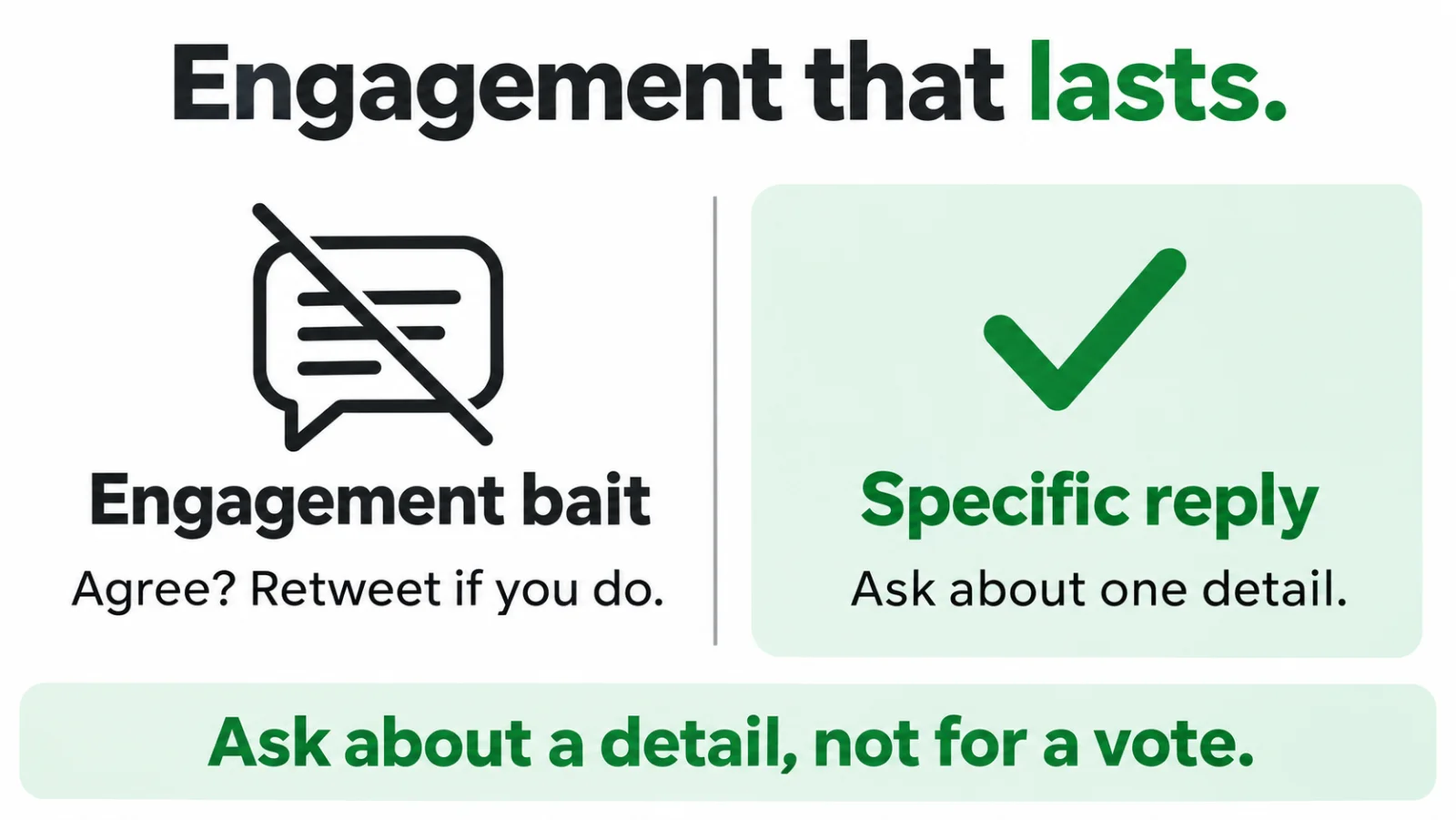
Engagement bait asks for an easy action that tells you nothing. Skip it.
Ask one question about a specific detail. A question a reader can answer is worth more than a vote.
Measure replies and the conversations they start, not likes alone.
Answer the replies you get. The conversation is where the engagement is.
Some engagement advice says to end every post with a question. Some of it says to ask people to agree, retweet or drop an emoji. That kind of post can get a quick reaction. It can fail to start a real conversation, and it can train readers to expect nothing specific from you.
This article is about the other kind of engagement: replies that carry a real answer, and conversations that keep going after the first one. The advice is simple. The hard part is keeping to it when a bait post looks like it is working for someone else. The article covers what bait looks like, how to write a question worth answering, what to measure, how to keep a conversation going, and where the advice disagrees.
Whatengagementbaitlookslike
Bait asks for an easy action that tells you nothing. Agree? Retweet if you do. Drop a fire emoji if you are in. Vote in the replies. These posts are built so the reader can respond without thinking, which is exactly why the response carries little information for you.
The problem is not that a question is bad. The problem is a question with no topic. A reader cannot answer "Agree?" with anything useful, so they may not try, or they may answer with one word that you cannot build on.
Bait has a few common shapes:
The agreement check. "Be honest, is this true?" The reader can only say yes or no, and the easy move is to say nothing.
The vote. "Reply 1 or 2." A vote is a count, not a conversation.
The repost request. "Repost if you agree." It asks for a share with no reason to share.
The empty hook. "You will not believe what happened next." The post makes a promise it does not keep, and readers learn to skip your posts.
Works
Ask about one detail from your own work
Ask a question only your reader can answer
Say what you think, then ask
Avoid
Agree? Retweet if you do
Vote in the replies
Ask a question with no topic
Askaboutonedetail,notforavote
A good question points at something specific. "Which of these three steps would you cut first?" is better than "Agree?" because it needs a real answer, and the answer tells you what your readers care about.
Keep one question per post. Two questions split the reader's attention, and they can answer only one of them. Put your opinion first, then the question. A post that says what you think gives the reader something to answer.
Before you post, read the question out loud. If it could be pasted under any post in your niche, it is still bait. Rewrite it around one detail from your own post, the thing only you know about this week.
A question has to be easy to answer and hard to fake. A reader who has used the product, or who has tried the step you describe, can answer it honestly. A reader who has not can still give you an opinion, which is also useful.
Five questions, rewritten
Here are five made-up bait questions and a rewrite for each. The pattern is the same each time: state the detail, state the point, then ask about a choice the reader has actually made.
Bait: "Agree?" Rewrite: "A signup form with six fields can lose people at the third one. Which field would you keep if you could only have one?"
Bait: "Retweet if you struggle with pricing." Rewrite: "Moving from seat pricing to usage pricing changes what support gets asked. What did your last pricing change do to your support load?"
Bait: "Who else is building in public?" Rewrite: "Building in public can bring in customers you would not find otherwise. Which post made you change your plan this year?"
Bait: "Thoughts?" Rewrite: "Many landing pages lose people at the second scroll, not the first. Does your page lose people before or after the pricing section?"
Bait: "Like if this helped." Rewrite: "A step that people repeat by hand is a good candidate for a tool. Which step in your process do you repeat by hand and still do not trust a tool to do?"
Each rewrite gives a reader something specific to answer. The answers tell you what your readers do, which is far more useful than a like.
Measurereplies,notlikes
Likes are easy to get and hard to use. Replies tell you whether a post started a conversation. Track three things: how many replies came from people in your niche, how specific those replies were, and whether you kept talking to the people who answered.
Read the replies themselves, not only the count. A reply that names one detail and disagrees with a point tells you more than ten reactions. Put those replies in your log with the post they answered, so you can see which kinds of posts start real talk.
X's Post Activity Dashboard shows impressions, engagements and an earned engagement rate for each post, with the last 28 days by default (X Ads Help Center). X also counts logged-in views on any surface, according to X's help page on view counts, so a view total can rise without a single reply. Put the replies next to those numbers, not in place of them.
The timeline below sketches one way a conversation can go. Each step is one place where a bait post loses the reader.
Post
Ask one question about one detail
Reply
Read the answers, not the count
Reply back
Answer the second message
Next post
Write from the best reply
Review the numbers once a week. Look for the posts that got specific replies. Write more of that kind, and drop the ones that only got reactions. A week is long enough to see a pattern and short enough to change course before a habit sets in.
For a view of how the account's trends look in one place, PostMine's Analytics page shows account trends and can import an account overview CSV. The PostMine quickstart docs explain the setup. For how to read the wider set of numbers, see how to read X analytics.
Replytothereplies
When someone answers your question, reply back with a point. Engagement is a conversation, not a count. A short reply that adds one detail tells the person you read what they wrote, and that can make the next answer more likely.
Many new accounts stop after the first answer. The next reply is where the conversation can start to build. The second reply can turn a reaction into a thread.
X's help page on conversations says that when you reply, you can see the participants in the conversation (X Help Center: Conversations). A reply to someone else also shows the label "Replying to" on your post, according to X's help page on mentions and replies. Use both to see who is in the thread before you answer.
A reply back has three parts: the thing they said, your point about it, and a question only if you really want the answer. Here is a made-up example. Someone replies "We kept the free tier because it brings the feedback." A good reply says that the feedback you got from free users changed your onboarding, names the one change, and asks whether they see the same pattern. The reply is short, and it gives the other person a reason to keep talking.
Writethenextpostfromthebestreply
The best reply is a free research note. It tells you what your readers care about, in their own words. Use it to write the next post. Quote the idea, not the person, and add your own point.
For example, suppose one reader replies that they cut a step because nobody used it. That is a post waiting to be written about the step you kept and why. Keep the post tied to the conversation that started it. That gives readers a reason to follow the thread, and it gives you a topic you already know people want to talk about.
Keep a short note of which replies gave you a new topic. Over a month, those notes become a list of questions your readers already asked, which is a better plan than guessing.
X's rules name the same problem from the other side. Under "Engagement Spam," X says it prohibits "inauthentic use of X engagement features to artificially impact traffic or disrupt people's experience" (X Help Center: Authenticity). A like or a reply that exists only to make a count look better is the same kind of thing.
Creators in X's Original Content Rewards program face a rule that targets the same ask. Their continuing eligibility covers a "Do not solicit engagements" rule: repeatedly instructing users to engage with posts, such as asking to like, reply, bookmark, follow, or repost (X Help Center: Original Content Rewards). A bait post that repeats the ask can cost eligibility, not only reach.
Wheretheadvicedisagrees
Some advice says every post should end with a question, because questions drive replies. Some says never to ask questions at all, because readers ignore them. Some says to post a clear call to action, and some says the call to action is what kills the reply rate. I do not think any of these is universally right.
What I would do is run the test. For two weeks, write half your posts with a specific question and half without one. Count the specific replies in each group. The group with more real conversations wins for your account, whatever the general advice says. This is slower than following a rule, and it is the only way to find out what your readers respond to. If you need a reply style to test, how to reply on X without sounding like AI has a checklist, and how to get more relevant X followers organically covers who to reply to.
Whatbaitcostsyou
Bait looks free. It costs one post and a few minutes. The cost shows up later, in three places.
The first cost is attention. A reader who learns that your questions are empty stops reading the answer, even on the posts where you have a real question. Think of a made-up account that posted "Agree?" twice a week for a month. Its readers learned the pattern within two weeks, and by week four the posts with a real question got the same silence as the bait.
The second cost is signal. Bait fills your log with reactions that tell you nothing. When you look back at the month, you cannot tell which topic your readers care about, because the bait replies look the same as the real ones. The data you would need to write the next post is buried under the data you collected from the bait.
The third cost is the people you could have talked to. A specific question brings a reply from the person who has actually done the thing, and that person is often the reader you wanted. A vote brings the people who clicked the button, and that is a different group from the readers you want.
None of this means you should never post a short question. It means that every question should carry a point and a topic, so the reply tells you something.
One builder who posted every day for 30 days wrote on r/buildinpublic that "Twitter loved giving me impressions. But actual engagement? Crickets." The poster says they built builtinpublic.xyz and pitch it in the same thread, so read the post as a reason to check engagement, not as evidence about bait.
Commonmistakes
Asking a question you do not want answered. If you would not reply to the answer, do not ask the question.
Counting likes as proof. A like can mean "I saw it" as easily as "I agree."
Changing the question every post. Readers learn what kind of question you ask. Keep the style steady and vary the topic.
Ignoring the replies that disagree. A disagreement with a detail is the most useful reply you can get. Answer it with a point.
Engagement-chasing on a bad day. A quiet week tempts people to try bait. Stick to the test and wait for the trend.
HowtoapplythisinPostMine
PostMine helps you read and answer replies. It can draft a reply when you press Generate, and it sends a reply only when you press Reply. It does not automate likes, follows or replies.
Feeds builds a feed from up to five keywords or from people lists. In the app you can also build one from your followers, the accounts you follow, repliers or an X list. You read each post and reply inline with the Reply button.
My Replies lists the replies you sent and how each one performs.
Analytics shows account trends, which helps you compare a month of posts with a month of replies.
No. A specific question with a topic is useful. A question that asks for agreement or a vote can bring low-value replies. Ask about one detail your reader can answer.
It can get a quick reaction, but it does not necessarily start a real conversation. Do not script reposts for engagement, because automated engagement is governed by X's automation rules.
Replies from your niche and the replies you sent that got an answer. Likes are a tie-breaker, not the goal.
Read the replies. If people added a detail, asked a follow-up or argued a point, the post did its job. A post that only collected reactions did not start a conversation, even if the count looks good.
We use cookies for product analytics to improve PostMine. With your consent we also record session replays, including the content you type and view, such as draft posts (passwords excluded), so we can see how the product is used and fix what breaks. Privacy Policy




 Yerkebulan RakhimovNov 9, 202616 min read