Your work is the best source of post ideas. Write them down the day they happen.
One idea makes one post. Two ideas in one post make both weaker.
Check every idea against X's rules on duplicate posts before you schedule it.
Measure one post over a fixed window before you repeat its format.
Founders often sit down to post with nothing ready. The idea usually happened earlier that week and was never written down. Your ideas come from your week, so capture them on the day they happen.
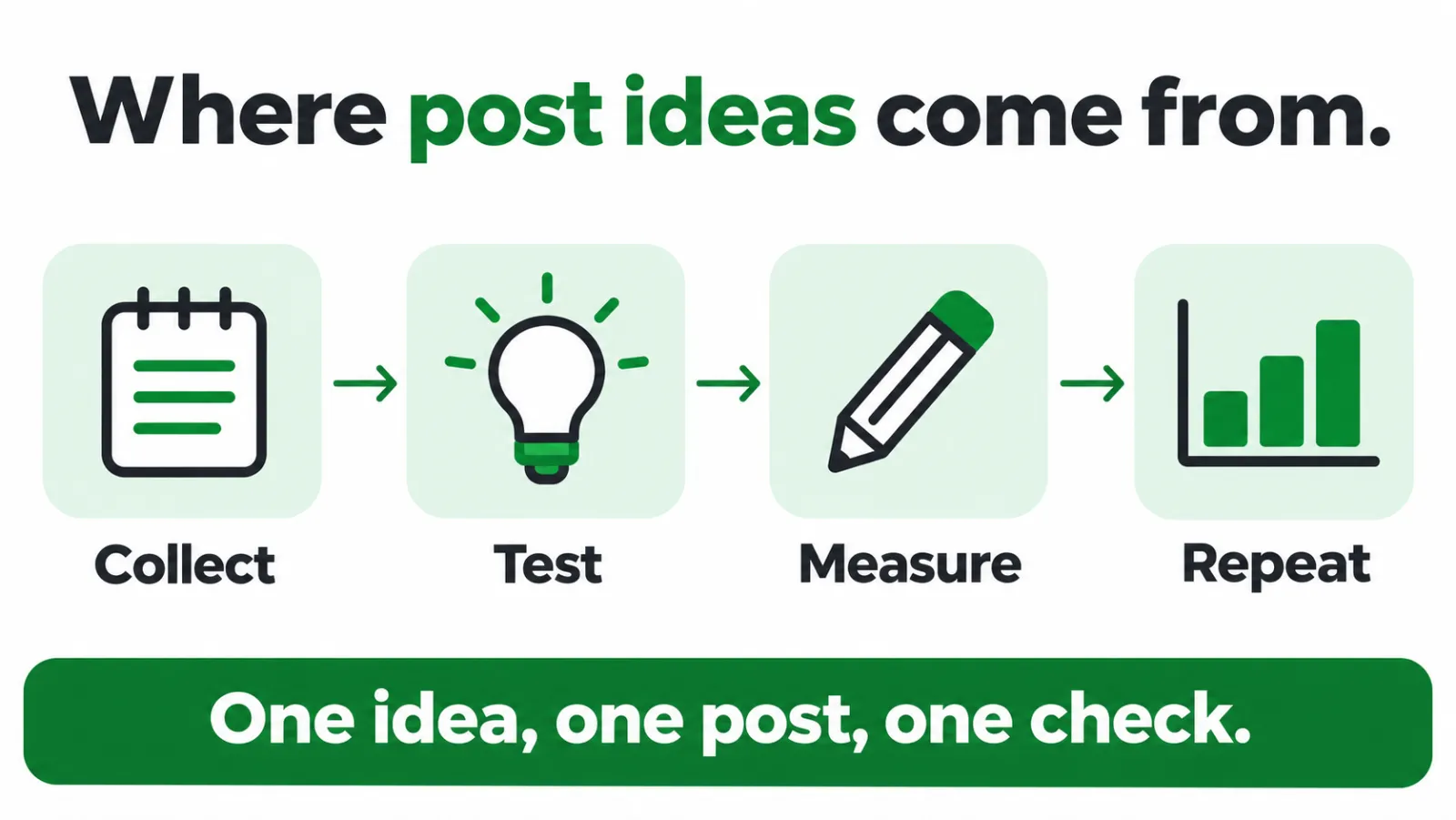
Keep a short list of what you built, what broke, and what someone asked you. When you need a post, read the list and pick one line. That is the whole system. The rest of this article explains how to make it work, where the usual mistakes are, and how to measure the posts so the list gets better over time.
Startwithwhatyoudidthisweek
Pick one thing you built, fixed, or learned in the last seven days. Write it as one plain sentence, the way you would say it to a friend across a table. Do not write it as a headline. A headline is what you write after you know the post. A sentence is what you write when you still know the facts.
A good test is to ask whether the sentence contains a fact only you could know. "I rewrote the onboarding email because two people asked the same question" passes. "Consistency matters on social media" does not. The first one is a post. The second one is a slogan that anyone could paste under any account.
The week is a useful unit because it is long enough to hold a real event and short enough to remember. Founders often lose the best ideas in the gap between doing a thing and writing about it. A weekly pass through the calendar, the commit log or the support inbox is one way to recover them.
Keep the list in whatever tool you already open every day. A notes app, a text file or a paper pad all work. The tool does not matter. What matters is that the list exists when you need it, and that you add to it without ceremony. A list that needs a template, a tag system and a weekly review will be abandoned by the second week.
Keepanideabankwithfoursources
I use four sources for ideas. Each one gives a different kind of post, so it helps to know which source you are drawing from before you write. The sources differ in how much evidence they carry, which is the reason to keep them separate.
Wherepostideascomefrom
Source
Example
Postshape
Yourbuildlog
Abugyoufoundandfixed
Whatbroke,andwhatyouchanged
Customerquestions
Thesamequestionaskedtwicethismonth
Theanswer,withonerealexample
Repliesyouwrote
Areplythatgotarealresponse
Thepoint,expandedinyourownwords
Yourolderposts
Onepostthatdidbetterthantherest
Thesameideafromanewangle
The build log is a reliable source, because the facts are already written down with dates. A commit message or a bug ticket tells you what happened and when. The post is then a story about a fact that already exists, and it is hard to make it vague.
Customer questions are another useful source. A question asked twice in one month is a signal that other people are stuck in the same place. Answer it with a real example, and keep the customer's exact wording out of the post unless they agreed to it. The question is the hook, and your answer is the content.
The third row matters more than it looks. A reply that started a real conversation is already a tested idea. Someone told you, in public, that the topic matters to them. Turning that reply into a post costs you almost nothing, and it keeps the post tied to a conversation people already had. Keep a note of which replies got a response, because those are the ones worth expanding.
The fourth row is useful for a different reason. An older post that did well tells you what your audience responds to, but it is only a clue. Do not copy the words. Find the idea underneath and say it in a way that fits what you are doing now. An older post with the same words will be read as a repeat, and an older post with a new example will be read as a follow-up.
Turnoneideaintoonepost
Each post should carry one idea. This is the rule to check first, because a post that breaks it gets weaker. When I try to say two things at once, neither one lands. The reader has to choose which point to keep, and the reader may keep neither.
The steps below are how I move from a line in the list to a post I can publish. Step four is the check to keep, even when the post feels ready.
The idea loop
1
Capture
Write the idea in one sentence.
2
Pick one point
Cut anything that is a second idea.
3
Write the post
Say it the way you would say it aloud.
4
Check it
Run the duplicate and rules check before you schedule.
Two ideas in one post leave the reader to choose.
When you write the post, start with the fact, not with a frame. "Here is what I learned" and "Thread on X" are frames. They add nothing and they push the real sentence down. Put the fact in the first line. If the first line is strong, the rest of the post can be short.
The second idea usually arrives while you write. It is the sentence that starts with "also" or "and the other thing". Do not delete it from your life. Move it to the list as a new line. You will write it later, as its own post, with its own example. That habit turns one good week into several good posts instead of one crowded one.
After you write it, read it once and ask what a stranger would learn. If the honest answer is "nothing new", cut the post or go back to the list. A short post with one clear fact is more useful than a long one that circles the same point.
Choosethepostshapebeforethewords
An idea can be shaped in several ways: a short fact, a short story, a question, a step, a comparison or a thread. Choosing the shape first saves a rewrite. A story needs a moment and a change. A step needs an order. A comparison needs two things that can be compared honestly. If you start writing without choosing the shape, the post tends to become a mix of all of them, and the reader cannot tell what it is for.
A simple rule for founders is to match the shape to the source. A build-log idea usually wants a short story: what broke, what you did, what changed. A customer question usually wants a short answer with one example. A reply idea usually wants a short point that expands the reply. Older-post ideas usually want a new angle, which often means changing the shape. If the shape does not fit, pick a different shape rather than forcing the same one.
Threads need one more decision. A thread is worth writing only when the idea needs several steps that cannot be shared in one post. If the idea fits in one post, a thread makes it longer without making it better. The thread-specific method is in the article on planning an X thread, and it starts from the same rule: one idea, one promise.
Checkforduplicatesbeforeyouschedule
Reusing an idea is fine. Posting the same words again on one account is a different thing. X's automation rules are the place to check what counts as automated activity and what X treats as spam, and the page is the reference for the current wording. Before you schedule any post, read X's rules on automated activity and decide for yourself whether your scheduling falls under them. Keep the post in your own words and your own examples, and keep a record of what you posted.
In practice the check is simple. Before you schedule a post, search your own recent posts for the first sentence. If you find the same sentence or the same example, change the example or the angle. If you find the same idea with different words, that is fine, as long as the wording and the example are yours this time.
I also avoid posting the same link with the same sentence in a short time window. The rules do not give a number for that, so I do not give you one either. It is a judgment call, and you should make it yourself, with the platform's current rules open beside you.
Measureoneideaoverafixedwindow
Ideas only help if you know which ones worked. The easy way to learn is to measure a small window. Pick one post, note its format and topic, and compare it with the posts from the same weekday and time window over the next few weeks. A single post can be lucky. A pattern over several posts is more useful.
A common error is to read a single post as a verdict. A post that got little reach might have been published at a bad hour, on a slow day, or right after a busy news cycle. A post that got a lot might have been a lucky reply from a large account. Neither result says much about the idea. Several comparable posts say a little more, and a note of the context says the rest.
280
Characters per post without Premium, the limit to plan around
These are the platform's numbers, not findings. The 280-character limit is the one to plan around unless you have Premium and a reason to use more, and the 25,000 limit applies only with Premium. A link counts as 23 characters whatever its length, so count it that way when you plan a post with a link.
PostMine's Analytics page shows your account's trends. You can also import an X account_overview CSV to load past days, and export the daily numbers for your own spreadsheet. If you use another tool, the rule is the same: one format at a time, a fixed window, and a note of what you changed.
Do not change the topic and the format and the time all at once. If you do, you will not know which change mattered. Change one thing, measure, then change the next. A founder who changes three things a week will learn nothing from any of them, and will end the month more confused than the month before.
Fromideatopostinsevendays
This is an illustration, not a result. It shows how one idea from the build log can move through the system over a week, with one check at each stage.
Day 0
Capture
Day 2
Pick one point
Day 3
Choose the shape
Day 4
Write and check
Day 5
Schedule
Day 7
Measure
The timeline is deliberately slow. Writing and posting in the same hour leaves no time for the duplicate check and the fact check. Spreading the stages over a week gives each check its own moment, and it lets the idea sit long enough for the second point to separate itself from the first.
Whatworksandwhatdoesnot
Before you write, check the idea against this list. It is short on purpose.
Works
A specific thing you did this week
A question a customer actually asked
A mistake you made, with the fix you used
Avoid
Advice anyone could post under their name
A trend you copied from a stranger
The same post with new words
The left column has a fact that only you can state. The right column has a claim that could come from anyone. If your idea sits in the right column, go back to the list and find the fact behind it. There is a fact behind it, usually a specific event. A generic lesson can hide a specific event, such as a week when something broke or a question that came back twice, and the event is the post.
Two more filters help. Ask whether the idea would still be true in a month. A fact about a launch is useful now and dated later. A lesson about how you work tends to age well. And ask whether you would say the idea aloud to a peer who asked you about your week. If you would, it is probably a post. If you would only say it to an audience, it is probably a slogan.
Commonmistakesfoundersmake
Waiting for the perfect idea. The list is for small, plain facts.
Writing the frame first. "Here is what I learned" adds nothing. Start with the fact.
Putting two ideas in one post. The second idea is a future post. Move it to the list.
Repeating the top post. An older post that worked is a clue, not a template. Find the idea under it and write a new example.
Judging one post. A single result is noise. Compare several posts over a fixed window.
Changing everything at once. If you change the topic, the format and the time together, you learn nothing about any of them.
Reddit's posting advice threads are full of confident rules, so I use them only as a way to check your own list. A thread on r/passive_income about posting engaging content on X drew a long debate about rage bait. The original post is by u/StephCurrySauce (r/passive_income, 2026-01-31, by StephCurrySauce). One commenter with 304 points, u/Comeonwith1t, says "You have to build a following first".
Check an idea before you post it. The Help Center's guide to how to use advanced search describes searching by words, people and dates, and the search rules say that repeated or near-duplicate posts can get an account filtered from search. A quick search for your own sentence before you post is the check that matters.
Keeptheidealistinoneplace
Save the strongest examples from your niche with bookmarks, which the Help Center describes as private and viewable only to you. A bookmark is the raw material for an idea, and it stays out of the feed of the people you follow. Keep the list of ideas separate from the list of bookmarks, so that the examples do not replace the ideas you chose.
Name the hashtags your niche uses in the list as well. The guide to hashtags says hashtags index keywords or topics, which makes them useful for finding a conversation, and a poor substitute for the plain words people use in it.
Some ideas need more room than the standard limit. The X Premium page says subscribers can post up to 25,000 characters in a longer post. Decide whether an idea belongs in a short post or a longer one before you draft it, and check that the account is allowed the longer format.
Do not automate the idea loop by sending replies from a keyword match. The automation rules say that automated replies sent to posts matched by keyword search alone are not permitted. The idea list is for your own judgment about what to post, and the reply is still yours to write.
Check view counts before you judge an idea by its audience. The view counts page says any logged-in view counts, so the views on a test post include your own visits. Judge an idea by the replies it gets from people outside your account.
WherePostMinefits
PostMine is built for this loop, but it does not replace your judgment. The Home page shows the conversations in your niche worth joining and your own posts that outperform, with follow-up drafts. Context holds your Style Guide and the creators you picked for inspiration. The composer drafts from what you give it, and you edit before anything goes out.
The useful part for this system is the link between the Home page and the list. Your own outperforming posts point back to ideas worth expanding, and the conversations show where a reply can become a post. The product can surface those inputs, but deciding which one is worth writing about is still a decision you make.
I would still keep the list in your own notes. A product can help you draft and queue. It cannot know the thing you learned on Tuesday unless you write it down.
We use cookies for product analytics to improve PostMine. With your consent we also record session replays, including the content you type and view, such as draft posts (passwords excluded), so we can see how the product is used and fix what breaks. Privacy Policy




 Yerkebulan RakhimovNov 9, 202617 min read