A thread needs one promise. If the promise has two parts, split the thread.
The first post has to work alone, because many readers only see that one.
Give each post in the middle one job. It is a fact, a step, or a proof.
Read the whole thread once as a stranger before you publish it.
Threads can lose the reader in the middle. The first post gets attention, the last post sounds finished, and the posts between them drift. The reader feels the drift before they can name it. They stop, and they do not come back to finish.
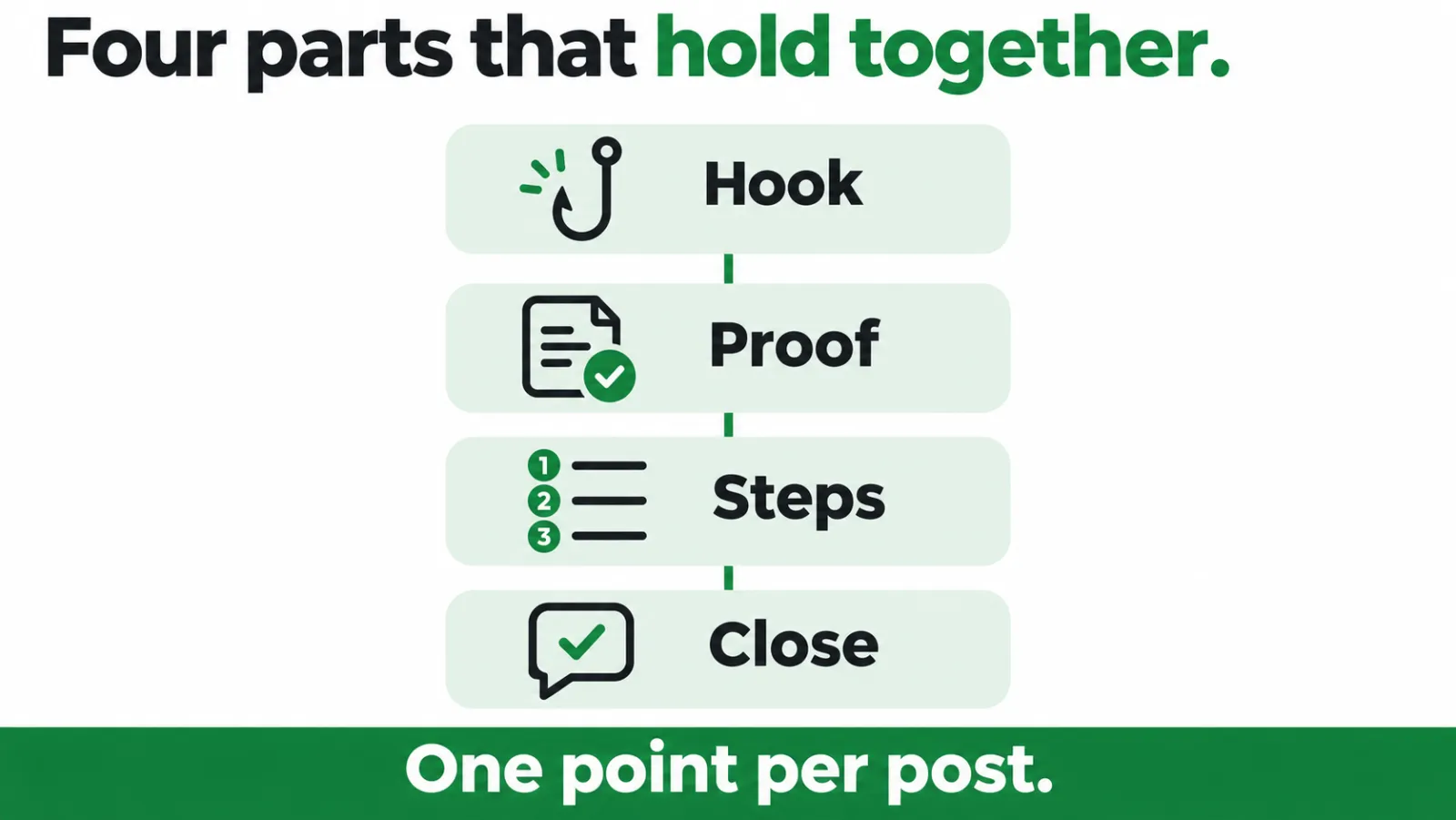
The fix is not better sentences. It is a plan. A thread that holds together has one promise, a hook that works alone, a middle where each post does one job, and a close with one action. This article describes a method for planning that structure before drafting a word of the thread. It is about the shape of the thread, not about the wording. For drafting with a tool, see the separate article on X thread generators, which covers the editing step that comes after the plan.
Each section gives one step, the test for that step, and the common ways it goes wrong.
Decidewhatthethreadpromises
Start with the promise: the one thing the reader should understand or do by the last post. A promise can be a lesson, a method, or a result from your own work. "How I rebuilt our onboarding in a week" is a promise. "Everything about onboarding" is not, because it cannot be kept in a thread. A promise tells the reader what they will have at the end, and it tells you what to leave out.
Test the promise by asking whether it has one part or two. "I cut our onboarding to three steps and here is why" has two parts: the change and the reason. That can work, because the reason supports the change. "I cut our onboarding, and also here is my pricing" has two unrelated parts. Split it into two threads. A reader who came for the onboarding will skim the pricing, and a reader who came for the pricing will skim the onboarding, and both will remember neither.
Write the promise on its own line before you open a draft. Then add one sentence that says who the thread is for. A thread for a founder who is new to X needs different steps from a thread for a founder who has posted for years. If you cannot say who it is for, the promise is still too general.
Thefourpartsofathread
Part
Job
Testbeforeyoupublish
Hook
Statethepromiseinthefirstpost
Wouldastrangerstopreadingafterthispostalone?
Proof
Showwhythepromiseistrue
Isthereafact,example,orresultyoucanname?
Steps
Walkthroughthemethod,onestepperpost
Doeseachpostaddonestepandnothingelse?
Close
Giveoneactionoronetakeaway
Isthereexactlyonethingtodoorremember?
The table is the skeleton for every thread I plan. The four parts are not a formula for reach, and no source I know of shows that this structure beats another one. It is simply a way to see the parts clearly before you write them, so that a missing part is visible before it costs the reader.
Writethehookasifitwerethewholethread
In my view, the first post decides whether the rest is read. So the hook has to state the promise in a way that makes sense without anything around it. Do not write "Here is what I learned" or "A thread". Write the fact or the result, in the first sentence.
Then check whether the hook makes the reader want the next post. It should raise a question the thread answers. For example, a made-up case: "We cut onboarding from five steps to three, and support tickets went down" raises the question of how. The reader wants the steps. A hook that only says "thread about onboarding" raises nothing.
A hook can fail in two directions. It can be too vague, like "I have been thinking about onboarding lately", which gives the reader nothing to hold. Or it can be too complete, like a hook that already contains the three steps and the result, which gives the reader no reason to read on. The right hook names the result and leaves the method for the middle.
The hook also has to stand alone. Many readers see only the first post in a feed, in a notification, or in a screenshot that someone else shared. If the hook says "as I mentioned above" or "this is part one", it fails in exactly the places where it travels.
Buildthemiddleonepostatatime
The middle carries the method or the story. The rule that keeps it tight is simple: one post, one job. A post can state a fact, show one step, or give one example. If it does two of those, split it. If it does none, delete it.
Write the middle as a list of jobs first, before the sentences. Then turn each job into a post. This keeps you from writing a paragraph that wanders between a fact, an opinion, and a joke. It also makes the length of the middle visible. If the list has nine lines, the thread has nine jobs, and you can decide whether nine is the right number before you write any of them.
Write the list. One fact, step, or example per line, with no sentences yet. Write fast, and do not judge the lines while you write them.
Cut the lines that do not serve the promise. Be strict. A line you like is not a reason to keep it.
Order the lines. Each line should follow from the one before it. If two lines could swap places without the reader noticing, one of them is probably redundant.
Turn each line into a post. Keep one job per post. Write the post in the words you would use aloud, and do not start it with a frame such as "Here is the next point".
Read the posts in order. Fix any post that starts with "Also" or that introduces a second idea. If a post begins by restating the previous one, merge the two.
Works
Each post names one fact, step or example
Each post follows from the one before
Each post reads well if you skip the others
Avoid
A post that says Also, and then a new point
Two steps squeezed into one post
A post that only restates the hook
A worked example of the list helps here. The example is an illustration, made up for this article, with no real results. Suppose the promise is "how we cut onboarding to three steps." The list might look like this: the old flow had five steps; the drop-off happened at the account-connection step; we moved the connection to after the first value; the new flow has three steps; the support questions fell in the first week. That is five jobs. A sixth line, "our founder's personal story", fails the test, because it serves the author's image and not the promise. Cut it.
Picktherightnumberofposts
Length is a decision, not a default. A thread should have as many posts as its promise needs, and no more. There is no magic count, and I would be suspicious of any guide that gives you one. What works is to count the jobs on your list, then check whether each job needs its own post or can share one.
The counts in that table are my own rule of thumb, not a measurement. A thread of four posts can hold a method. A thread of twelve posts can hold a story that is hard to stop reading. What breaks the thread is not the count but the drift that a long list creates. When you notice that the middle has grown, ask whether the new lines still support the promise or whether they belong in a second thread.
Keep the close in mind when you count. If the close needs more than one action, the thread has two promises, and the close is the place where that becomes obvious. Split the thread before you publish it, not after readers have already been confused by the close.
Closewithoneaction,notasummary
The last post needs care. The temptation is to summarize: "So to recap, here are the three points." A summary repeats what the reader just read, and it lowers the value of the thread at the exact moment it should land.
Close with one action or one thing to remember. An action is something the reader can do today: check their own numbers, rewrite one sentence, or try one step on their account. A thing to remember is one sentence the reader can carry out of the thread. Keep it to one. In my view, two closing ideas give the reader a choice, and the reader may pick neither.
The close also has to match the promise. If the promise was "how we cut onboarding," an action such as "count the steps in your own flow this week" fits. A close that asks readers to follow the account, or to share the thread, is a different promise, and it usually reads as a request for attention rather than a continuation of the method. If you want readers to follow you, earn it with a thread that keeps its promise, and let the profile do the rest.
Checkthelengthofeachpart
Every part of the thread is its own post, and X counts each one separately. The X Premium page describes up to 25,000 characters for subscribers; 280 is the standard limit it implies. Links count as a fixed 23 characters, and the developer documentation on counting characters says emojis count as 2 each and CJK characters as 2 each.
The practical consequence is that a thread is planned as a set of posts, each with its own budget. A plan that puts one fact per post usually fits. A plan that puts a full argument into one post will not, and the cut will fall on the argument, which is the part the reader came for. Check the count of each part while you plan, not after you have written the whole thread.
Readthewholethreadasastranger
Before you publish, read the thread once from start to finish, pretending you have never heard of the topic. Mark every post where you feel confused, bored, or told what to think. Those are the places to fix.
Then check each post alone. Remove any post that depends on the one above it for its meaning, unless the link between them is part of the method. Each post should be able to stand on its own in a screenshot, which in my view is how a thread often travels.
The cold read also catches terms you use without explaining. If a word is specific to your product or your field, define it once in the thread, in the post where you first use it. A reader who meets an unexplained acronym in post four will not go back to post one to find it. They will leave.
A useful variant is to read the thread out of order. Start with the close, then the middle, then the hook. If each post still makes sense when it is read first, it stands alone. If a post only works after the one before it, decide whether the link is part of the method or a crutch that you can remove.
Checktheclaimsbeforetheygoout
A thread often contains claims that sound confident and that you have not checked. Every number, every rule about the platform and every statement about what works needs one of three things: a source you opened, a measurement you made, or a sentence that says it is your opinion. Anything else comes out.
Be especially careful with claims about reach. I have not found a source that settles whether threads get more reach than single posts, so I do not claim that threads do or do not. If you want to know for your own account, test it: post a thread and a single post on the same topic over a fixed window, compare the results, and repeat over several weeks. One pair tells you almost nothing.
Claims about the platform's rules need the same care. X's Help Center explains its automation rules, and the page is the place to check the current wording. If a thread says what a rule allows, link the page in the thread or in the first reply, and make sure the wording matches the page you read on the day you publish.
Aworkedexampleofthewholeplan
This is an illustration, not a real thread. It shows how the steps above turn one idea into a plan you can write from.
Read the table as a checklist. Each post has one job, the hook states the promise, the close gives one action, and the proof is in the middle where it belongs. The one line marked for your own numbers is deliberate. If you do not have a measured number, remove the row's claim and keep the job. A thread with fewer claims and no invented figures is better than a thread with a precise number nobody can check.
Commonmistakesthatbreakthethread
These are common mistakes, and each one is visible in the plan before it is visible in the published thread.
A promise with two parts. The thread tries to teach two things and teaches neither well. Split it.
A hook that says "thread". The first post names the format instead of the fact. Rewrite it around the result.
A middle with bridges. Posts that announce the next point or summarize the last one. Cut them, or merge them into the post they support.
A close that recaps. The last post repeats the thread. Replace it with one action.
A part that needs the photo. The text does not stand alone without the image. Rewrite the text so the point survives if the image does not load.
A number nobody can check. A figure with no source, placed where the reader will trust it most. Remove it or source it.
Edgecasestoplanfor
Some threads need a different plan. A thread that answers a question from a reply should keep the question in the hook, so a reader who lands on it knows what is being answered. A thread that continues an earlier thread should repeat the one fact it needs from the first, rather than sending the reader back to read it. A thread that includes a screenshot should say, in the text, what the screenshot shows, so the claim survives if the image is cropped or fails to appear.
A thread about a product needs one more check. If the thread describes a feature, the feature has to exist when the thread is read, and the description has to match what the product does. A thread about a feature that is still in testing should say that it is in testing. Readers who try the feature and find something else will not trust the next thread.
If the promise changes halfway through the drafting, stop. Go back to the promise line and rewrite it before you continue. A thread that changes its promise in the middle is almost always two threads welded together, and the seam shows.
Schedulethethreadwithoutrushing
A thread is often best published at a time you choose, not the moment it is finished. PostMine's Queue lets you schedule to your next free slot or a time you pick, and Make my schedule more natural adds up to 5 minutes of random variation to each time slot. The X web composer has a Schedule post button, observed on 2026-11-09, so you can schedule a post without a third-party tool. X's scheduled-posts help page embeds a video on scheduling both organic and Promoted-only posts. The point of scheduling is to keep a steady rhythm, not to pack posts together.
One practical limit to keep in mind: X counts characters per post, and links count as a fixed 23 characters. Check each part before you schedule it, so a post does not fail at its slot. Scheduling also hides the moment of publication from you, so the cold read has to happen before you set the time, not after.
For the mechanics of building the thread in the app, the Help Center's guide to creating a thread on X covers the steps. This article is about the plan that comes before those steps.
CheckascheduledthreadonX
For X, the check is the same one the plan above uses. Post a thread at the planned time, then read the result in the tweet activity dashboard guide. Compare the impressions and engagement per post with the posts you published by hand in the same week. Change one variable at a time, such as the hour or the first post, so that the difference you see can be traced to something you chose.
Keep the plan in one place. A scheduled thread that is edited after it goes out, or a thread posted from two accounts, makes the numbers hard to read. The plan is the record that lets you compare cleanly, so write down each change on the day you make it.
Count each post before you schedule it. The counting rules explain how links and emoji count, and a thread planned for a longer account may need a different split, as the X Premium page describes. Record which account each post is planned for. Check who can reply to the opening post before you publish, since the conversations guide says the author can change who replies. Write the opening post in your own notes until you publish it, and bookmark it afterwards, as the bookmarks guide describes, if you want to find it again. Views count under the view counts rule, so judge the plan by replies from others.
WherePostMinefits
PostMine's composer handles threads as parts, and each part shows its own X character count. That makes the per-part check visible while you plan, which is the point where a fix is cheapest. Improve writing with AI rewrites a part or a selection as a diff, and you accept or reject each change. Publish opens a review, and you confirm with Slide to publish.
The product does not plan the thread for you. It does not choose the promise, and it does not decide which post is a bridge. Those are the decisions that make a thread hold together, and they stay with you. The composer is the place where the plan becomes text, and the review is the last cold read before it goes out.
Plans get better when you keep a short record of each thread: the promise, the number of posts, the close, and what happened to the replies and the saves over a fixed window. Do not record only the threads that did well. The record is useful because it includes the ones that did not, and it shows whether a pattern holds across several threads or only in one lucky case.
For the next thread, read the record before you write the promise. Ask which promises you kept, which hooks stood alone, and which closes were the ones readers answered. The record is also where you will notice a repeated mistake, such as a middle that always grows to nine posts, and you can fix it at the planning step.
Long enough to prove the promise and no longer. If the middle has a post that does not serve the promise, cut it. A thread with one clear method beats a longer one with padding.
Yes, if the old post contains a promise the thread can prove. Start from the claim, not from the old wording, and rewrite each part for the new thread.
I have not found a source that settles this, so I do not claim it. Test it on your own account over a fixed window and compare threads with single posts from the same period.
Use your voice, not your old sentences. Repeating the same wording across posts makes the thread look like a copy, and it gives readers no reason to read the new parts.
We use cookies for product analytics to improve PostMine. With your consent we also record session replays, including the content you type and view, such as draft posts (passwords excluded), so we can see how the product is used and fix what breaks. Privacy Policy




 Yerkebulan RakhimovNov 9, 202614 min read