The format should follow the point. Pick it after you know what you want the reader to answer.
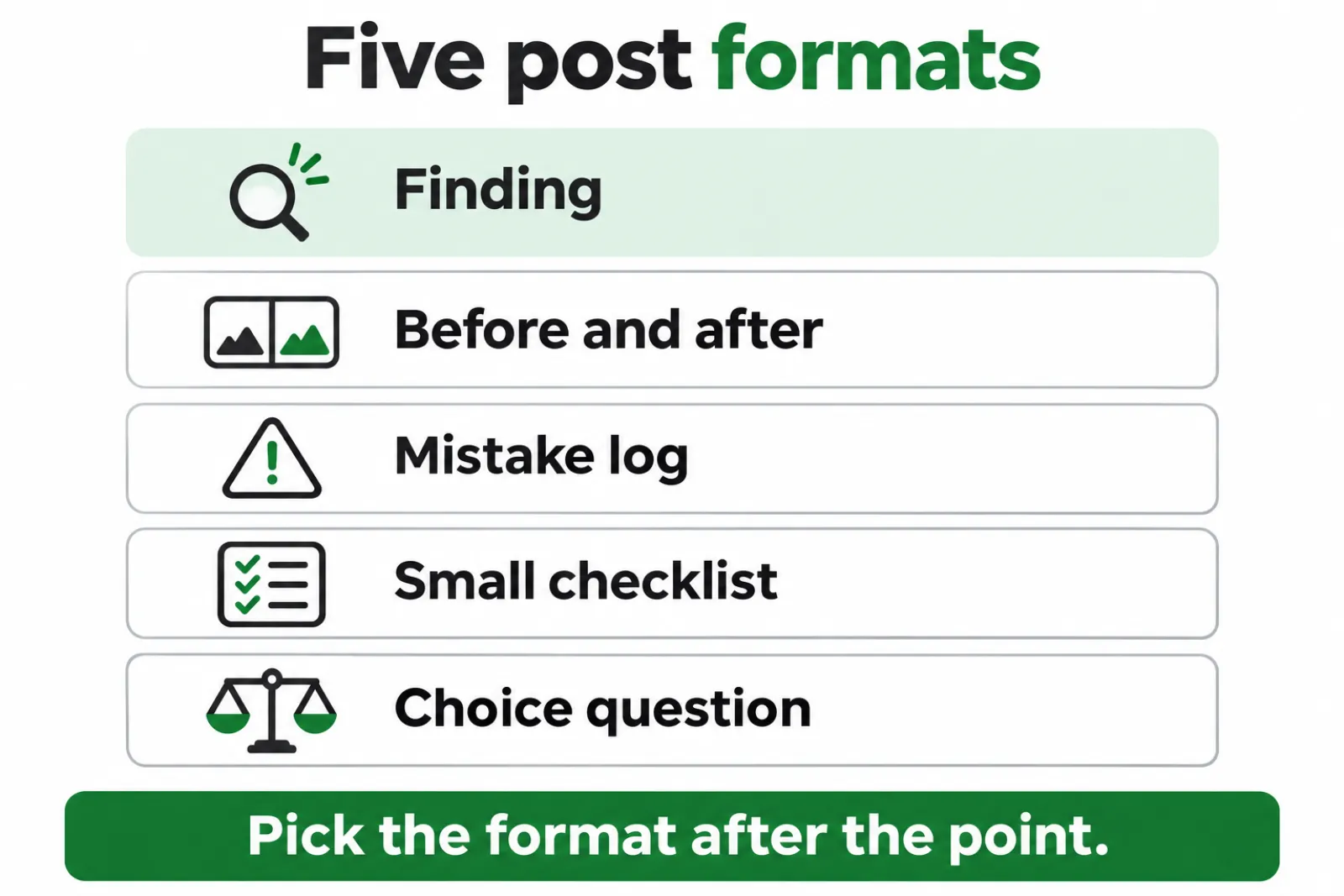
Five formats cover most founder posts (the finding, the before and after, the mistake log, the small checklist and the choice question).
Check the character limit for your account before you write a long post, because a format can fail on length.
Test one format at a time for a month and read the replies, not the reach.
A post format is the shape of the post: how many lines it has, where the point sits, what the reader is asked to do. Founders often pick a format by habit, usually a thread or a long list, and then fit the point into it. That order is backwards. The point comes first, and the format follows from what the point needs.
This article describes five formats that work well for founders, with a made-up example for each, and a note on when each one fails. It also covers the length limits that decide whether a format fits, and a simple way to test formats one at a time. The examples are invented, and the numbers in them are only there to show the shape.
Checkthelengthbeforeyoupickaformat
The length limit decides which formats are possible. Free accounts have a 280-character limit per post, according to X's Premium help page, and links count as 23 characters each, according to X's developer documentation on counting characters. Premium subscribers can post longer posts of up to 25,000 characters, according to the same Premium help page.
X's own announcement of longer posts is worth reading for context. In an @Subscriptions post from October 2024, X's subscription account wrote "Longer Posts up to 25,000 characters." An earlier @Subscriptions post from February 2023 introduced longer posts with the line "we're introducing longer Tweets!" That post did not state a character limit. The longer limit changes which formats work, but a long post is not automatically a better one. In my view, a one-point post in 280 characters is easier to reply to than a long post that buries the point.
Pick the format after you know the point, and check the length before you draft.
Formatone:thefinding
A finding is one thing you measured or noticed, with the result and what you would try next. It is specific and easy to reply to, which makes it a strong starting format.
Made-up example: "Moving the price from the top of the page to below the first feature lifted sign-ups in a small sample. It is not clear yet whether the position or the timing did it. What do you put first?"
The finding works when you have a real result, even a small one. It fails when the result is vague, such as "our conversions improved." A finding needs a number, a comparison or a clear before and after.
Formattwo:thebeforeandafter
A before and after shows a change in one line each. The reader sees the old way and the new way side by side, and the change is the point.
Made-up example: "Before: a support ticket took two days to answer. After: the answer is in the first reply, with a link to the setting that usually fixes it. Tickets dropped by a third. The setting was the same, the reply was new."
This format works well for product changes and process changes. It fails when the before and after are not comparable, or when the change is too small to matter to a reader.
Formatthree:themistakelog
A mistake log names a specific mistake, what it cost and what you changed. Readers trust a founder who admits mistakes, and the format is easy to reply to, because readers who have done the same work can answer it.
Made-up example: "Mistake: the onboarding email went out before the product was ready for the first login. Twelve people signed up and could not finish setup. The email now waits until the first login works. How do you time your first email?"
The mistake log works when the mistake is specific and the fix is clear. It fails when the post is a confession with no lesson, because readers then have nothing to reply to.
Formatfour:thesmallchecklist
A checklist gives three to five steps a reader can run. It is useful for process topics, and the reply often adds a step the author missed.
Made-up example: "Before you send a proposal: check the timeline is in the first line, name the next step, remove the second attachment, and send it on a weekday morning. What would you add?"
The checklist works when each step is concrete. It fails when the items are general advice, such as "be authentic," because readers cannot run them. For a longer plan built from short steps, see how to plan and write an X thread, which covers when a list needs more room.
Formatfive:thechoicequestion
A choice question puts two options in front of the reader and asks which one they would pick and why. It can start a conversation, because the reader can answer with a choice and a reason.
Made-up example: "Two ways to price a small tool: per seat or per project. Per seat drew fewer questions in a small test with four clients, and per project in a test with three. Which would you pick for a team of five?"
The choice question works when both options are real and your own experience sits behind them. It fails as bait when the options are fake or the choice is obvious. An honest choice question is a useful thing to write, and it sits close to the ideas in how to improve X engagement without engagement bait.
Fiveformats,whentousethem,andwhentheyfail
Format
Useitwhen
Itfailswhen
Finding
Youhaveonemeasuredresult
Theresultisvagueornotyours
Beforeandafter
Achangeiscomparableonbothsides
Thetwosidesmeasuredifferentthings
Mistakelog
Youcannamethemistakeandthefix
Thepostconfesseswithoutalesson
Smallchecklist
Thestepsareconcreteandshort
Theitemsaregeneraladvice
Choicequestion
Bothoptionsarerealandyouhavetriedthem
Thechoiceisfakeorobvious
Testoneformatatatime
Pick one format for a month and keep the rest of the routine fixed. Count the replies from people who match your reader, and the follow-up questions. After a month, compare the replies per format and keep the one that starts the most real conversations.
Measure with the right number. X counts a post's views as logged-in views on any surface, including the timeline, search and a profile, according to X's Help Center on view counts. A view tells you the post was shown, not that anyone read it or replied. One founder who posted every day for 30 days described the same gap in a r/buildinpublic thread from March 2026: "200K impressions. 30 followers. What am I doing wrong?" The poster says they built builtinpublic.xyz and pitch it in the thread, so read the account with that in mind. It is one user's experience, and it is the reason this article counts replies and follow-up questions instead of views.
For a format test, write down the format, the number of replies from people who match your reader, and the one question that got the most answers. Keep the log in a plain note. A month of five lines is enough to see which format earned its place.
Week 1
Pick one format
Weeks 2 and 3
Keep the format steady
Week 4
Compare with the other formats
Wheretheadvicedisagrees
Some advice says threads get more reach than single posts, and some says a thread is a waste of a reader's time. Both can be right in different cases. I think the test is whether the point needs several steps. If it does, a thread is the honest format. If it does not, a single post is usually better, because the reader can reply in one line.
X's own help page is clear on the thread itself. It describes a thread as "a series of connected posts from one person," and says you can save a thread as a draft and review it before you post, according to X's Help Center: how to create a thread. That matters for format testing, because a thread draft and a single-post draft are not the same thing to review. Check the thread as a whole, and check each post as if it were the only one a reader saw.
Some advice also says images always help. I would use an image only when the point is visual, such as a chart of your own result or a screenshot of the step you describe. An image without a point is decoration.
Commonmistakes
Choosing the format first. The format then bends the point to fit.
Using long posts for short points. A long post with one point asks more of the reader than it gives back.
Rotating too many formats. Five formats in one week make the feed hard to follow.
Using a format without a detail. A checklist or a finding with no detail from your work reads as generic.
Judging a format by one post. A single post can be lucky or unlucky. Read the month.
Aworkedweekofformats,madeup
Here is a made-up week for a founder who runs a small accounting software company. The founder has one point each day and picks the format from the point.
On Monday, the point is a result: after moving the invoice reminder to the due date, a few clients paid faster in a small sample. The founder writes a finding, with the sample size and a question about timing. On Tuesday, the point is a change to the onboarding screen, with the drop-off before and after. The founder writes a before and after, two short lines, and a question about the first screen.
On Wednesday, the point is a mistake: the founder sent a reminder to the wrong contact list, and the fix is now in the checklist. The founder writes a mistake log, names the fix and asks how others check contact lists. On Thursday, the point is a process: four steps to send a year-end report. The founder writes a small checklist with four concrete steps and a question about the step people skip.
On Friday, the point is a real choice: monthly billing or annual billing for a small team, with the numbers from a two-week test. The founder writes a choice question and asks which option the reader would pick. The week produces five posts, one format each, and every post has a detail and a question.
The log at the end of the week shows that the mistake log and the choice question started the most follow-up replies, and the checklist started the fewest. The founder keeps the first two formats for the next month and rewrites the checklist around one step people struggle with. The formats were chosen by the points, and the log chose which ones to keep.
HowtoapplythisinPostMine
PostMine helps you write, schedule and read the results. It does not choose the format for you.
Queue schedules the posts you wrote, in List or Calendar view, and publishes each one at the time you schedule it. Publish opens a review, and you confirm with Slide to publish.
My Replies lists the replies you sent and how each one performs, which is the record you need to compare formats.
Analytics shows account trends, with account overview CSV import for past days and a daily export.
Only when the point needs several steps. In my view, a single post with one finding can get a quicker reply than a thread, because the reader can answer it in one line.
Free accounts have a 280-character limit per post. Premium accounts can write longer posts of up to 25,000 characters, according to X's Premium help page. Check which one you have before you draft a long post.
No. Use an image or a video when the point needs it, such as a screenshot of a result. A text post with one finding is often the clearest format for a founder.
Two or three is enough for a small account. Rotating five formats in one week makes the feed harder to follow, and the log harder to read.
We use cookies for product analytics to improve PostMine. With your consent we also record session replays, including the content you type and view, such as draft posts (passwords excluded), so we can see how the product is used and fix what breaks. Privacy Policy




 Yerkebulan RakhimovNov 9, 202617 min read