Start a generated thread from one claim the thread can prove. A generator cannot pick the claim for you.
Each part must make sense when read alone, not only in order.
Check the character count of each part, not the thread as a whole.
Never let a generator invent a number. If a part has a claim, the claim needs a source you checked.
A thread generator is useful for one reason. It gives you the shape of a thread faster than you can build it from nothing. What it cannot do is decide what the thread is about. If you feed it a topic, you get a long list of loosely related points with a hook on top. In my view, readers notice that quickly.
For a comparison of the thread makers, what each one costs and which free options exist, see X thread makers compared.
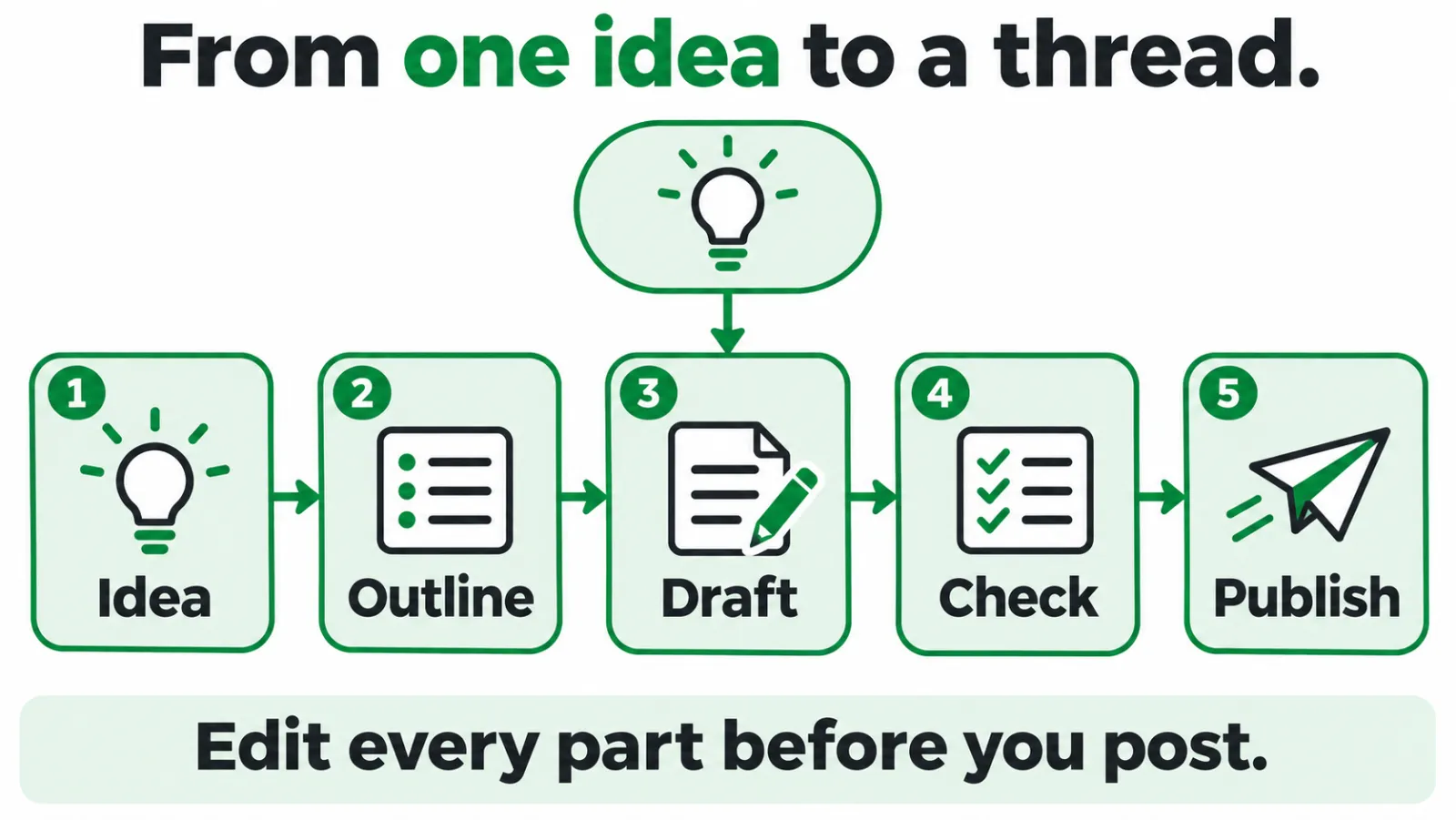
I use these tools for the first pass, and I edit everything after. This article covers the workflow I follow: pick one claim, ask for an outline, let the tool draft the parts, then check each part as its own post. It is the same discipline as writing a thread by hand, with the drafting step faster. The places where generators fail are the same places where hand-written threads fail, so the checks below are the ones I apply to both.
Startfromoneclaimthethreadcanprove
Write the claim in one sentence before you open any tool. The claim is the thing the reader should believe at the end. "Short replies get more answers than long ones" is a claim. "Tips for better threads" is a topic, and a topic gives a generator nothing to prove. A topic produces parts that sound informed and never arrive anywhere.
A claim also tells you what to leave out. If a point does not support the claim, it goes in a different thread. This is the part a generator cannot do, because it does not know which points you care about. It will happily add a fifth tip that belongs in another thread, and it will add it in the same confident voice as the first four.
To test the claim, ask whether a reader could repeat it after reading the thread. If the answer is "they could repeat the topic", the claim is still a topic. Rewrite it until it is a sentence someone could quote back to you.
Givethetooltherightinput
The input for a thread is different from the input for a single post. A single post needs one point and one detail. A thread needs the claim, the proof you have, and the number of parts you want. The number of parts matters because a generator will otherwise fill whatever length you did not set, with padding.
The example row is an illustration, not a result. If you do not have a real detail yet, do not invent one for the prompt. Go and collect it first. A thread built on a made-up detail is worse than a short thread built on a real one.
Askforanoutlinebeforethefullparts
Give the tool the claim, the detail and the part count, and ask for an outline before the full draft. An outline is quick to check, and it is where structural problems show up. If the outline has a part that does not support the claim, fix it there, not after the full text is written and polished.
Check the outline against the claim. Each outline line should state one fact, one step or one example that moves the claim forward. Remove any line that does not.
Check the order. Each part should follow from the one before it. If part four could come first without the reader noticing, it is in the wrong place or it is not needed.
Check the first and last lines. The first part must state the claim in plain words. The last part must give one action or one thing to remember, not a summary of the parts above it.
Approve the outline, then ask for the full parts. Ask for the parts one at a time if the thread is long. A single long generation is harder to correct than several short ones.
Once the outline holds, ask for the full parts. Then do the work that matters: take each part out of the thread and read it alone. A good part can be read by someone who has not seen the first post. If a part only makes sense because it refers to "the point above", rewrite it so it stands by itself.
Editeachpartasaseparatepost
Each part has to earn its place. I use a simple test for every part. Could a reader who saw only this part learn one fact from it? If not, the part is a bridge, and bridges are where generators pad. Cut them, or merge the bridge into the part before it.
Here is an illustration of the difference, made up for this article. The draft part says: "Replies matter a lot in this space, and there are many reasons for that. Let's look at what makes a good reply." That part gives the reader nothing. The edited part reads: "Over [N] weeks I replied to [N] posts. The replies with a specific question got an answer [N] times as often as the ones that only agreed." The second version is a claim with a number, so it needs the source the rest of the article describes. Until you have that source and your own count, the honest version is the one without the number.
Works
Each part states one fact or one step
The first part gives the claim in plain words
The last part gives one action or one takeaway
Avoid
Part four restates part two
A closing line that says what the thread was about
Hashtags and emojis added as decoration
Check the voice too. A generator can smooth every sentence to the same rhythm. Read the thread out loud and change the parts that sound like the same person wrote none of them. You do not need a perfect voice. You need the parts to sound like one human who knows the topic.
Pay particular attention to the openings of each part. Generators often begin every part with a connecting phrase such as "Next," "Another point is" or "It is also important to note." Those phrases carry no information. Replace each one with the fact the part states, so the reader gets something new at the start of each post.
Checkthecountofeachpart
The limit is per post, so count each part. The X Premium page describes up to 25,000 characters for subscribers; 280 is the standard limit it implies. X counts links as a fixed 23 characters, and the weighting for the rest of the text is in the X developer documentation. The developer documentation says emojis count as 2 each, and that CJK characters count as 2 each.
The photo row matters because a photo attached to the wrong part confuses the reader more than a missing photo does. Put each image on the part that it explains. A chart in part two should sit in part two, not in the opening post that has no context for it yet.
When a part is over the limit, the first instinct is to cut words at random. Resist that. Count the part, then decide which sentence carries the fact and which one only supports it. Cut the supporting sentence first. If the fact alone does not fit, the fact is too big for one part, and it should move to a second part, not be squeezed in with small print.
Aworkedexample:oneclaim,fiveparts
This is an illustration, made up for the article. It shows how a claim becomes parts and what each part has to do. The numbers are placeholders, not results, and you should replace every one with a number you measured or sourced.
Notice what is missing. There is no recap of the five parts, no hashtag stack and no line that asks readers what they think. Each part has a job, and the table makes the job visible. If a part does not fit its row, that is the part to fix. If two rows say the same thing, merge them. This is the same check the planning method uses, and the article on planning and writing an X thread goes further into it.
Donotletthetoolinventtheproof
This is the warning that matters most. A generator will write a sentence like "Threads with a strong hook always get more reach" with no source behind it, because a confident sentence is what a good thread pattern looks like. Do not keep it. If a part makes a claim about results, a rule, or a platform behavior, you need a source you checked yourself.
When a claim is your own experience, say so and keep it small. "I tested this on my account over two weeks" is honest. A confident figure you did not measure is not, and readers who check it will not trust the rest of the thread. The same applies to rules. If a part says X does or does not allow something, link the page you read, and write the claim in the part, not in the tool's words.
Watch especially for generators that invent a study. A sentence such as "Research shows" followed by no link is a red flag. Delete the sentence or find the study. I have not found a source that settles whether threads get more reach than single posts, so the thread should not claim that either. Test it on your own account over a fixed window and report what you saw.
Wheregeneratorsgowrong
Generators fail in a few predictable ways. Knowing them makes the edit faster.
Padding bridges. Parts that restate the previous part or announce the next one. Cut them or merge them into the part they support.
Repeated parts. Two parts that make the same point with different words. Keep the stronger one and cut the other.
Invented structure. A tidy number of tips, such as exactly three or exactly five, chosen for rhythm rather than content. Use the number your claim needs, even if it is two or four.
Recap endings. A last part that says "So to recap" and repeats the thread. Replace it with one action or one sentence to remember.
Confident numbers. Statistics with no source. Remove or source them.
Decorative tags. Hashtags and emojis added to every part. Remove them unless they add information.
Each of these is easy to fix once you see it. The hard part is seeing it in a draft that reads smoothly. That is why the check is to read each part alone, out of order, and to ask what it adds that the reader did not have a sentence earlier.
Keepthevoiceacrosstheparts
A thread written by one generator call often drifts in voice from the first part to the last. Openings get more formal. Sentences get longer. The final part may sound like a different person. You can catch this with a quick read of the parts in a row. If the parts sound like five authors, rewrite the openings and the closing line first, since readers notice those most.
Two habits help. Keep a short note of the words you always change, and add them to your prompt as words to avoid next time. Keep one or two of your own posts open while you edit, and read a sentence from them before you rewrite a part. The goal is not a perfect imitation. It is a thread that sounds like the same person who wrote the posts around it.
Commonmistakestoavoid
Starting from a topic. A topic produces parts that sound informed and never arrive anywhere. Start from the claim.
Asking for the whole thread at once. A long single generation is harder to correct. Outline first, then parts.
Trusting the count the tool gives you. Count each part in the composer. Emojis and CJK characters change the number.
Keeping the recap. The last part should give one action, not repeat the thread.
Publishing the first full draft. Edit it part by part before you publish.
Forgetting the photos. Attach each image to the part it explains, and check that the image still fits once you have cut the text around it.
Edgecasesworthaseparatecheck
Some threads need a different check. A thread of two parts does not need an outline, but it does need each part to stand alone, because a reader who sees only the second part will be lost. A thread of twelve parts usually needs to be two threads. If the claim cannot be stated in one sentence that covers all twelve parts, split the thread.
A thread that answers a question from a reply should keep the question in the first part, so a reader who lands on it knows what is being answered. A thread that builds on an older post should repeat the one fact it needs, rather than sending the reader back to read the earlier thread first. And a thread with a photo in one part should not rely on the photo to carry the claim, because some readers will see the text without it.
The planning step and the drafting step both start with the composer's own mechanics. The Help Center's page on how to create a thread on X describes the parts as connected posts from one account, which is the unit the per-part count applies to.
Howageneratedthreadreadstotheaudience
A thread is a chain of posts that a reader follows in order. X's create a thread guide describes the composer steps for adding posts one after another, and its mentions and replies guide explains how a post connects to the one it answers. A generator that outputs numbered posts has done half of the job. The sequence still has to survive the composer, and the reader still has to experience it as one piece.
Two checks matter for generated threads. First, read the opening post alone, because it is the only one many people see before they decide whether to read on. Second, check that each later post makes sense without the rest, because a reader can arrive at a middle post from a reply or a notification and see no context. Who can reply to each post is set by the author, as the conversations guide explains, so check that setting on the opening post before you publish.
Length is the last check. The X Premium help page describes a longer post limit for subscribers. A generator that assumes that limit for every account can produce posts that do not fit the standard limit. Count each post in the composer, for the account that will publish it.
Count every post before you publish a generated thread. The counting-characters guide explains how each kind of character is counted, and every post in the thread has to pass the limit on its own. Keep a copy of the draft in your own notes until you publish it, so you can reread it after the first pass. Once the thread is out, you can bookmark its first post, as the bookmarks guide describes, to find it again. The view counts page says a logged-in view counts wherever the post was seen, so a thread you read yourself adds to its view total. Judge the thread by the replies from other people. The post activity dashboard shows the activity for each post once the thread is out.
WherePostMinefits
PostMine's composer handles threads as parts. Each part shows its own X character count, and each part takes up to four photos or one GIF from KLIPY search. Improve writing with AI rewrites a part or a selection as a diff, so you accept or reject each change. Publish opens a review, and you confirm with Slide to publish.
The part I rely on most is the per-part count. It makes the limit visible while you are still writing, and that is when you can fix it. The diff view matters too, because you can see when a rewrite changed the fact in a part, not only the wording, and reject that change.
For the planning step that comes before any tool, the article on planning and writing an X thread covers the promise, the hook and the close. For the length rules on a single post, the character limit guide has the full counting rules.
Drafting is a writing aid. Publishing is yours to confirm. Automated posting and automated replies fall under X's automation rules, and AI reply bots need X's prior written approval.
As many as the claim needs and no more. If a part does not support the claim, cut it or move it to another thread.
Only partly. Give it two or three words about your tone, then rewrite the openings and the closing line yourself. The voice lives in those lines.
Yes, every one. Replace any number you cannot source with your own measured result, or remove it.
We use cookies for product analytics to improve PostMine. With your consent we also record session replays, including the content you type and view, such as draft posts (passwords excluded), so we can see how the product is used and fix what breaks. Privacy Policy




 Yerkebulan RakhimovNov 9, 202614 min read