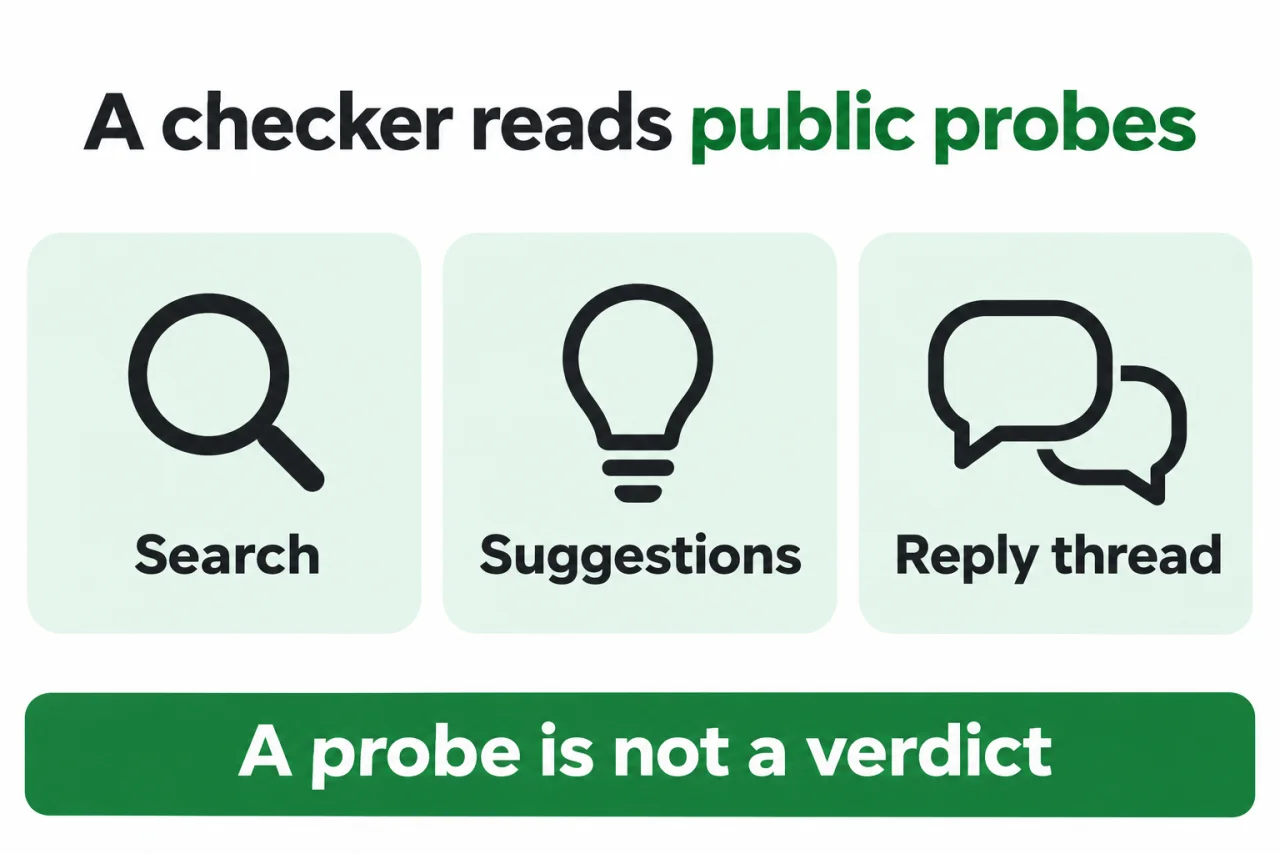
Shadowban checkers read public signals from outside X: search results for your handle, the username suggestion list, and replies seen from a logged-out view. None of them can see X's internal labels or ranking.
The checkers disagree because they run different probes. One compares 20 timeline posts with search, another checks the suggestion list, and a third reads reply threads. A disagreement is a reason to run the manual test, not a verdict.
The pages I read give conflicting durations for the same restriction, and I did not find an X source for any of them. X's own Under the Hood report lists labels for last month, but it does not show search or reply visibility today.
Use a checker for one question: is my handle missing from search or suggestions right now? Confirm any result yourself while logged out, and keep a dated record before you change anything.
Shadowban checkers promise a quick answer to a question many account owners cannot settle on their own: is X hiding my posts? I opened the pages of eight free checkers on 2026-11-09 and read what each one says it tests, how it samples, how long it says a restriction lasts and what it says it cannot prove. I also read a ninth page that had no readable method. This article repeats each checker's own description, and it says where a checker stops.
Three of the checkers say they cannot confirm a shadowban. Two others present their results more firmly. Sorsa calls a live test "the fastest way to confirm a shadowban," and NotPeople promises "a straight answer in seconds." Those are the vendors' words, and the article quotes them as such. What the checkers can do is repeat a few public probes that a logged-out person could repeat by hand. That is useful, but only if you know which probe you are looking at.
A shadowban checker reads three things from outside X: whether a handle's posts appear in search, whether the handle appears in the username suggestion list, and whether a reply appears in a thread seen from a logged-out view. Some add a profile check and a sensitive-media flag. None of them reads X's internal ranking, label system or enforcement records.
Treat a checker result as a claim about one probe at one time. A missing search match is a reason to test again. A clean result does not mean your reach is healthy. Confirm anything you might act on with the manual test in the section below, and write down the date and the result.
WhatXitselfsaysaboutvisibility
X does not describe a shadowban, but it does describe the reasons a post may be missing from search. Its help page says: "While we may not show every post in search results, here are a few reasons you may not be seeing yours." The reasons it lists include protected posts, sensitive content and whether a post "contribute[s] to the conversation in a meaningful way." (Saved copy of X's help page on search, read in a browser on 2026-11-09.)
The search policy page is more direct about filtering. It says that "In order to keep your search results relevant, X filters search results for quality posts and accounts. Material that jeopardizes search quality or creates a bad search experience for other people may be automatically removed from X search." It also says that "Accounts may be filtered from search for posting similar messages over several accounts." (Saved copy of X's search policies, read in a browser on 2026-11-09.)
These two pages explain why a checker can show a missing search result. They do not say which filter applied to your account, and they do not give a list of signals or a duration. That gap is where the checkers compete.
Whatthecheckerssaytheytest
The table below repeats each checker's own description. Where a page did not say, the cell says "not stated". I did not run any checker against a test account, and I did not compare their results with each other. Everything here is read from the pages on 2026-11-09.
The table makes one thing clear. The pages agree on four names for the four restrictions people talk about. They do not agree on which ones they can measure automatically. Sorsa and TweetBoost say ghost bans and reply deboosts need a manual check. MicroPoster and SocialCal say they measure replies, with different reliability claims. Pounce says it does not measure either. Read the method column before you read the verdict.
Howeachcheckerdescribesitsmethod
xshadowban.com lists the widest set of probes: search ban, search suggestion ban, typeahead ban, ghost ban and a sensitive-media flag. It describes itself as "a faster version of a logged-out look at search, suggestions, replies, and sensitive-media flags," and says plainly that "It is not an official X status." Its FAQ also says "This checker is a heuristic. It is not an X enforcement API." It is the only checker I read that states it does not publish a countdown: "X does not publish a countdown."
Pounce is the most cautious about what its test proves. It compares "eligible posts from a sample of 20 timeline posts with up to 20 Latest search results in the same date window," and it skips reposts, replies, posts older than 30 days and posts under 15 minutes old. It reports a sample visibility percentage, and its example reads: "If 4 of 12 eligible posts appear in search, sample visibility is 33%." It says outright that "Missing matches alone do not establish a shadowban." It does not measure reply placement or suggestions, and it says so.
MicroPoster describes four checks and a method per check. For search, it says it asks "X search for from:@handle in the Latest tab, then in Top," and compares the posts it finds with the post count on the profile. For suggestions, it says that "X stopped serving its search-suggestion endpoint to logged-out clients, so no tool can read it without your login," and it hands the user a manual check. For reply deboosting, it writes: "X does not expose the 'Show more replies' marker over its API, so this is a ranking measurement rather than a flag read." It also says that "One buried reply is never called deboosting on its own." That is a careful statement. MicroPoster also sells a monthly diagnosis for connected accounts, and its page says so.
NotPeople presents its checker as a health and engagement score. Its page shows an "Account health" of 92/100 and an "Engagement" of 46/100, and it labels those figures as example output, telling visitors to run their own handle for real scores. The FAQ says the checker tests search, reply deboosting, reach and engagement against "the platform norm." The page I read does not give a formula for the score or name the norm. The same page sells a recovery service that puts "your next posts in front of creators from our network," and it estimates "Two to four weeks, usually." Treat the score as the vendor's measure, not a measure of X. The checker page also promises "a straight answer in seconds," which is a stronger claim than the checkers that say they cannot confirm a shadowban.
OpenTweet says it checks "profile accessibility, search visibility, and content restrictions using the official X API." Its FAQ repeats the claim. That is a checkable statement. The other checkers in this article describe their probes as public search, typeahead or conversation reads, and I do not know which of them, if any, uses the official API. The same page describes its scheduling as "Built to stay within X's API limits and guidelines."
TweetBoost is the most explicit about the limits of automation. Its page says: "'Shadowban' is really four different restrictions. Two can be verified automatically; two can only be confirmed from a logged-out browser - any tool claiming to fully automate all four is guessing." It labels search ban as automated, suggestion ban as automated with a manual confirm, and the other two as guided manual checks. It also says the method was "last verified August 25, 2026." MicroPoster's page says "Last reviewed on October 9, 2026," and Pounce's says "Updated October 12, 2026," so the dates are not unique to TweetBoost.
SocialCal says its four checks run "against Twitter's public APIs," and it gives reliability figures: about 95% for the search and suggestion checks, and about 70% for ghost bans and reply deboosting. The page does not say how those figures were measured, what test set was used or how many accounts were checked. Read them as the vendor's claim, not a validated rate.
Sorsa API is the most structured. It says every check "comes back as clean, banned, or unknown with a reason," and that "is_shadowbanned" only turns true "when a check actually found a restriction." It separates a measurement that failed from one that found nothing. It says results are "measured live and then cached for one hour." Its page is also a sales page for a paid API, and it says the first 100 requests are free. It calls a live external test "the fastest way to confirm a shadowban," which is the strongest confirmation language on any page here.
shadowban.yuzurisa.com is another checker in this list. The page I could read contains template placeholders, with names such as "functionality" and "common", and no method statement. I cannot describe its method, so I do not compare it.
Whytwocheckersdisagree
The checkers disagree for four reasons, and each one is visible in the pages above.
They run different probes. One checks whether from:handle returns recent posts. Another checks the suggestion list. A third reads reply threads. A result from one probe says nothing about the other two. xshadowban.com puts it plainly in its FAQ: "They often are not running the same test."
They sample different posts. Pounce uses 20 timeline posts and skips reposts, replies, posts older than 30 days and posts under 15 minutes old. A checker that samples eight posts can disagree with one that samples twenty, even for the same account on the same day.
They cache. Pounce says results "may be cached for five minutes." Sorsa says one hour. A result you read at noon can describe a search at 11:55.
They read one view. Several checkers say they read results logged out. A logged-out result describes that view only, and X's help text says that search may not show every post, so one view is not all views.
When two checkers disagree, the right response is not to pick the one you like. It is to repeat the probe they disagree about by hand, in a logged-out window, and record the result.
Whatnocheckercansee
The checkers read public signals. Several things that matter for reach are outside those signals.
X's internal labels. Under the Hood, which X first offered in August 2026, lists labels that X applied to an account or its posts. In August, TechCrunch described the report as a download of "aggregate stats as a JSON file" that "will show if any labels have been applied to their account or posts over the past calendar month." (Read from TechCrunch, August 13, 2026.) No public checker reads this file.
Which posts were labeled. Roboin, which tested the report in September 2026, says the report "does not identify which posts received each label," and that it "does not let you view current data." Its example report covers July 2026 and was generated on August 8. It gives counts per label, not post IDs. Roboin's September 27 update adds that X later added a readable report on the page, and it says the report still "does not identify the specific posts that received those labels." (Roboin, September 4, 2026; Roboin, September 27, 2026.)
Reply placement inside a long thread. MicroPoster's method note, quoted above, says the reply-deboost check is "a ranking measurement rather than a flag read." A checker sees where a reply sits in the thread it can load, not whether X's ranker chose to fold it.
Distribution to people who do not follow you. A reach drop can come from fewer views in the For You feed, from a topic that stopped resonating or from a change in the post's format. None of those show up in a search or suggestion check, and a clean result does not rule them out.
Protected and dormant accounts. Sorsa says a protected account "hides its posts from everyone who does not follow it, so no external tool can measure its search visibility." Pounce says protected accounts, missing profiles and empty timelines produce an inconclusive result, not a shadowban diagnosis.
History. A checker reads the state today. It cannot tell you whether a restriction existed last week, which is what you need when you are reading a reach drop that started a few days ago.
Theofficialreport,andwhatitadds
X's own report is the closest thing to an official source, and it is not a checker. Under the Hood shows labels for the previous calendar month. The first version, in August 2026, was a pilot for accounts at least a year old that had posted 10 or more times in the prior month. TechCrunch reported that pilot in August. Roboin's September 27 update says X announced on September 19 (JST) that all users who meet those eligibility requirements can now use the tool, and that X added information about legal withholding. (Roboin, September 27, 2026.) X's announcement was posted by its open-source account on August 13, 2026. I verified the post's date and account through X's public syndication endpoint, and I could not read its text, which is a link. (X Open Source, August 13, 2026.)
A user posted about the report on the same day. One post, from August 13, says that someone had sent them another account's report and that it showed "768 posts analyzed in July," with "1 post flagged as 'SPAM_HIGH_RECALL' = Hidden from recommendations to non-followers." (X post by @CreeCoder, August 13, 2026.) That is one report, shared by someone else, not a sample. It shows the kind of information the report contains: a label, a count and a plain-English effect.
Roboin also reports that X "avoided the word 'shadowban'" in its announcement and said users would be able to "see the labels applied to your account and posts." That wording matches the limits above. The official report tells you which labels X applied. A checker tells you what a logged-out viewer saw. Neither one tells you why a specific post reached fewer people.
Use the two together. Start with the report if you are eligible, because it is X's own data. Then run a checker to see the visible search and suggestion state today. Then run the manual test below to confirm the one probe you care about.
Themanualtest,stepbystep
You can repeat the probes that most checkers run without any tool. Do this in a logged-out browser window or a second account that does not follow you.
Open a private window and sign out of X. Logged-in views show your own posts whether or not X is filtering them.
Search from:yourhandle and open the Latest tab. Compare the posts it shows with the last ten posts on your profile. If recent posts are missing while they appear on your profile, that is a search ban signal.
Type your @handle into the search box and read the suggestion list before you press enter. If your account is missing while other accounts appear for the same text, that is a suggestion signal.
Open a thread where you replied in the last few days, and look for your reply without expanding "Show more replies." If the reply is missing, that is a ghost signal. If it is only visible after the expansion, that is a deboost signal.
Write down the date, the handle, the three results and the view you used. Repeat the same steps on the same schedule, for example every three days.
Change nothing about the account until you have two or three dated records that agree.
This is the search and reply check from the shadowban article's "facts you can see" list. That article also covers account settings, the Under the Hood file and your own analytics. The steps above take about ten minutes and cover the probes a checker runs, with your own judgment about the result.
WhatusersreportonReddit
I searched my saved Reddit threads on shadowbans for mentions of checkers. I found no saved thread that evaluates a checker by name, so I cannot say which checker users trust. The threads do show how people read the signals. Three comments are useful for that.
In a July 2026 thread on r/twitterhelp, u/shiroi_mirage wrote that they had "checked and i am search banned apparently without a warning or opportunity to appeal," and asked whether X "denies the existence of shadowbans officially." In the same thread, u/chaotic_loverrr replied to someone that "In that example case you are search banned. I should have mentioned ghostban but I have seen ghostban also hides my posts from users." Both comments describe a search or reply check, the same probes the checkers run. (Reddit, r/twitterhelp, July 20, 2026.)
In an August 2026 thread, u/actioncycle wrote: "Logged out. I'm seeing some people be banned from a few days to a few months though." That is one user's observation about duration, not a measurement, and it matches the wide range the checkers themselves give. (Reddit, r/twitterhelp, August 12, 2026.)
These are comments, and I quote them as such. They do not show that any checker works or fails.
Howlongashadowbanlasts,accordingtothecheckers
Every checker that gives a duration gives a different one. None of them cites an X source for its figure. The table below lists what each page says.
Put simply, the vendors disagree about how long a restriction lasts. Two pages give no number at all: xshadowban.com says X publishes no countdown, and Pounce does not report a duration. If you read a duration from a checker, ask where it came from. If the answer is "the page says so," the duration is a marketing claim.
The better approach is to measure your own case. Run the same manual test every three days after you change what you post. If the search and reply results change, you have a record. If they do not change after two weeks of clean activity, the restriction may be a different kind of problem, and the record will help you explain it.
Whatagoodcheckerpagesaysaboutitself
A checker is more useful when its page says what it cannot do. Look for these signs.
It names each probe and says which ones it automates. TweetBoost's split between automated and guided checks is an example.
It says what a missing result does not prove. Pounce says that missing matches alone do not establish a shadowban.
It shows the sample. Pounce shows which of 20 posts it compared, and which it skipped.
It returns "unknown" when a probe fails. Sorsa separates a clean result from a measurement that could not run.
It states its cache. A result that is five minutes or an hour old should say so.
It does not put a score on a guess. MicroPoster says that "A percentage 'shadowban score'. There is no number to read, so a number would be theatre." NotPeople shows a health score on its page, and its method for that score is not stated on the page I read.
Be cautious with any page that promises a result it cannot check, that says a restriction is "guaranteed," or that sells a removal service in the same screen as the result. Several of the pages above include a sales step. That does not make them wrong, but it does mean you should read the method before you read the call to action.
WherePostMinefits
The PostMine quickstart describes no shadowban check. Its docs describe Analytics as showing "your account's trends," with CSV import and export. That is the kind of record described above, but PostMine does not read X's labels or tell you whether an account is limited. If you want a checker, use one of the tools in this article and read its method. (PostMine docs.)
Summary
Shadowban checkers are useful for one narrow question: is my handle missing from search, the suggestion list or a logged-out reply thread today? They run different probes, sample different posts and disagree for good reasons. They cannot see X's labels, the ranking that decides who sees your posts, or the history that would explain a drop. The official Under the Hood report adds real data for eligible accounts, but it reports labels for a past month, not a verdict on your reach.
Run the manual test, keep the dated record, check the method on any tool before you believe its result, and ignore any duration that does not come with an X source.
Sources
Each link was read on 2026-11-09 unless noted. Where a page has no readable method, I say so in the text.
They can show one visible signal at one moment: a handle that is missing from search, a suggestion list that does not include it, or a reply that is not in a thread seen from a logged-out view. They cannot show why, and no checker I read claims an official confirmation from X.
They run different tests on different samples, some cache results for minutes or an hour, and some skip reposts, replies or old posts. Read each checker's stated method and check the same post yourself in a logged-out window.
No. The checkers I read give durations from a few days to a few weeks, and none cites an X source for them. X does not publish a countdown, according to xshadowban.com's own FAQ. Measure the restriction by repeating the same test on a schedule.
No. Under the Hood lists visibility labels for the previous calendar month, for accounts that meet X's eligibility rules. It does not show search or suggestion visibility today, and it does not identify which posts received each label.
We use cookies for product analytics to improve PostMine. With your consent we also record session replays, including the content you type and view, such as draft posts (passwords excluded), so we can see how the product is used and fix what breaks. Privacy Policy




 Yerkebulan RakhimovNov 9, 202610 min read