Shadowban is a word people use for several different things. X's own documents describe visibility limits, not a single switch.
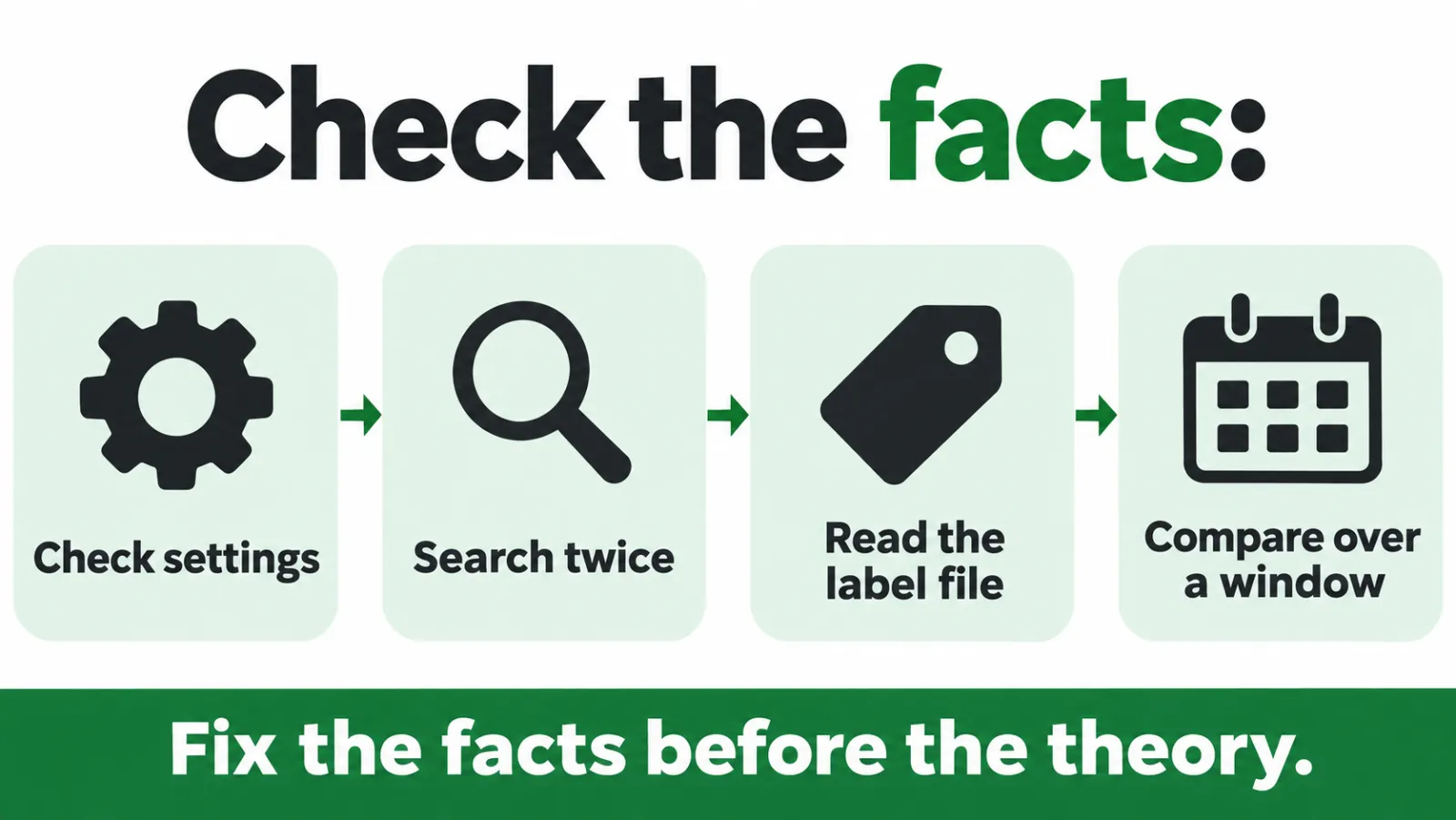
Check the facts you can see: search visibility, account status, your Under the Hood report if you have it, and your own analytics.
A third-party shadowban test sees one check from one place. It cannot prove what every viewer saw.
Reach drops can have several overlapping causes. Change one variable and compare over a fixed window before you conclude anything.
Keith Coleman's August 2026 post quotes "Am I shadowbanned?" among the questions people ask. The phrase describes a feeling: a post that used to reach people now reaches almost nobody, and the creator cannot see why. The phrase is useful for describing that feeling. It is much less useful as a diagnosis, because it bundles several different causes under one name and implies a single switch that someone turned off.
This guide separates what X has published about limited visibility from what people infer, lists the checks you can run yourself, and explains why a third-party shadowban test cannot settle the question on its own. It also gives a step-by-step method for investigating a reach drop, so you can change the right variable instead of changing everything at once.
X's own public material does not describe a shadowban as a named mechanism. It describes visibility in a more specific way. On August 13, 2026, Keith Coleman, X's VP of Product, posted that the company was giving the public more transparency into the algorithm. His post quoted questions people ask, and he quoted them directly: "Am I shadowbanned?" "Is X fair?" "Why am I seeing this post?" The post says the company wants the public to be able to answer these questions themselves.
The published ranking code describes the mechanism behind those questions. The repository README says that ranking sets the order of posts, but that whether a post can be shown at all is decided separately, by a system called visibility filtering. It lists four answers that system can give for each post and viewer: allow, notice, interstitial, and drop. A notice attaches a notice to the post. An interstitial puts the post behind a tap-through screen. A drop removes the post from the feed. The README states that the rules read labels attached to posts and accounts, and also read whether the viewer blocks, mutes or follows the author.
That last point is easy to miss. The visibility rules are applied per viewer. The same post can be allowed to a follower and dropped for a non-follower, because some rules only drop a post when it is a recommendation from an account the viewer does not follow. The README gives spam caught at high recall as an example of such a rule. This is one of the reasons a single shadowban test cannot describe what everyone saw.
Note that weights scale predicted probabilities, not counts Source
Sep 18, 2026
Reports show legal-compliance visibility limits by country Source
The timeline shows the three dated changes that bear on visibility. The first is the release itself, with the Under the Hood tool. The second is the note about weights, which matters because people often read a weight as a count. The third adds legal-compliance limits to the reports, which means some visibility limits are tied to a country and a legal demand, not to your behaviour.
WhattheUndertheHoodreportcantellyou
Under the Hood is the official tool that shows some of your visibility history. According to TechCrunch's report on the release, in August the tool sat on an Under the Hood page in settings, and users who had posted 10 or more times over the past month could download aggregate statistics as a JSON file. The file shows whether labels were applied to the account or its posts during the past calendar month. TechCrunch also reports that the first pilot was limited to accounts at least a year old. Roboin's September 27 update says X announced on September 19 (JST) that all users who meet the eligibility requirements can now use the tool, and that "Earlier versions of Under the hood only let you download a file in JSON format." X has since added a readable report on the page.
The README adds that since September 18, 2026, the reports include whether an account or post was limited for legal compliance, and in which country. The README describes the Under the Hood report. If you are eligible, that report is direct official evidence you can get. It does not give you a reach number, a score or a per-viewer breakdown, and you should read it as a list of labels for a month, not as an explanation of one post.
10
Posts in the past month to qualify for the Under the Hood download
Some reasons a post does not appear in search are visible from your own account. X's Help Center page on search lists common reasons that posts, hashtags or accounts may not appear in search results, including protected posts, an account without a confirmed email address, and content that the safe search setting filters. If one of those applies, the cause is in your settings, not in a hidden penalty. X's search rules and restrictions page says that when an account is filtered from search, its followers still receive its updates. So a drop in search does not mean the followers stopped seeing you.
Check these before anything else. Is the account protected? Is the email address confirmed? Has the safe search setting changed? Is the post's content one that a filter is likely to catch? None of these explains every drop, but each one takes a minute to rule out, and each one is a fact you can change.
Amethodforinvestigatingareachdrop
The method below is the one I use when a number falls. It is slow on purpose, because a fast answer is usually a wrong answer.
Write down the drop in numbers. Note the impressions and engagements for the same weekdays over the last four to six weeks, not only the last post. A single weak post is not a drop.
Check the account facts. Confirm protection, email confirmation and the safe search setting. Note any change you made in the same period.
Check search visibility from two places. Search for a distinctive sentence from one of your posts while signed in, then do the same signed out in a private window. A post that appears only when signed in is a useful clue. Do not draw a conclusion from one search.
Read your Under the Hood file if you have one. Look only for labels in the past calendar month. If none are listed, that is evidence about labels, not about your topic or timing.
List the other causes. Timing, topic, the day of the week, a change in your format, a wave of similar posts from others, and simple variance across a small sample. Write each one next to the evidence for and against it.
Change one variable and compare. Post one format change over a fixed window, keep the rest steady, and compare with the same weekdays before the change.
The last step is easy to skip. A reach drop is easy to explain after the fact, and it is hard to test before. A fixed window with one change is a fair way to separate a real effect from the noise of a small account.
Atableofsymptomsandwhattheycanmean
The table below pairs what you see with the causes it can point to, and with the check that separates them. A symptom rarely points to one cause, so use the table to narrow the list, not to pick a winner.
The table makes one point clear. Symptoms can have more than one possible cause, and the cheapest check is not always the most informative one. Start with the settings, because they are quick to verify and easy to fix. Move to the analytics window next, and treat the label file as one piece of evidence among several.
WhatusersreportonReddit
Reddit threads are one more place where people describe the same symptoms. They are not evidence about X's systems, and each account below is one user's experience.
One thread on r/twitterhelp describes replies that disappear without notice. Its author, DG-ZTE16, writes that "my comments are hidden on every post I comment on", and says they had received no message from the platform about rules, reports or suspension (r/twitterhelp, 2026-08-06, by DG-ZTE16). That is the symptom people call a ghost ban. It is worth checking against your replies page.
A second thread argues that waiting does nothing. The author cites Grok for the claim that "inactivity does not remove reply visibility limits", and then lists behaviours to avoid, such as mass replies and generic one-liners (r/twitterhelp, 2026-07-20, by Mooorgan_69). I could not confirm the Grok claim from X's pages. The list of behaviours is worth reading, because several of them overlap with the rules on automated and repeated replies.
A third report describes a review path. After a temporary label appeared in the app, the author clicked a notice, requested a review, and says X removed the label a few minutes later (r/twitterhelp, 2026-08-14, by ConsciousMaterial230). The author adds that they had already submitted an EU/DSA inquiry before the notice appeared, and says "I can't prove that caused the review option to surface". They also say they do not think every shadowban has the same cause or fix. That matches the point of this article: a temporary label is a specific, checkable thing, and one report is one case, not a rule.
Some reports describe restrictions that did not lift with time. One user says each new account they created was banned within days of the first interaction, even after leaving the account untouched for two to three weeks (r/twitterhelp, 2026-11-05, by Research-Rare). A commenter in the same thread warns that rotating accounts can get a device or IP limited. That is a claim about security systems that I cannot verify, and I would not build a plan around it.
Reading these threads together, the reports describe different routes out. One author says a review removed a label (r/twitterhelp, 2026-08-14, by ConsciousMaterial230). In that same thread, a commenter, u/New_Flatworm7318, writes "My first ban expired after exactly 30 days". A commenter, u/chaotic_loverrr, in the thread by Mooorgan_69 writes that a restriction "got fixed after almost 12 days break from any activity" (r/twitterhelp, 2026-07-20, by Mooorgan_69). The original poster in another thread, TheCryptoCat75, writes that "7 days isn't folklore. It's a number sitting in a config file" (r/twitterhelp, 2026-08-28, by TheCryptoCat75). I checked the README's notable updates and did not find that number, so I treat it as unverified.
The X Help Center page on search lists reasons a post may not appear in search results, including protected posts, an unconfirmed email, safe-search filtering and relevance. Check those before you assume a limit. Those reasons concern search results, so they do not by themselves explain a drop in the timeline. The view counts page says that any logged-in view counts wherever the post was seen, so compare views only within the same window. Keep a note of the date you first noticed the change, so that its timing can be compared with the reports.
Whyathird-partyshadowbantestcannotsettleit
Third-party shadowban tests are popular because they promise a yes or no. They can check one signal, such as whether a post appears in a search from one location at one moment. They cannot check the per-viewer rules that the README describes, because those rules read the viewer's own blocks, mutes and follows, and they read labels that are not published. A checker that says "limited" has seen one view. A checker that says "fine" has seen one view too.
The research question is simple: what did the people who should have seen your post actually see? A third-party test cannot answer that, and neither can a single manual search. Your own analytics, read over a fixed window and compared with similar posts, is closer to the answer, because it counts the viewers you really had. If you run a checker, treat its result as one data point, and run a second check before you act on it.
Be careful with any claim that a tool has confirmed a penalty. Visibility rules can apply to a post, an account, or a country, and some are tied to legal demands that the README says are now shown in the reports. A tool with no access to those records cannot confirm them.
Commonmistakesinareachinvestigation
Treating shadowban as a diagnosis. The word is a description. Name the specific check that failed.
Changing everything at once. A new topic, a new format and a new posting time in the same week tell you nothing about any of them.
Reading one post as a verdict. A single weak post is common. Compare several posts over the same window.
Trusting a single test. Two tests from different places, plus a manual search, give you a better picture than one checker.
Ignoring your own settings. Protection, email confirmation and the safe search setting are the cheapest causes to rule out.
Posting more to recover. More posts in a panic usually add noise and repeat the problem. Fix the facts first.
Edgecasesthatchangethereading
Some drops have a plain explanation. A post about a news event can reach many people in a day and then fall quickly, which can happen without any limit. Check the date and the topic before you treat a drop as unusual.
A reach drop after a change of account status, such as a new protection setting or a changed email address, is a sign to check the settings first. If you are eligible, the Under the Hood report can show labels applied for legal compliance, so check that file when a drop follows a legal notice in your country.
Howtokeeparecordduringasuspectedrestriction
A restriction is easier to judge when you have a record. Before you change anything, write down the date you first noticed the drop, the last change you made to your account, and the posts or replies you published in the seven days before it. Keep the numbers you can see in the analytics window, and note which ones you could not see. If you later request a review, the record shows what you did and when.
Keep the record short. A spreadsheet with one row per day is enough: posts published, replies published, impressions for the replies, and any notice that appeared in the app. The point is to test the hypothesis that a particular behaviour is the cause, not to collect every number. When the same pattern repeats over several weeks, the record is the evidence that separates a bad week from a limit.
Do not treat the record as proof of anything. It shows what happened to your account, and it cannot show what X's systems decided. Its value is that it lets you compare a suspected cause with the timing of the drop, and that it stops you from changing five things at once and learning nothing.
WherePostMinefits
PostMine does not check whether an account is limited, and it does not claim to. What it gives you is your own numbers in one place. Analytics shows your account's trends, and you can import an X account_overview CSV to load past days. That is the data for the method above: a fixed window, compared with the same weekdays, with the changes you made written down. Home shows your own posts that outperform, which helps you see whether a drop is across the account or limited to a topic.
If a product tells you it can confirm a shadowban with certainty, ask it to show the method and the data it used. A claim that cannot name its inputs is not evidence.
X's published material describes visibility filtering and label-based limits, and it does not describe a single shadowban switch. The word is useful as a description of a drop you cannot explain, not as a name for a specific mechanism.
Not on its own. A tool can check one visible signal from one location. The visibility rules read the viewer, the labels and the account, so one checker cannot represent what every follower or non-follower saw.
Search for a distinctive sentence from one of your posts while signed in, then while signed out in a private window. Compare the results, and check the account protection and email confirmation settings that X's search help page lists.
Not in a hurry. Check the facts first, then change one variable at a time over a fixed window. Large changes made in a panic make the next drop harder to explain.
We use cookies for product analytics to improve PostMine. With your consent we also record session replays, including the content you type and view, such as draft posts (passwords excluded), so we can see how the product is used and fix what breaks. Privacy Policy




 Yerkebulan RakhimovNov 9, 202618 min read