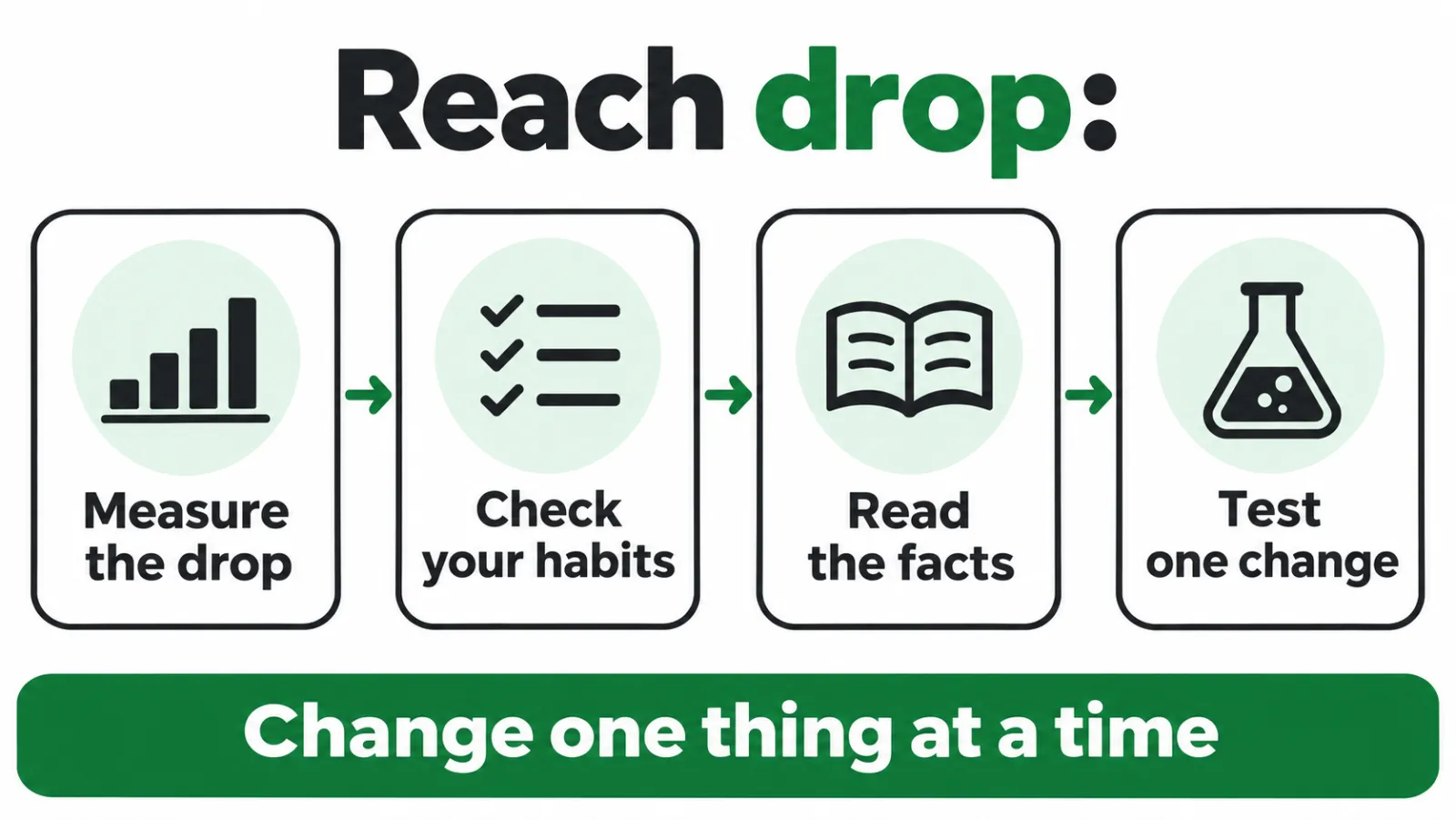
Check your own habits before you suspect the platform: format, frequency, timing and what changed in the same week.
Published ranking facts give you a short list of things that change how a post is scored, such as age and repeated authorship.
Compare posts over a fixed window, with the same weekdays, before you decide that anything has changed.
One change at a time. Changing topic, format and timing together makes the next drop impossible to explain.
Reach falls for reasons that can be ordinary. A post goes out at a quiet hour, a topic is out of fashion for a week, a link changes how people read the first line, or the account has been posting the same format for a month and the audience has stopped responding to it. A sudden drop feels like a verdict, but the possible causes can be checked in an afternoon.
This checklist is for the moment after you notice a drop. It starts with your own habits, then moves to the published facts about how X scores and filters posts, and ends with a method for testing one change at a time. It covers the same ground as the separate guide on what a shadowban means and how to investigate it, but it focuses on what you control, not on visibility limits you cannot see.
Step1:Measurethedropproperly
Start with the numbers. A drop is a change in a fixed window compared with a window before it, using the same weekdays. A single post is not a drop, because single posts vary by a lot on any account. Pull the impressions and engagements for the last four to six weeks, and set them against the four to six weeks before that. If your posts are on different weekdays in each window, the comparison is already unfair.
X's own definition of a view matters here. The Help Center's page on view counts says that views count logged-in views on any surface, so a post seen in a feed, a search result or a profile counts the same way. Use the same definition in both windows, and do not mix impressions from one tool with engagements from another.
Step2:Checkwhatyouchanged
A reach drop can follow a change you forgot. Make a list of everything that changed in the drop window: the format of your posts, the frequency, the time of day, the first line, the use of links, the use of images, the number of replies you posted, and the topics. Add anything that happened to the account, such as a new bio, a changed photo or a change to a protected setting.
Each item on the list is a candidate. You will test them one at a time later, so write them down now, with the date each one changed. A change that lines up with the start of the drop is worth testing first. A change that happened long before the drop is less likely to explain it.
The table is a list of questions, not a list of answers. Each row names a habit and the comparison that would show whether the habit matters. Check each row, and expect some of them to be noise.
Step3:Readthepublishedrankingfacts
X has published the code behind the For You feed, and the repository README describes the parts of the pipeline that affect a post's reach. Four facts from that text are useful when you check a drop. They are not a full model of the feed, and the README says that the weights are production defaults that can change.
The first fact is age. The README lists an age filter in the pre-scoring stage that removes posts older than 48 hours before they are scored. The second fact is repeated authorship. The README describes an author-diversity adjustment that lowers the score of later posts from the same author in one feed. Posting many times in a short window can reduce the score of your later posts, even when each one is good. The third fact is out-of-network distribution. The README describes a discount for posts from accounts the viewer does not follow, and the same discount for replies and reposts from accounts the viewer does follow. The fourth fact is the scoring itself: the final score is a weighted sum of predicted probabilities for each action, and the weights scale probabilities rather than counts.
48 hours
Age limit before scoring, per the README's pre-scoring filters
Timing matters for two reasons. The first is the age filter, which removes posts older than 48 hours before they are scored, so the window a post has in its first two days is set by the platform, not by your timing. The second is the sample. A post at an unusual hour is compared with posts at normal hours, and its numbers can look weak for reasons that have nothing to do with the content. The fix is not to find the best hour. It is to compare posts at the same hour for several weeks. Pick the hour you post most often, and keep it steady for a month. If the drop persists at that hour, timing is not the explanation. If it disappears when you return to an old hour, you have found a useful clue, and one that is cheap to test again.
Step5:Checkthefirstlineandtheformat
Readers decide in the first line. A post that opens with a fact is read differently from one that opens with a frame such as "Here is what I learned". If your recent posts changed from the first kind to the second, the drop may be in the opening, not the reach. Compare the openers of your best posts from the last three months with the openers of the posts from the drop window. The difference is often obvious.
Format works the same way. A thread, an image post and a single text post are read differently, and each one has its own completion rate. If you switched format in the drop window, compare posts of the same format before and after, rather than comparing a thread with a short text post and calling the difference a drop.
Step6:Testonechangeatatime
Once you have a candidate cause, test it. The test has three parts: one change, a fixed window, and a comparison with the same weekdays. Change the opening line on half your posts for three weeks, keep the rest of the habits the same, and compare. Or drop the link from every post for a month, and compare with the month before. A test that changes two things at once cannot tell you which one mattered.
Pick one habit from the table. Choose the one that lines up with the start of the drop.
Write the test in one sentence. For example, "Posts open with the fact for the next four weeks, all else equal."
Set the window. Four weeks is a reasonable minimum for a small account, and six is better.
Keep everything else steady. Same weekdays, same hour, same format, same topic.
Compare with the same weekdays before the change. Use impressions per post and replies per post, not a single best post.
Decide and write it down. Keep the change if the result is clear, drop it if not, and note the result either way.
Commonmistakesafteradrop
Posting more. More posts in a panic can trigger the author-diversity adjustment and add noise to your account.
Changing everything. Topic, format, time and tone in the same week leave you with no explanation.
Trusting one post. A single weak post is normal. Compare several.
Blaming the platform first. Check your habits before you assume a platform change. Your habits are the cheaper check.
Ignoring the measurement. If the definition of a view changed between two tools, the comparison is wrong, not the reach.
Stopping the test early. Three days of data is not a test. Give the change its window.
Edgecasesthatchangethereading
Some drops are seasonal. A topic that peaks in one month can be quiet in the next, and a comparison with the month before the peak can make a normal dip look like a crisis. Compare with the same month a year earlier when you have the data, or note the season and keep the comparison honest.
A drop that happens only in a specific country or language can reflect a different audience mix. The audience of a post is a mix of followers and non-followers, and the mix can change without any change in the post. If the drop is concentrated in one audience, look at who is seeing the posts before you change the posts.
A drop after a big single post can make the next few posts look weaker by comparison. If the baseline is inflated by one outlier, compare with the median of several posts, not the average.
When a reach drop is also a question of whether the account is seen as limited, the first thing to read is how X itself frames the question. Keith Coleman, X's VP of Product, posted on August 13, 2026 that people ask "Am I shadowbanned?" and that the company wanted the public to be able to answer it, in a post on X. The shadowban article covers that question in full.
WhatpeoplesayafteradroponReddit
Reddit has many threads from accounts that lost reach and asked what to do. They describe the feeling of a drop, and each one is a single account's experience.
The original post on r/Twitter asks whether organic growth is dead for accounts with no followers (r/Twitter, 2025-12-24, by WatermelonWOseeds). One commenter, u/theegreenman with nine points, answers "X is dead on all counts", and the original poster also writes that "they are constantly changing the algo". The comparison in the method above is the test that could confirm or deny a verdict like that.
Another thread on r/GrowthHacking asks how to go from 0 to 1,000 followers on X (r/GrowthHacking, 2026-08-07, by Euphoric_Dog1000). The question is the same as a drop, asked from the other side. Write down what you did in the first two weeks of a new account, and compare it with what you did before the drop.
Checkthecountingrulebeforeyoucompare
Views are counted by a fixed rule. The X Help Center page on view counts says that any logged-in view counts regardless of where the post was seen. If you compare views across a window, make sure the rule did not change between the two periods, and that the posts you compare were seen in the same way. A view total that rises or falls for a reason the rule explains is not a reach signal.
Search visibility has its own causes. The X Help Center page on search says the platform may not show every post in search, and lists reasons, including protected posts and safe-search filtering. The search policies say that an account can get filtered from search when it repeats or near-duplicates content. A drop in search results can come from any of these, which is why the checklist separates search visibility from the timeline.
The public ranking code is documented in the repository README, and the release was covered by TechCrunch. Read the README for the stages a post passes through, and treat the news coverage as a summary you can check against it.
WherePostMinefits
PostMine's Analytics page shows your account's trends over time, and you can import an X account_overview CSV to load past days. That is the data for the window comparison in step six. Home shows your own posts that outperform, which helps you see whether a drop is across the account or limited to one format or topic. PostMine does not score posts for the feed, and it does not promise to restore reach.
If you want to test an opening line or a format, write the two versions in the composer, check each one, and publish only the version your test calls for. Nothing goes out without your confirmation.
Compare at least four to six posts on each side of the change, from the same weekdays and the same window. A single weak post is normal variation.
The published ranking code text I read does not say so, so I do not claim it. Test it with two posts that differ only in the link, over a fixed window.
Usually not. More posts in a panic add noise and can repeat the same problem. Check the facts first, then change one habit.
The repository text I read does not say that it does. Check the published configuration yourself, and test any change on your own account.
We use cookies for product analytics to improve PostMine. With your consent we also record session replays, including the content you type and view, such as draft posts (passwords excluded), so we can see how the product is used and fix what breaks. Privacy Policy




 Yerkebulan RakhimovNov 9, 202613 min read