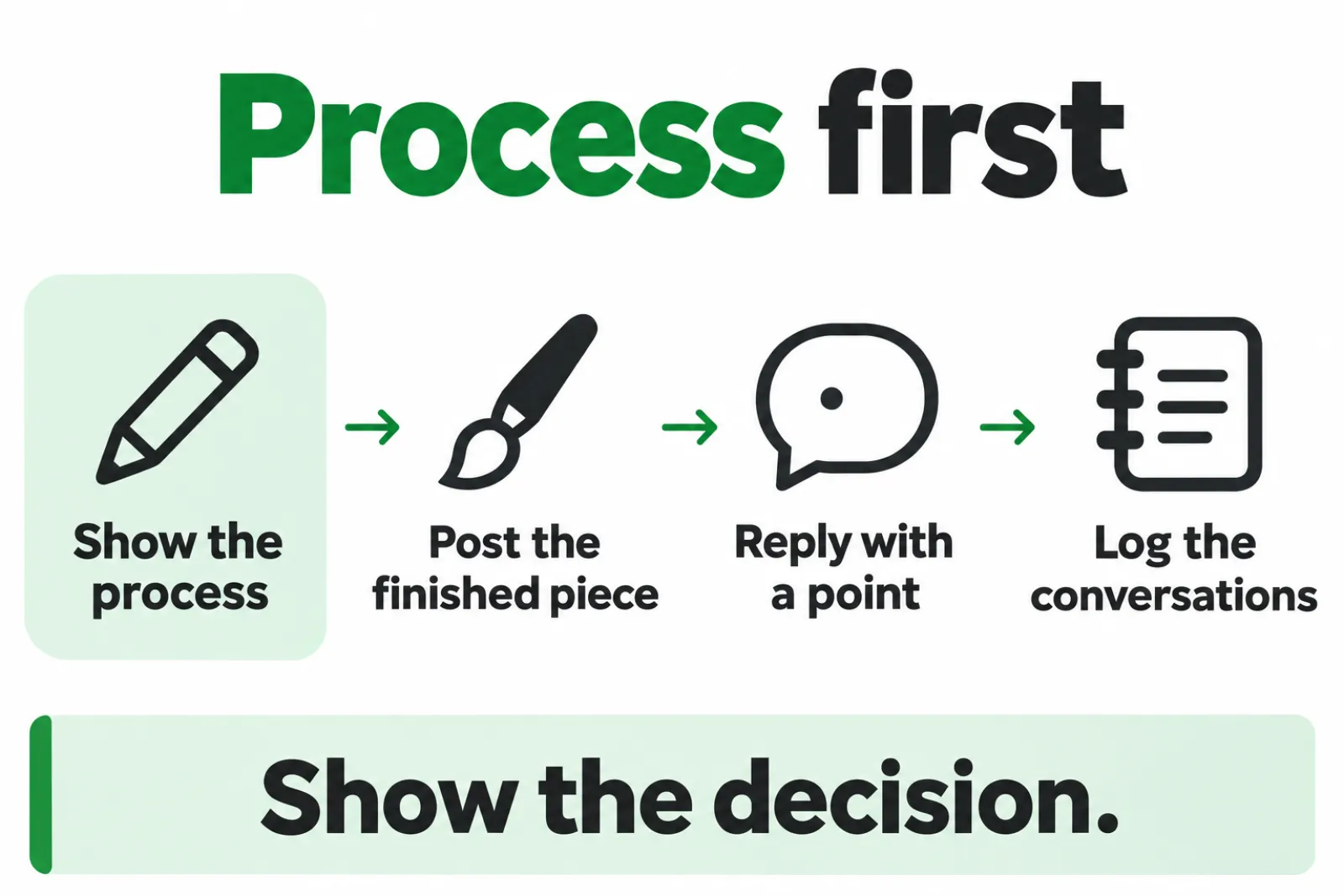
Show the process, not only the finished piece. A sketch, a decision or a failed attempt gives people something to respond to.
Reply to other artists and to the people who collect or commission work, with one specific point about their work.
Put the bio and the pinned post to work. A stranger should see what you make and what you are looking for in one glance.
Keep a log of the conversations that turn into commissions, critiques or collaborations, and repeat what they have in common.
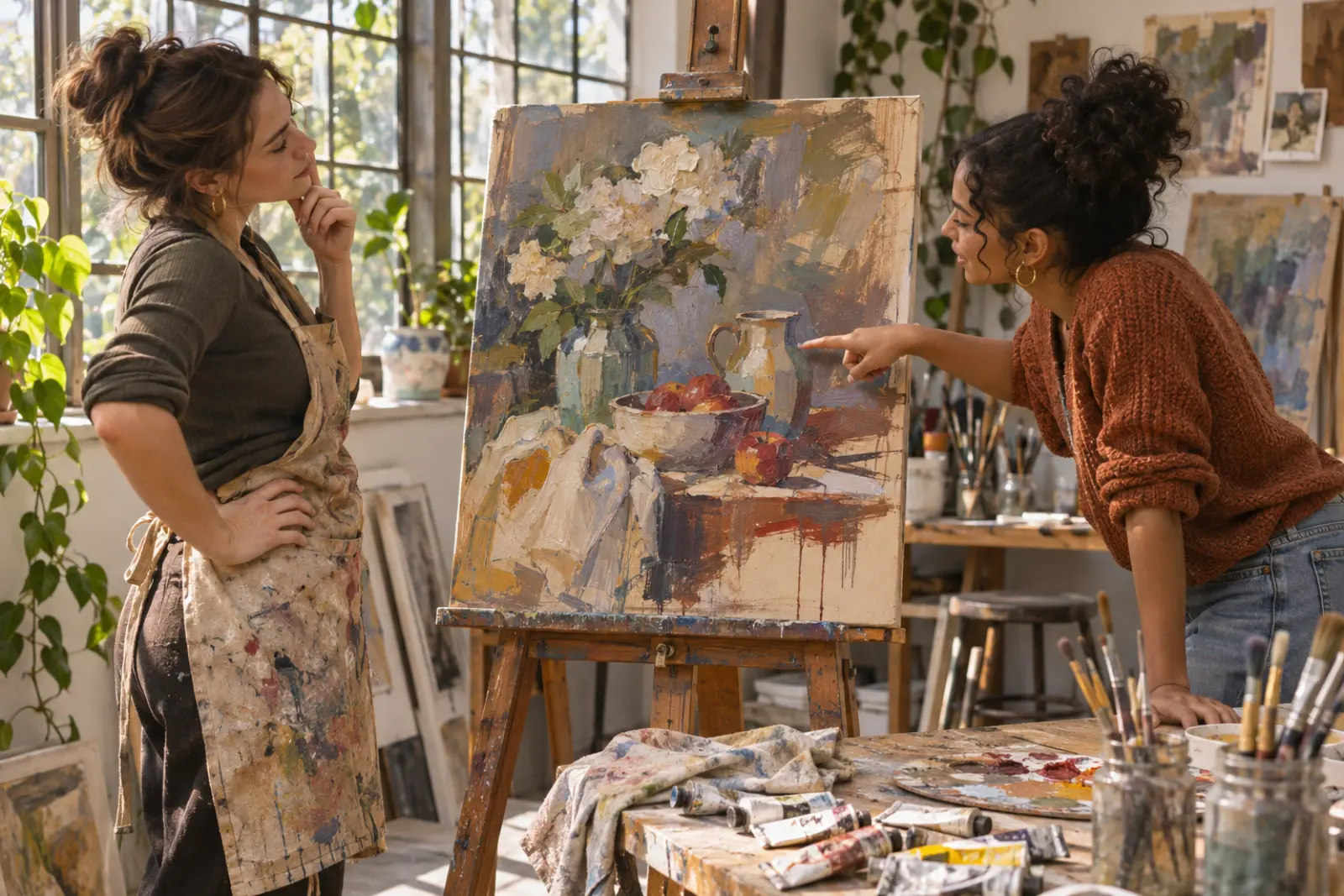
An artist's work is visual, and X rewards the same thing a gallery wall does: a clear image that makes a stranger stop. The difference is that X also rewards the conversation around the image. A finished piece gets a like. A sketch with a question about the composition gets a reply, and a reply from a person who knows painting is the start of a relationship that can lead to a commission, a critique or a collaboration.
This article gives artists a workflow for a studio week. It covers the profile, the mix of process and finished posts, a reply routine that fits a working day, how to find the people who respond to your work, and how to measure whether the account is bringing real opportunities. The advice is for working artists, illustrators, designers and makers, and it assumes you post your own work rather than other people's.
Startwiththeprofile
The bio is the first thing a stranger reads, and for an artist it does two jobs at once. It says what you make, and it says how to reach you. X allows a bio of up to 160 characters, according to X's guide to customising your profile. Use the space for a medium and a subject, and one line on what you take on, such as commissions or collaborations.
A bio like "Artist" tells the reader nothing. A bio like "Oil painter of harbour towns. Taking two portrait commissions in the spring" tells a stranger what to look at and what to ask. The profile photo should be a clear photo of you or your studio at the recommended 400 by 400 pixels. The banner can show one of your best works, as long as it is cropped to 1500 by 500 pixels, the size X gives in the same guide.
Write the bio so a stranger knows what to look at and what to ask.
Showtheprocess
The strongest artist posts show a decision. A sketch with two options, a colour test that failed, a mistake you fixed in the last layer or a question about the composition all give readers something to respond to. People who make things love to talk about how things get made, and they are more likely to reply to a process post than to a finished piece alone.
Here is a made-up example. A painter posts a photo of a rejected first layer and writes: "Tried a warm underpainting for the harbour. It made the water look muddy. Going back to a cool grey. Has anyone else changed the underpainting this late?" The post shows a decision, a detail and a question. A painter who has done the same thing will reply with their own experience, and that reply is a conversation.
Keep one rule for process posts: show the thing you changed, and say why. A process post that only shows a half-finished piece invites a generic reaction. A post that explains a choice invites a specific answer.
Postfinishedworkwithalineofcontext
Finished work still matters. It is what a collector or a commission client wants to see, and it should be easy to find on the profile. Give each finished piece one line of context: the medium, the size or the reason you made it. Skip the long story. The image carries the work, and the line tells the reader what they are looking at.
A simple rhythm works for many studios: two process posts and one finished piece in a week. Adjust the number to your time, and keep it steady for a quarter before you judge it. A studio that posts three times a week and keeps the rhythm will learn more than one that posts daily for a month and stops.
The pace has to fit the person posting. One account with no followers, in a niche thread on r/socialmedia, got the advice "You're going to post once a day something relevant to your niche," and a reply block that targets larger accounts in the same niche. That is one commenter's plan, and it is close to the rhythm here: small, steady, and about the work.
AstudioweekonX,made-upexample
Day
Post
Whyitfits
Monday
Aprocesspost:asketchwithtwooptionsandaquestion
Startsaconversationaboutcomposition
Wednesday
Aprocesspost:acolourtestthatfailed,andthefix
Invitesotherpainterstosharetheirexperience
Friday
Afinishedpiecewithonelineofcontext
Givescollectorsandclientstheresulttolookat
Replywithapoint,notacompliment
Replies are where artists find each other. A reply under another artist's post is a chance to show your eye and your experience. The method is the same as in other accounts: read the post in full, name one specific thing about the work, and add one point of your own.
X's help page on conversations calls a reply "one of the easiest ways to join in a conversation as it's happening" (X Help Center: Conversations). For an artist, that is the reply block: a conversation under another artist's work that is already happening.
"Love this" ends the exchange. "The light on the left edge does the work the shadow usually does, which I had not noticed until I cropped it" starts one. The second reply shows that you looked closely, and it invites the artist to answer. For the reply method in detail, read how to reply on X without sounding like AI.
Read the work twice. Look at the detail the artist may not have described in the caption.
Name one thing you noticed. A composition choice, a colour, a technique or a mark.
Add one point from your own practice. A short comparison or a test you ran.
Log the reply. The artist, the point, the date and whether they answered.
Findthepeoplewhorespondtoyourwork
The people who respond to your work are not always the biggest accounts. Look for three groups: other working artists in your medium, the people who collect or commission work like yours, and the writers and curators who cover your field. Each group has a different reason to reply, and each one can lead to a different kind of opportunity.
The same niche thread has a warning about shortcuts. A commenter told the poster to "Look less at the number of followers and more at the other benefits," and added "Whatever you do don't buy followers unless you want to risk losing the account, even further down the road." An artist who wants collectors and critics needs the people who look at the work, and a purchased list of accounts that never look does not give them that.
Make a list of ten accounts across those groups, and read them once a week. Keep the list honest. A list of accounts you never reply to is not a community. A list of accounts whose work you follow closely is. For the method of building that list without bulk following, see how to get more relevant X followers organically.
Usethelogtofindtheconversationsthatmatter
For an artist, a conversation is valuable when it turns into a commission, a critique, a show, a collaboration or a sale. Log each conversation with the artist's name, the subject of the exchange and what happened next. After a quarter, look for patterns. The conversations that became commissions may share a subject, a medium or a type of question.
The chart of your own numbers can be a simple table. Count the conversations each month, the ones that moved to a second exchange, and the ones that led to a next step. The numbers are yours, so there is no benchmark to compare against. The trend in your own log is the measure.
X's help page on Lists says you can create Lists of other accounts "by group, topic or interest" and use them to prioritize the posts you see in your timeline (X Help Center: Lists). A List of your ten accounts turns the weekly read into one screen.
Views are a weak signal for an artist too. X counts logged-in views on any surface, according to X's help page on view counts, so a large view count can come from people who never look at the work closely. X's Post Activity Dashboard shows impressions, engagements and an earned engagement rate for each post, with the last 28 days by default, and it exports to CSV (X Ads Help Center). Use the export for the log, and count the replies and commissions first.
Month 1
Set up the profile and the log
Month 2
Run the rhythm
Month 3
Read the log
Automationandthestudioweek
A studio week is busy, so scheduling helps. Prepare the posts in a batch, schedule them for the days you choose, and keep the reply block live. A reply needs a point you write that day, so it cannot be scheduled in the same way. X's help page on scheduled posts describes scheduling in the ads.x.com Composer, according to X's help page on scheduled posts. Check the current steps there before you rely on a schedule.
Do not automate likes, follows or replies. An automated reply under another artist's work is easy to spot, and it damages the trust that the community depends on. X's automation rules limit automated engagement.
Wheretheadvicedisagrees
Some advice says artists should post every day to stay visible. Some says the work should speak for itself, and posting about the process is a distraction. I think the process is part of the work for most artists, and the right frequency is the one you can keep. A quiet studio that posts process notes once a week may build a more loyal following than a loud studio that posts every day and disappears.
There is also a disagreement about whether to share unfinished work. Some artists fear it will be judged too early. Others find it is the best way to get useful critique. My view is that unfinished work is worth sharing when you have a question you want answered, and not otherwise.
Commonmistakes
Posting only finished pieces. The work gets seen, but nobody has a reason to respond.
Replying with praise only. Praise without a point ends the exchange.
Posting without a question. A process post with no question is a photo, not an invitation.
Judging the account by likes. A likes count does not tell you whether a collector or a critic noticed your work.
Automating engagement. Automated replies are visible to the community, and they damage the relationships you need.
HowtoapplythisinPostMine
PostMine helps you schedule, find and track the conversations. It does not make the work for you, and it does not send replies for you.
Queue schedules the posts you prepared, and publishes each one at the time you schedule it. Publish opens a review, and you confirm with Slide to publish.
Feeds builds a feed from up to five keywords or from people lists. In the app you can also build one from your followers, the accounts you follow, repliers or an X list. Paste an X post link to pull in one post, then reply inline with the Reply button.
My Replies lists the replies you sent and how each one performs, so your log has a starting point.
Analytics shows account trends, with account overview CSV import for past days and a daily export.
Both, but process posts start more conversations. A finished piece shows the result, while a sketch or a decision invites people to say what they would have done.
Choose a number you can keep for a quarter. Two process posts and one finished piece a week is a workable rhythm for many studios, but judge the number by the replies.
Reply when you have a specific point about their work, such as a technique you noticed or a choice you would make differently. A reply that only says love this does not start a conversation.
Yes. Schedule the posts you prepared, so the rhythm holds during a busy week in the studio. Keep the replies in a live block, because a reply needs a point you write today.
We use cookies for product analytics to improve PostMine. With your consent we also record session replays, including the content you type and view, such as draft posts (passwords excluded), so we can see how the product is used and fix what breaks. Privacy Policy



 Yerkebulan RakhimovNov 8, 202613 min read