A relevant follower came for your topic. Define the reader before you measure followers.
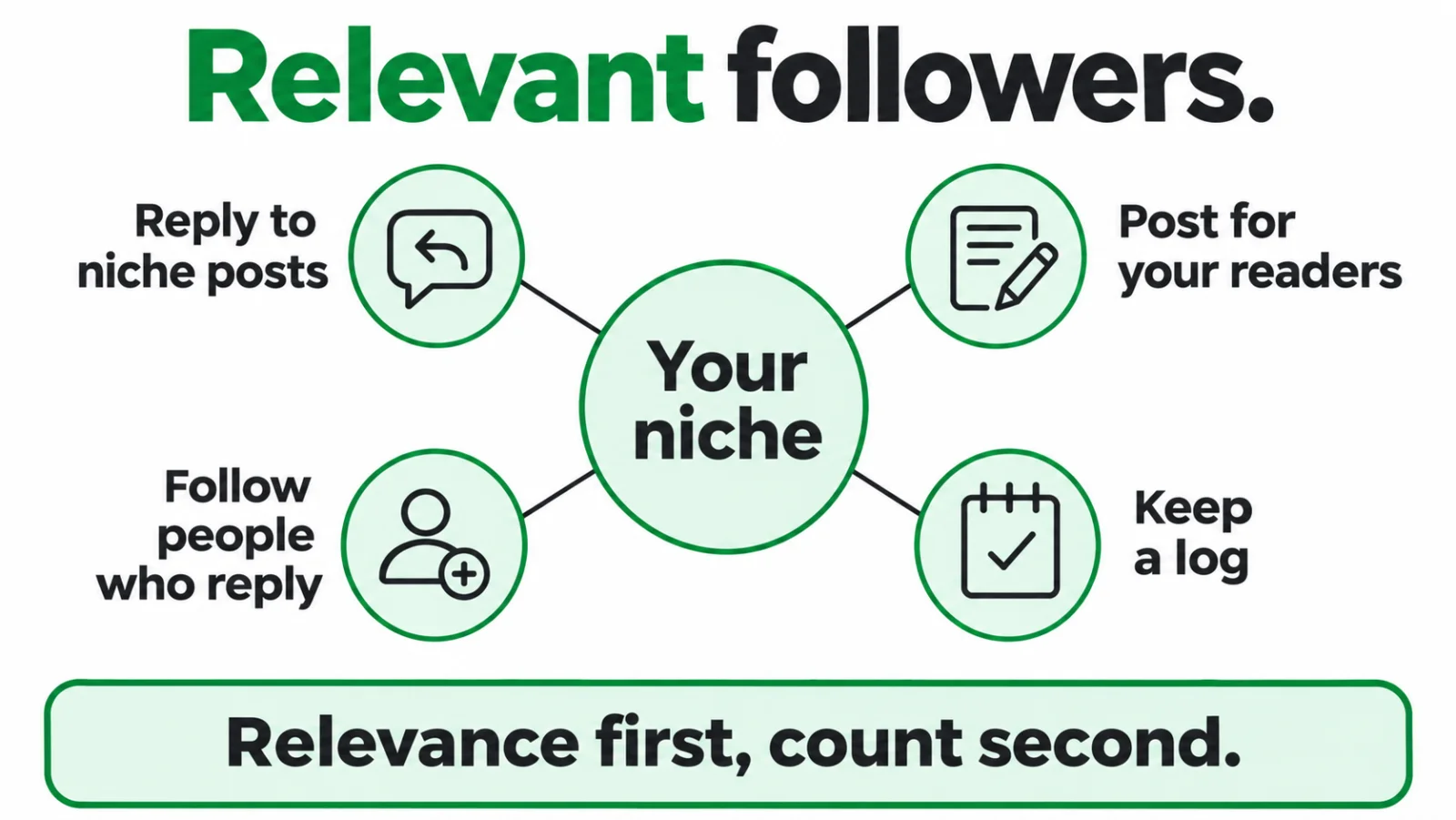
Reply to posts your reader already reads, with one detail and one point.
Follow people by hand, after you have read their posts. Never in bulk.
Keep a log of who replies back. Those are the people worth following closely.
A follower count can rise and still mean nothing. If the people who follow you do not care about your topic, they are less likely to reply, read or buy. The number on the profile is the easiest thing to watch and the least useful thing to optimise. The goal is not more followers. The goal is followers who came for what you post.
Organic growth for that kind of follower comes from conversations, not from tricks. Here is the approach I would use, step by step, and why each step is slower than a shortcut but can be worth more. The steps are: define the reader, reply where the reader already reads, post for that reader, follow by hand, and keep a log of who answers.
Definethereaderyouwant
A relevant follower is someone who would miss your posts if you stopped. To find them, write the reader down. Give them a job, a problem and the posts they already read. Be specific. "Anyone who likes tech" is not a reader. "A solo developer who wants to grow a side project on X" is.
If the reader is too broad, you may get followers who do not care about your topic. They follow once, scroll past your next posts and disappear. Broad reach can look good on a dashboard, and it does little for your replies.
A follower is relevant when they came for your topic, not for a stranger's viral post.
A quick test: read the last ten people who followed you. Ask whether each one would understand a post about your topic without a long explanation. If most of them would not, the reader is too broad, or your profile does not say what you post.
Write the reader in one paragraph
Write one paragraph for the reader. Include their job, the problem they are trying to solve this month, the accounts they probably read, and one thing they would be embarrassed to get wrong in public. Keep the paragraph on your desk. Every post and every reply should pass the test: would this person stop and read it, and would they answer?
Here is a made-up example. "A bootstrapped founder with a two-person team, selling a niche tool to dentists. They read posts about cash flow and about reducing support tickets. They would be embarrassed to recommend a feature nobody uses." A reader like that gives you a topic (small-team operations), a set of accounts to read (other small-team founders), and a sharp test for every post.
Replytothepostsyourreaderalreadyreads
Find the posts your reader already reads. These are the accounts they follow, the threads they comment in and the questions they ask. Reply to those posts with one detail and one point.
That is the organic part. You do not need a trick. You need a good reply in the right place, repeated often enough that people start to recognise your name.
Here is the difference, using a made-up example. A post says a team cut its onboarding from five steps to three. A weak reply says "Great work, so inspiring." A useful reply says that the cut from five steps to three matters most at the step where people give up, and asks which step they removed first. The second reply gives the author something to answer, and it shows your readers what you know.
Use the same test before every reply: could the author tell that you read the post? If not, delete the reply and move on. Replies that pass the test can build a small, real audience over time, and that audience is the relevant follower you were looking for.
X's help page on conversations says that when you reply, you can see the participants in the conversation (X Help Center: Conversations), and the help page on mentions and replies says a reply shows the label "Replying to" on your post (X Help Center: Mentions and replies). A thread on r/TwitterMarketing asks the same question about who sees a reply (thread). That is one question from one thread, and it is the test this section applies.
Find the conversation. Choose a post from an account your reader follows, under a question in your niche.
Name one detail. Quote the idea in your own words, so the author knows you read the full post.
Add one point. A short opinion or a comparison from your own work. Keep it yours.
Stop. One reply is enough. A second reply should come only when someone answers.
Each post speaks to one reader and one problem. Pick the reader, then write the post they would save. A post that helps one person is more likely to bring in the next person like them than a post written for everyone.
Keep the post short. Make one point and stop. If a post needs three paragraphs of setup, cut the setup and lead with the point. Readers who came for your topic will read to the end. Readers who came for a stranger's viral post may not, and that is fine.
A post that fails and one that works, made up
A weak post: "Hiring is hard, here are my thoughts." It could be written by anyone, and the reader has no clear problem to solve.
A post for the reader above: "We cut our support queue by a third after moving the setup video above the form. Before you add more help, check whether the first screen is the problem." The reader knows the problem, can test the advice, and can reply with their own number. That reply is the kind that brings a relevant follower.
Followpeoplebyhand,notinbulk
Follow an account after you have read its posts and replied with a point. Do not run a script that follows a list of accounts. X's automation rules say bulk or aggressive following is a violation, and applications that claim to get users more followers are prohibited, according to the X Help Center page on automation rules.
Manual following takes longer. It also means every follow comes from a real read, so the account you follow is one you can actually talk to next week. Some days you may follow nobody, and that is fine.
To keep the accounts you read in one place, X's help page on Lists says you can create Lists of other accounts "by group, topic or interest" (X Help Center: Lists). A List organizes the reading. It does not follow anyone for you, and it does not add followers.
Here is a simple daily routine for manual following:
Read five posts from your reader's accounts.
Reply to one or two with a point.
Follow an account only if you read its last few posts, not just its bio.
Stop when the list of accounts you read is empty. Do not fill the quota.
Works
Read a post before you follow
Reply with one point, then follow
Follow a few accounts a day by hand
Avoid
Follow a list of accounts in one run
Follow back everyone who follows you
Use follow-for-follow groups
Follow back by judgement, not by default
Following back everyone who follows you is a habit that fills your feed with off-topic accounts. Check the new follower's last few posts. If they match your reader, follow back and reply to one of their posts later. If they do not, leave the follow where it is. Nobody expects a reciprocal follow from every account in a small niche.
Keepalogofwhorepliesback
Write down who replied to you and what they asked. The people who reply back are a strong signal of relevance. Reply to them with a specific point, read their posts and keep the conversation going.
Keep the log short: date, name, what they said, what you answered. After a few weeks, the people who keep talking to you are the followers worth having. Some of them may become regular readers, and a few may send you the next idea for a post.
Arelevancelog,made-upexample
Date
Account
Whattheysaid
WhatIanswered
Week1
Asmallagencyowner
Askedhowlongthesetupsteptakes
GavethenumberandthestepIcut
Week2
Asolodeveloper
Disagreedwithmyorderofsteps
Agreedononestep,explainedwhyIkepttheother
Week3
Afounderinthesameniche
Sharedtheirownresultfromthesametest
Linkedmynextposttotheirs
The table above is an example of what the log should hold. The names and quotes are invented. The useful part is the last column: a reply that you wrote with a point, which keeps the conversation alive.
Whatthenumberscanandcannottellyou
Follower counts rise and fall for many reasons, and a single week tells you very little. The better signal is the share of new followers who match your reader. You can estimate it by reading the last twenty new followers each week, and marking the ones who match the reader paragraph.
The timeline below is the order this article recommends, one step a week, so the share of relevant followers has a chance to move before you change anything.
Step 1
Write the reader paragraph
Step 2
Reply where the reader talks
Step 3
Post for that reader
Step 4
Follow by hand and log replies
For a wider view of which numbers to read, see how to read X analytics. PostMine's Analytics page shows account trends and can import an account overview CSV, so you can read the daily numbers next to your log.
Wheretheadvicedisagrees
Some advice says to follow more accounts to get more follow-backs. Some says to post as often as possible, and some says to stop replying to people who do not follow back. I would not treat any of those as a rule. They are strategies, and each one trades a number you can see for a relationship you cannot.
My own view is that a relevant follower is worth more than a fast follower count, and that the cheapest way to get one is to be useful in a conversation your reader already has. If you test the other strategies, put them in the log like everything else, and judge them by the share of followers who match your reader.
A shortcut that trades relevance for a count can also run into X's authenticity rules, which list reach restrictions as an enforcement tool, including removing posts from the For You and Following timelines.
Commonmistakes
Writing the reader paragraph for everyone. A reader who is "anyone interested in business" is not a reader.
Replying to big accounts without a point. Such a reply gives the author nothing to answer.
Following in bulk after a bad week. The quick follow brings in people who will not read.
Changing the topic when the share falls. Tighten the reader first, then judge the topic.
Measuring replies only by count. Ten replies that all say thanks are worth less than two that ask a question.
HowtoapplythisinPostMine
PostMine helps you find the conversations, and you decide who to reply to and who to follow.
Feeds builds a feed from up to five keywords or from people lists. In the app you can also build one from your followers, the accounts you follow, repliers or an X list. Paste an X post link to pull in one post, then read it and reply inline with the Reply button.
My Replies lists the replies you sent and how each performs. Keep your own note of who answered in the log.
Analytics shows account trends, with account overview CSV import and daily export.
PostMine does not automate follows, likes or replies. The PostMine quickstart docs explain the current setup.
They read your posts, reply to them, or talk about the same problem you write about. A follower who came for a viral post outside your topic is less likely to stay.
No. Buying followers or joining follow-for-follow groups works against relevance. X's rules prohibit apps that claim to get users more followers, so avoid them.
Follow only the accounts whose posts you read and replied to. The number matters less than the reading. Follow by hand, never in bulk.
I cannot give you a number of weeks without evidence. Keep the reader defined, keep replying with a point, and read the log every week. A trend over a month is more useful than any single day.
We use cookies for product analytics to improve PostMine. With your consent we also record session replays, including the content you type and view, such as draft posts (passwords excluded), so we can see how the product is used and fix what breaks. Privacy Policy




 Yerkebulan RakhimovNov 9, 202616 min read