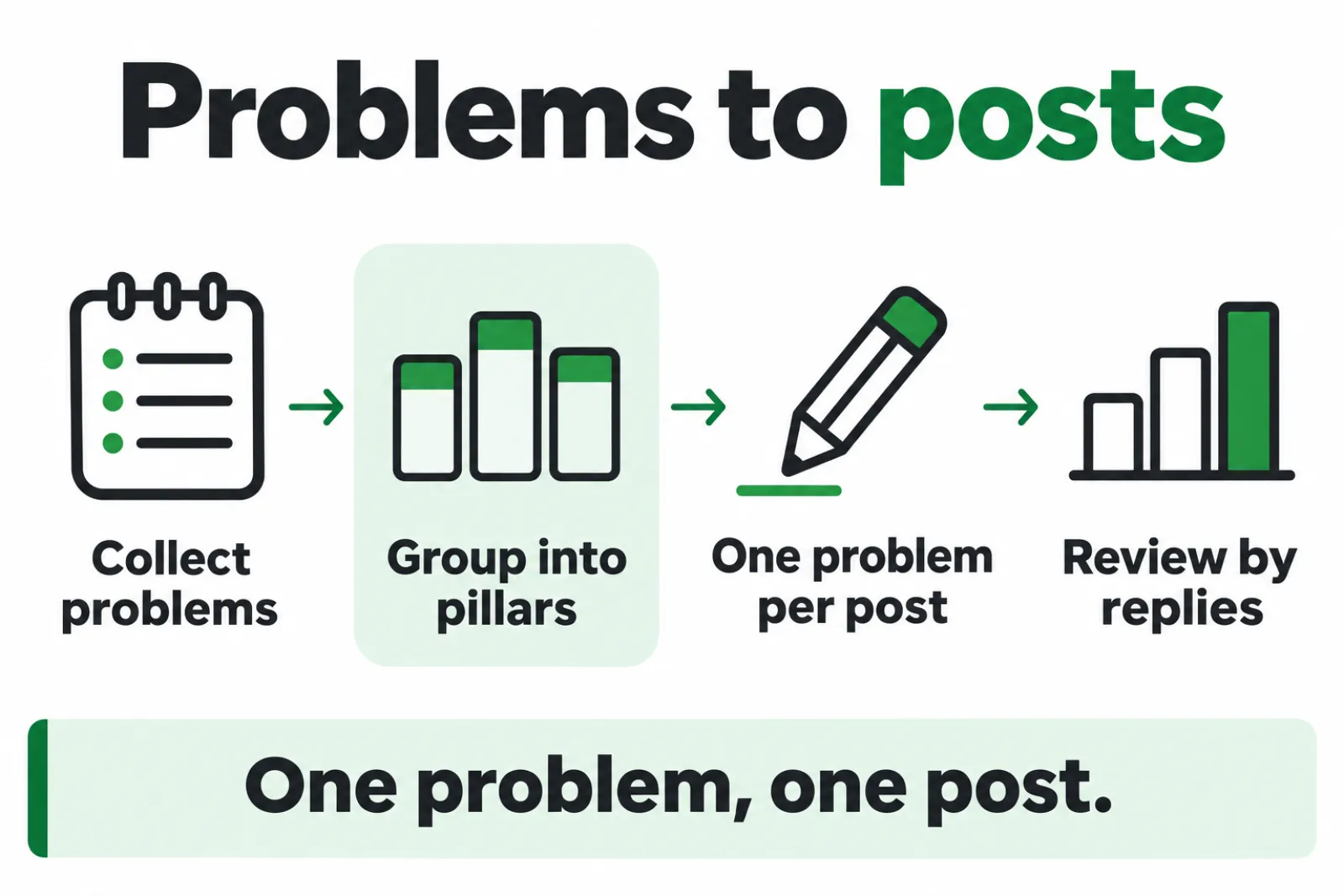
Start the content plan from the problems your audience names, not from the topics you want to talk about.
Group the problems into three to five pillars, and give each pillar a clear reader.
Every post should answer one problem, add one detail and invite one reply.
Review the pillars monthly by the conversations they start, and retire the ones that stay silent.
I think some X content plans start from the founder's list of topics. The founder wants to talk about the product, the market and the lessons from the last quarter, and the plan is a calendar of those subjects. The calendar looks sensible, and it can produce posts that readers skim, because the posts answer questions nobody in the audience is asking.
A content strategy built around audience problems reverses the order. You start from the problems your readers name in their own words, group them into a small number of pillars, and write each post as an answer to one problem. The method is slower to set up than a calendar, and it produces a feed that readers can use. This article covers how to collect the problems, how to group them, how to write posts against them and how to measure which pillars earn their place.
Whytopiclistsfail
A topic list describes what you want to say. A problem list describes what your reader is trying to do. The two rarely match. A founder may want to write about the future of AI in marketing, while the reader wants to know why their last three posts got no replies. The first post speaks to the founder. The second post speaks to the reader, and only the second one gets answered.
The difference shows up in replies. A post that answers a problem gets specific replies with details, and those replies give you the next problem to answer. A post about a topic gets general agreement, and the conversation stops.
A founder in an r/startups thread put the same gap as a question: "What do you post about if you're on the business side?" That is a problem, not a topic, and it is the kind of sentence a content plan should start from.
Start from the problem your reader has this week, not the subject you want to cover.
Collectproblemsfromtheplacesreadersalreadytalk
You do not need a survey to collect problems. Four sources cover most of what a small account needs, and all of them are free.
Replies on your posts. A reply that says "this does not work for us because" is a problem written in the reader's own words.
Replies under posts in your niche. A disagreement in a thread shows an open problem that people still argue about.
Your inbox. Support questions, sales questions and emails that begin with "how do I" are the most specific problems you will get.
Your own work. A problem you hit this week, written as a question, is a problem your readers probably share.
Write each problem as a sentence in the reader's words, with the date and the source. Keep the list in one note. A list of twenty problems written this way is more useful than a survey of two hundred people who answered in one word. For the research method, see how to learn what your X audience cares about.
X's help page on hashtags says a hashtag is used "to index keywords or topics," and that clicking a hashtagged word shows other posts that include it (X Help Center: How to use hashtags). Use that to read what people in your niche name as a problem, then write the entry in their words. X's help page on conversations describes a reply as "one of the easiest ways to join in a conversation as it's happening" (X Help Center: Conversations), so the replies under those posts are the fastest place to check the wording.
Grouptheproblemsintothreetofivepillars
A pillar is a group of related problems that one kind of post can answer. Three to five pillars cover most small accounts, and each pillar should name the reader it serves.
Here is a made-up example for a team that sells a tool to help freelance designers track client approvals. The problems collected in one month fall into three groups: proposals that go unopened, approvals that stall after the first round, and invoices that get paid late. Those three groups are the pillars. Each has a clear reader, a set of problems and a set of posts you can write from experience.
Each post in the table answers one problem, adds one detail from experience and ends with a question that asks for a real answer. The table is an example, and the numbers are invented. The shape is the point: a pillar, a problem, a detail and a question.
Writeoneproblemperpost
A post that tries to answer three problems answers none of them well. Pick one problem from the pillar you are writing for, and give the post one job. The job is to show the reader a specific thing they can check or try.
A useful structure for an answer post has four parts. Name the problem in one line, in the reader's words. Give the detail from your experience, with a number or a choice if you have one. Say what you would try next, even if it is only a guess. End with one question about the reader's own case. The post is short, and the reply has something to build on.
Name the problem. Use the reader's words from your list, not your product's language.
Add one detail. A number, a choice or a mistake from your own work.
Say what you would try. One sentence, marked as your view.
Ask one question. About the reader's own case, so they can answer from experience.
Buildacalendarfromthepillars,nottheotherwayround
Once the pillars exist, the calendar is simple. Rotate between them so that no pillar goes silent for more than two weeks, and write one post per pillar per week at the start. If a pillar keeps producing replies, give it more weight. If it produces nothing, check whether the problem is real for your reader or only for you.
Keep the calendar in a note or a spreadsheet, with the pillar, the problem and the date. Scheduling is separate from the calendar. PostMine's Queue schedules the posts you wrote for your next free slot or a time you choose, and publishes each one at its scheduled time. X's help page on scheduled posts covers Promoted-only posts in X Ads at ads.x.com, according to X's help page on scheduled posts. Nothing publishes without your action or the schedule you set.
Measurethepillarsbyconversations
A pillar is working when it starts conversations with people who match your reader. Count three things for each pillar each month: the number of posts, the replies from your reader and the follow-up questions. A pillar with few views and many follow-up questions is stronger than a pillar with many views and no replies.
Views are a weak signal on their own. X counts logged-in views on any surface, according to X's help page on view counts. A view shows a post was shown, not that a reader needed the answer. Read the replies before you decide a pillar is strong.
X's Post Activity Dashboard keeps the last 28 days by default and shows an earned engagement rate for each post, according to X's Post Activity Dashboard help page. Use it to compare pillars post by post, but keep the replies as the main test. One builder who posted every day for 30 days, and who says in the same thread that they built builtinpublic.xyz, wrote that "the algorithm didn't care about our journeys. It cared about viral tweets" (r/buildinpublic thread). That is one reading, and a steady stream of views is still not a pillar that answers a problem.
Month 1
Collect and group
Month 2
Run one post per pillar per week
Month 3
Review by conversations
Wheretheadvicedisagrees
Some advice says a strategy should be built around the founder's expertise, because the founder's point of view is the brand. Some says the audience's problems should drive everything, and the founder should follow the audience. My view is that the two are compatible if you pick the problems your expertise can answer. A founder who answers a problem they have actually solved builds a brand. A founder who answers every problem they heard about builds noise.
There is also a real disagreement about whether pillars should be fixed for a year or revised monthly. I would revise them monthly for the first quarter, because the log is still learning what your readers need. After that, a quarterly review is enough.
Commonmistakes
Writing the topic list first. The calendar then answers the founder's questions, not the reader's.
Too many pillars. Ten pillars means each one gets one post a month, which is not enough to learn from.
Posts that answer nothing. A post that describes a problem without a detail or a question gets agreement and no reply.
Judging by views. A pillar with views and no conversations is not working for your reader.
Never retiring a pillar. A pillar that produces no replies for two months should be rewritten or replaced.
Whenapillargoessilent
Every pillar goes quiet at some point. The problem may have been solved by your readers, the replies may have moved to a new question, or the posts may have stopped answering the problem the way readers describe it. A silent pillar is a signal to look, not a reason to panic.
Start with the replies you did receive. If the pillar produced one or two specific replies in a month, it is alive but small, and the next post should ask a narrower question. If it produced none, reread the last three posts and check whether each one names the reader's words, adds a detail from your work and ends with a question they can answer.
Next, check the inbox. A problem that stops appearing in customer questions is usually a problem that has been solved, or one that customers have stopped raising. Either way, it is time to rewrite the pillar around the problems that are still coming in, or to replace it with a new group from the list.
Finally, decide with a rule rather than a feeling. Retire a pillar after four weeks with no specific replies and no new questions in the inbox. Write the decision in the log with the date, so a future you can see why the pillar was dropped and whether it was the right call.
HowtoapplythisinPostMine
PostMine covers the parts of this strategy that are about habits and records. It does not write the pillars for you.
Queue schedules the answer posts you wrote, in List or Calendar view, and publishes each one at the time you schedule it. Publish opens a review, and you confirm with Slide to publish.
Feeds builds a feed from up to five keywords or from people lists. In the app you can also build one from your followers, the accounts you follow, repliers or an X list. You read each post and reply inline with the Reply button.
My Replies lists the replies you sent and how each performs, so you can match replies to pillars.
Analytics shows account trends, with account overview CSV import for past days and a daily export.
Start with three to five pillars, each covering a small set of related problems. More pillars than you can write about from experience will produce thin posts.
Use replies under posts in your niche, questions you receive in messages, and the questions in your own support inbox. Those sources work at any audience size.
Most should. A few can be progress notes or personal updates, but a strategy built only on updates tells readers what you did, not what you can help with.
Count the replies from people who match your reader, and the follow-up questions a pillar produces. A pillar that brings repeat exchanges is working, even if its views are low.
We use cookies for product analytics to improve PostMine. With your consent we also record session replays, including the content you type and view, such as draft posts (passwords excluded), so we can see how the product is used and fix what breaks. Privacy Policy




 Yerkebulan RakhimovNov 9, 202610 min read