Your audience already tells you what it cares about. Read replies, questions and messages before you guess.
Note the exact words readers use. Those words are your next headline and your next post.
Test one topic at a time for two weeks and judge it by the conversations it starts.
Keep a short list of recurring questions. It becomes your content plan without any new research tool.
I think many accounts guess what their audience wants. They pick a topic, post for a few weeks, and look at the numbers to decide whether the guess was right. That works slowly and costs a lot of posts. A faster route is to read what the audience is already telling you. People reply, ask questions, quote your posts and send you messages about their problems. Those signals are free, and they arrive in the words your readers actually use.
This article covers five sources of audience signal, how to read each one, how to write the findings down, and how to test a topic before you commit a month to it. It is written for a founder or a small team with an account that already has some replies. If you have almost no audience yet, start with the sources that do not depend on followers, which are described below.
Whyguessingfails
Guessing usually starts from what the founder cares about, not from what the reader needs. The founder thinks the market needs a new framework, and the reader is stuck on a much smaller problem, like losing a client's email thread. A post about the framework gets polite likes and no conversation.
Reading the audience fixes the order. You start from a problem a reader already has, in their words, and you write a post that answers it. The post is more likely to start a conversation because the reader recognises the problem as their own.
The reader's words are the research. If a reader writes "I never know which proposal got opened", that sentence is a headline, a post and a reply prompt in one line.
Fiveplacesthesignalalreadyexists
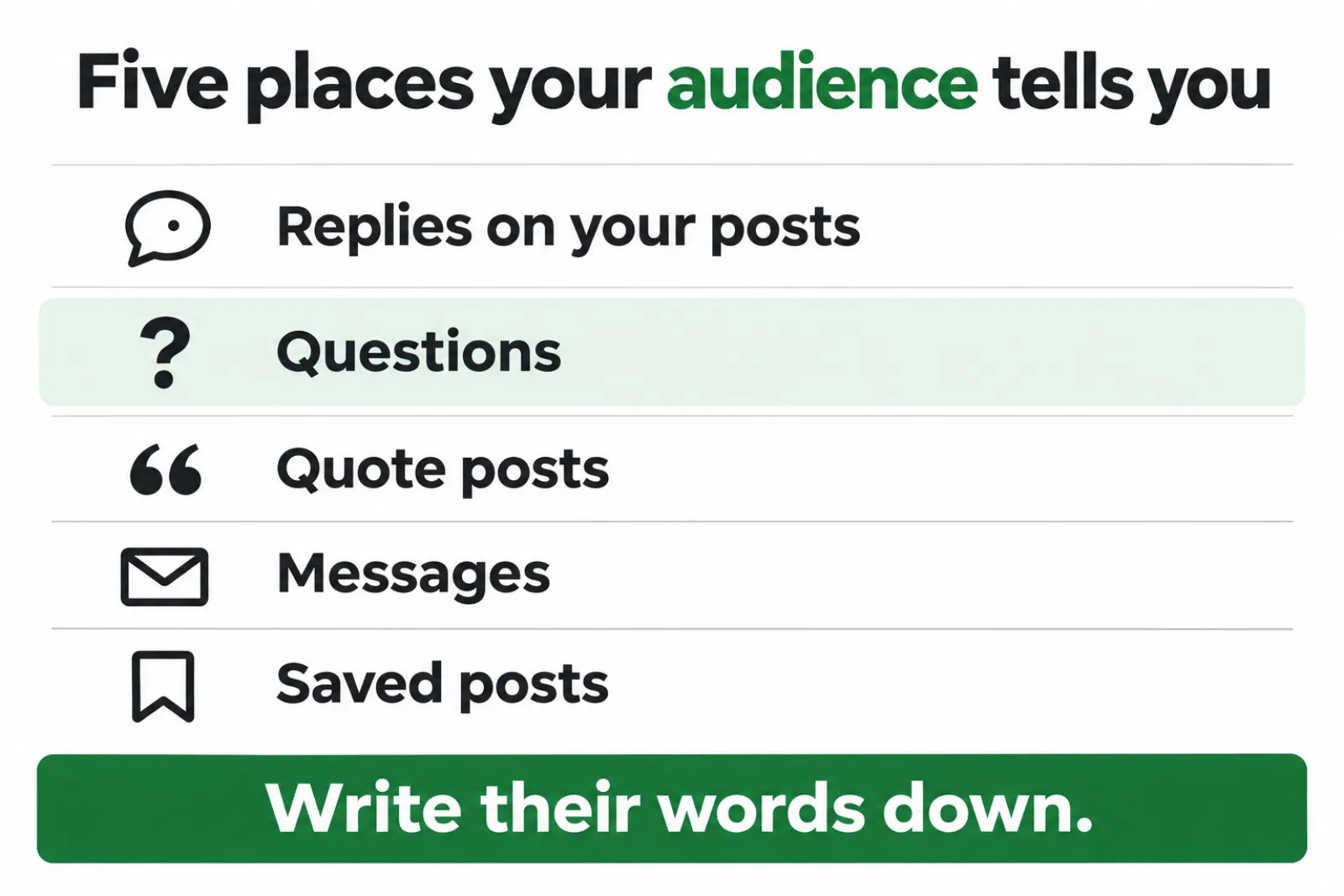
You do not need a survey or a paid panel to start. Five sources cover most of what a small account needs.
To find the posts in your niche, X's advanced search filters posts by words, people, places and dates. It works when you are logged in, according to X's help page on advanced search. Start with the exact phrase your reader uses, because that is the phrase the replies will repeat.
Replies on your own posts. These are the most direct signal, because a person chose to respond to your point.
Replies on posts in your niche. The replies under other people's posts show what a community argues about, which is often more honest than the original post.
Quote posts of your posts. A quote adds the reader's own framing, which tells you what they took from your point.
Direct messages and support requests. If people write to you privately, the question they ask is the most specific research you will ever get.
Your bookmarks and saved posts. The posts you save for later show what you find useful, which often predicts what your readers will save from you.
Bookmarks are private. Only you can see the posts you saved in your account, according to X's help page on bookmarks. That makes your own bookmarks a record of your taste, not a view of what your niche saves, so treat them as one signal among five.
Replies are also a direct place to read a conversation. X's help page on conversations calls a reply "one of the easiest ways to join in a conversation as it's happening," and says that when you reply you can see the participants in the thread (X Help Center: Conversations). Use that participant list to find the people who match your reader, not only the loudest voices.
Whereeachsignalcomesfrom,andhowtoreadit
Source
Whatittellsyou
Howtoreadit
Repliesonyourposts
Whatareaderreactstofirst
Counttherepliesthataddadetail,notthetotal
Repliesundernicheposts
Whatthecommunityarguesabout
Notethedisagreements,theyshowtheopenquestions
Quotepostsofyourposts
Thereader'sownframingofyourpoint
Copytheexactwordstheyusedinthequote
Messagesandsupportrequests
Theproblemareaderhasrightnow
Writedownthequestionasthepersonaskedit
Yourbookmarks
Whatyoufinduseful
Lookforapatternacrosstensavedposts,notone
Readthereplieslikeaninterview
A reply is a short interview answer, and you can read it the same way. Ask three questions of each one. What problem does this person describe? What did they try before? What would make them change their habit? Those three answers are the core of most good posts.
Take one made-up example. A founder posts a finding about onboarding. A reply says, "We had the same drop, but it was the email, not the screen. Once we moved the link to the first line, the drop stopped." The reader has named a problem, a prior attempt and a fix. The next post can start from that: the email link as the first line, and a question about where the reader's own drop happens.
Write the words down exactly. Paraphrasing too early removes the phrase your next reader will search for, and it removes the tone that made the reply worth reading.
X's help page on mentions and replies says you can join conversations "by replying to others and by mentioning them in your own posts" (X Help Center: Mentions and replies). Your mentions tab is a signal list too. A mention that asks a question is a reader telling you what they want to know, and it belongs in the log with the same wording.
Turnsignalsintoalistofrecurringquestions
A single reply is an anecdote. Five replies on the same problem are a pattern. Keep a running document with one line per recurring question, the words people used and the number of times you have seen it. You do not need a spreadsheet for this, a note on your phone is enough.
Log every signal. When a reply, message or quote raises a problem, add one line: the problem in the reader's words, the date and the source.
Group the lines. Once a week, read the log and group similar problems. Two lines with the same meaning become one entry.
Rank by repetition. The entries that appear most often, from readers who match your reader paragraph, go to the top.
Pick one for the week. Choose one entry and write one post and one reply about it. Judge it by the conversations it starts.
The list becomes your content plan. It is grounded in what people asked, so it is less likely to drift into your own preferences. It also keeps the account from repeating the same topic, because each entry has a count you can check.
Testonetopicatatime
Once you have a short list, test one topic at a time. Give each topic two weeks, with a post and a set of replies about it. Count the specific conversations, meaning exchanges with more than one reply from the other person. Then compare topics.
The test is about conversations, not reach. A topic that brings three real exchanges from readers who match your paragraph is worth more than a topic with a large view count and no replies. Keep the test simple. Change nothing else during the two weeks, so the difference between topics is easy to read.
Week 1
Collect signals
Week 2
Group and rank
Weeks 3 and 4
Test one topic at a time
Week 5
Compare and keep
Commonmistakes
Treating likes as a vote. A like is a cheap reaction. A reply is a choice to talk.
Asking open questions. "What do you want to see?" gets vague answers. A specific question about a choice gets a specific reply.
Reading only the biggest replies. The most useful reply is often short and from someone with a small account.
Over-reading one post. One reply with a strong opinion is a signal to check, not a rule for the account.
Skipping the paraphrase check. If you cannot repeat the reader's problem back to them in one sentence, you have not understood it yet.
Mixing your opinions into the log. Keep your own ideas in a separate list. The audience log should only contain what readers said.
Wheretheadvicedisagrees
Some advice says to ask your audience directly through polls and surveys. Some says polls get shallow answers and that the best research is quiet observation. Some says the audience will tell you nothing until the account is big. My view is that polls are fine for a choice between two options, and they are poor at finding problems you have not thought of. Observation is slower but more honest. I would not wait for a big audience, because the replies you get in the first month are already enough to start a list.
A commenter in an r/Entrepreneur thread gave the rule in a short line: "Go where your ICP is." Another commenter, who says they work at an outreach company, advised engaging directly with the target audience instead of joining communities. Those are two users' views, and neither one is data.
Whattheresearchcannottellyou
Reading the audience tells you what people care about today. It does not tell you whether your product solves that problem, whether the market will pay for the answer, or whether the people who reply are the people who buy. Keep those questions separate. Research the topic first, then test the product claim with a separate, specific measurement.
Aweekofsignalcollection,madeup
Here is one made-up week for a founder who sells a time tracker to freelance editors. On Monday, a reply under the founder's post says that the hardest part is not tracking hours but remembering to start the timer. On Tuesday, a quote post adds that editors bill by the page, so hours are the wrong unit for them. On Wednesday, a message asks whether the tool can split a project by chapter. On Thursday, the founder reads three replies under a post by a copywriter, and two of them mention the same frustration with invoice timing. On Friday, the founder saves a thread about billing rates because it has many detailed replies.
By Friday the log has five entries, and they point in one direction. The recurring problem is not tracking time. It is starting the timer and matching the unit of billing to the work. The founder writes that sentence in the reader's words, adds the date and the source, and marks it as the first candidate for a post. The quote about billing by the page becomes the headline. The chapter question becomes a reply prompt for next week.
The founder does not stop there. The same log also shows two entries that are not signals at all: a reply that said "great tool" with no detail, and a message from a person selling outsourced editing. Both go in the log with the label "no need stated", so they do not return as false leads. The week ends with one clear topic, one reply list to continue and two notes that keep the list honest.
HowtoapplythisinPostMine
PostMine helps you find the conversations and keep the record. It does not decide what the audience cares about for you.
Feeds builds a feed from up to five keywords or from people lists. In the app you can also build one from your followers, the accounts you follow, repliers or an X list. Paste an X post link to pull in one post, read it, and reply inline with the Reply button.
My Replies lists the replies you sent and how each one performs, so you can see which conversations to continue.
Analytics shows account trends, with account overview CSV import for past days and a daily export for your own log.
There is no fixed number. Look for a question that comes up more than once, from people who match your reader. Two independent replies on the same problem are a useful start.
Ask one specific question per post, about a choice they have made. Open requests like what should I post next get vague answers and few replies.
No. The replies on your posts, the replies on posts in your niche, and the questions you already receive are enough to start. A paid tool can help with volume later, once you know what to look for.
A small audience gives you fewer signals, but each signal is more specific. Read every reply and every message, and write down the exact phrasing. That is more useful than a large sample of likes.
We use cookies for product analytics to improve PostMine. With your consent we also record session replays, including the content you type and view, such as draft posts (passwords excluded), so we can see how the product is used and fix what breaks. Privacy Policy




 Yerkebulan RakhimovNov 9, 202616 min read