An audience is worth something when a reader turns into a conversation, and a conversation turns into a next step.
Map the opportunities you want first, such as customers, partners, hires and feedback, and write one path for each.
Follow up on the replies that show a real need, with one specific question, not a pitch.
Track opportunities in a short pipeline, and judge the channel by the next steps it produces.
Most founders who build an X audience want to know what it is worth. The honest answer is that a follower count is not worth much on its own. It becomes useful when a reader describes a problem, asks a question, or replies with a detail that shows they need what you sell. That moment is the start of a business opportunity, and it is the one thing the account should be built to produce.
This article explains how to turn an X audience into opportunities for a small company. It covers the four types of opportunity most founders care about, how to spot the replies that matter, how to follow up without spamming, how to track a short pipeline, and where the common advice goes wrong. It assumes you already have some conversations on the account, and it focuses on the next step after a reply.
Whatcountsasabusinessopportunity
An opportunity is a reader whose situation matches what you sell, and who has shown a sign of interest. The sign can be a question, a described problem, a request for more detail or an invitation to talk. A follower who likes your posts is an audience member. A reader who describes the problem your product solves, in their own words, is an opportunity.
It helps to name the four kinds of opportunity you want from the account before you write any posts. Each kind has a different path and a different follow-up.
Customers. Someone with the problem your product solves, who would buy or try it.
Partners. A person or company whose audience overlaps yours and who could refer or work with you.
Hires. A person whose work you respect and who might join the team or help on a project.
Feedback. A reader who knows the problem well and will tell you what is missing.
Name the opportunity you want before you write the post that finds it. A post aimed at customers reads differently from a post aimed at partners.
Spottherepliesthatmatter
Most replies are not opportunities, and treating every reply as a lead wastes time and damages trust. Look for three signs in a reply. The reader describes a problem in specific terms. The reader asks a question that your product or your experience answers. The reader shares a detail about their situation, such as a team size, a tool they use or a step that fails for them.
Write these replies in your log with a short note: the problem, the detail and what you answered. After a few weeks, the log shows which kinds of reply lead to conversations, and which problems come up most often.
Replysignalsandwhateachonemeansforanopportunity
Signalinthereply
Whatitmeans
Whattodonext
Aspecificproblemintheirwords
Arealneedyoumaysolve
Answerwithonepoint,thenaskonefollow-upquestion
Aquestionyoucananswerfromexperience
Yourjudgementisusefultothem
Answerpublicly,andkeeptheanswershort
Adetailaboutteamsizeortools
Theycanbeafitforyourproduct
Askonequestionaboutthesteptheyarestuckon
Athankswithnodetail
Politeness,notinterest
Keepthereplyandmoveon
Followupwithonespecificquestion
When a reader shows a need, the next move is a public reply with a point. A public reply shows your judgement to everyone who reads the thread, and it does not put the reader on the spot. Only after the reader replies again, or invites you, should you move to a direct message.
When you do write a direct message, keep it to one specific question. For example: "You mentioned the step where invoices stall. Is it the reminder, or the approval before it?" The question shows you read the reply, and it gives the reader an easy answer. A message that opens with a pitch, a link and a demo request usually gets no answer, and it can lose the conversation entirely.
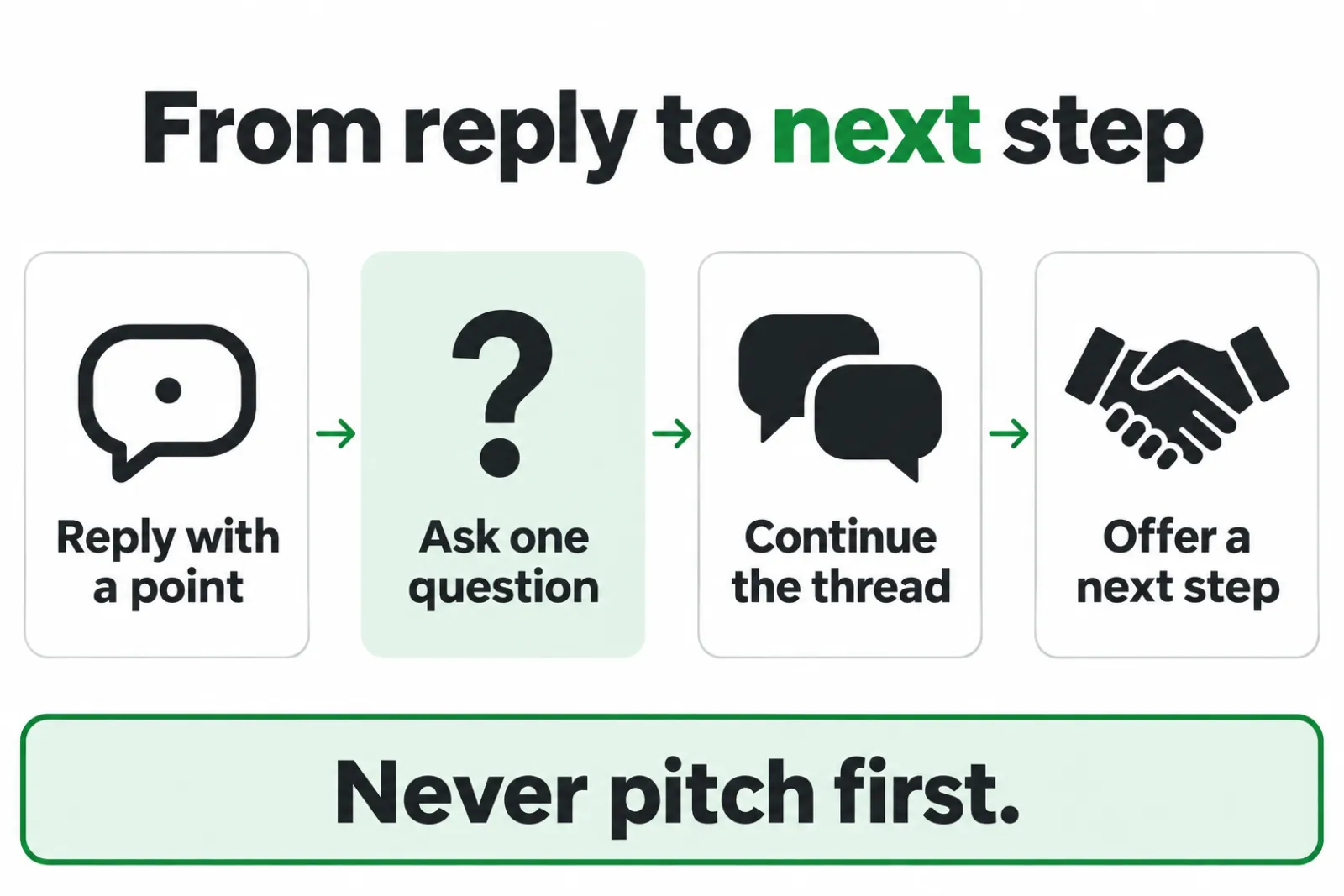
Reply publicly with one point. Name the detail they shared, and add one thing from your experience.
Wait for a reply. If they answer, continue the thread in public.
Send one direct question, if invited. Keep it to one specific question about their situation.
Offer one next step only when they ask. A short call, a trial or a reference, depending on the kind of opportunity.
Trackashortpipeline
A pipeline does not need software. It needs one list with four columns: the person, the kind of opportunity, the stage and the next step. The stages can be simple: reply received, conversation started, next step offered, and closed. A closed opportunity can be a customer, a partner, a hire or a piece of feedback that changed the product.
Review the pipeline once a week. Move each person one stage, or note why they stopped. The point of the review is to see which kinds of replies move to the next stage, and to spend more time on those. A pipeline that grows with no next steps is a list of audience members, not opportunities.
Weeks 1 to 2
Collect the signals
Weeks 3 to 4
Answer publicly and follow up once
Month 2
Offer one next step to the right readers
End of quarter
Review the pipeline
Donotspamyourreaders
The fastest way to lose an audience is to treat it as a list of leads. Readers notice when a reply is a pitch in disguise, and they stop engaging with the account. A reader who sees a founder send the same offer to every reply in a thread will not come back.
Keep three rules. Reply publicly before you message privately. Message only people who have shown interest or invited you. Never send a bulk message or a scripted follow-up. X's automation rules limit automated actions, and bulk messaging is the kind of action that damages trust in any case.
Aworkedpipeline,madeup
Here is a made-up month for a founder who sells a tool that helps small clinics confirm appointments. The pipeline starts with four replies in the first week, from a practice manager, a dental hygienist, a clinic owner and a student writing about clinic admin.
The practice manager describes missed confirmations on Mondays and asks which reminder timing works best. That is a real problem and a clear question. The founder replies publicly with one point: the reminder that worked best for their own sample was sent the evening before, not the same morning. The practice manager replies again with the number of no-shows in her clinic. The founder sends one direct question: "Is the Monday gap mostly from new patients or from recall visits?" She answers, and the founder offers a short call, which she accepts.
The clinic owner replies with a complaint about a reminder tool, and the founder answers publicly with one point about how reminders fail when nobody reads them. The owner does not reply again. The log records the exchange as a public reply only, and the founder does not message her, because she has not asked for more.
The hygienist and the student do not describe a need that fits the product, so they stay as audience members in the log. At the end of the month, the pipeline has one call, one open conversation and two closed threads. The next month's plan keeps the practice manager's question as a post topic, and drops the reminder post that brought no replies.
Whentostopfollowingup
A follow-up is useful when the reader has shown interest, and harmful when they have not. Set a simple limit before you start. One public reply, one direct question, and one offer of a next step is the full sequence for most readers. If the reader does not answer after that sequence, close the thread in the log and move on.
Stop immediately if the reader asks you to. A reader who says they are not interested, or who asks you not to write to them again, has told you what they want. Respect the answer in the log and in the thread. A founder who keeps a list of people they have stopped writing to is protecting the account and the relationships it depends on.
Turnaconversationintoacustomerinterview
Some of the best product research on X comes from a reply thread that goes three or four exchanges deep. When a reader has described a problem in detail and agreed to talk, a short interview is the next useful step. Ask for twenty minutes, state the purpose in one sentence, and offer to send the notes. Keep the interview to four questions: what they do today, what they tried before, what would make them change and what they would pay to avoid.
Take notes in the reader's words, and write the exact phrases in your log. Those phrases become the headlines of your next posts and the wording of your product page. An interview that produces one phrase you can use is a good interview, even if the reader does not buy. Send a short thank you with the one thing you changed because of their answer.
Partnersandhires,briefly
The same method works for partners and hires, with one difference: the question changes. A partner conversation asks where the audiences overlap and what each side could offer the other. A hiring conversation asks about the work the person has done and the problem they would like to solve. In both cases, start with a public reply to their work, then one direct question about their next project.
Do not treat a partner or a candidate as a lead. Treat them as a peer with their own goals. A partner who finds you useful will refer readers without being asked, and a candidate who respects your public thinking will apply with a clear picture of the work. Both outcomes depend on the conversation being honest from the start.
Reviewingthepipelineeachquarter
Once a quarter, read the whole pipeline. Count the opportunities by kind, the number that reached a next step, and the replies that led nowhere. Ask which kind of reply moved furthest and which type of post produced it. Adjust the reply list and the post topics for the next quarter, and drop the reply patterns that produced no next steps.
Share the quarter's lesson in one post if it is useful to your readers. A post that describes what you learned from a pipeline, without naming the people in it, is often more valuable than any single offer. It shows readers how you work, and it invites the next group of conversations.
Repliesthatlooklikeleadsbutarenot
Some replies sound promising and go nowhere. A reply that says "we should talk" without a problem, a reply from an account that exists only to sell a service, and a reply that praises the product without describing a need are the common cases. Treat them as audience replies. Answer publicly with one point, and keep them in the log with the label "no need stated". That label stops you from spending a week on a conversation that never had a problem in it.
Some sales-like replies come from people who do have a need, but want a free answer. A reader who asks for a full analysis of their setup in a reply is asking for consulting. Give one useful point in public, and offer a short call if the situation fits your time. Do not write the analysis in the thread. A public answer that helps everyone in the thread is worth more than a private one that helps one person for free.
Achecklistforeachopportunity
Before you move an opportunity to the next stage, answer four questions in the log. Has the person described a problem in their own words? Did they ask a question or share a detail that I can answer from experience? Have they invited more contact, or have I asked and they agreed? Is the next step something they asked for, or something I want?
If the answer to the last question is "something I want", pause. A next step that only serves your pipeline will show in the conversation, and it costs the trust the thread was built on. Wait for the reader's next message, and let the step follow from their words.
Whocanreply,andwhyitmatters
X's help page on replies says that "You can join conversations on X by replying to others and by mentioning them in your own posts" (About replies and mentions). That is the whole opportunity in one line: a conversation two people choose to have. The same page is where to start when a thread is not going to work.
X's conversation settings matter too. X's help page on conversations says the author can change who can reply "to help minimize unwanted replies and improve meaningful conversations," and that the setting can be changed midway through a conversation (About X conversations). The same page says popular conversations are easy to find and join. If you start a conversation about a problem your product solves, leave replies open. If a thread turns into noise, tighten it. The setting is there to manage the conversation, not to avoid it. X's help page on mentions and replies also says you can reply by clicking or tapping the reply icon on a post (X Help Center: Mentions and replies).
Reply ranking is another factor you do not control. Read any claim about who sees a reply as a hypothesis to test in your log, not as a promise.
Two Reddit threads describe the same uncertainty. One r/TwitterMarketing thread asks, "Can Replying To Bigger Accounts Be A Real Growth Strategy?" (thread). In another r/Twitter thread, a user asks how reliable the reply-guy method is, after a week and a half of replies in a niche that brought likes but no following (thread). These are individual experiences, not data, but they match what a log should show: visibility is not the same as a conversation with a buyer.
Paid promotion is a different thing, and the line matters. A post in r/buildinpublic offered to "hire 5 twitter creators (100k+ followers) for total $100" (thread). X's authenticity rules prohibit trading, buying or selling accounts, and give "pay for affiliation" schemes as an example within that account-trading rule. Read the exact wording before you buy a shout-out. In my view, a disclosed partnership is a different thing from a scheme that trades accounts or inflates reach, so ask what is being bought. When in doubt, offer a real product trial instead of a fee.
Wheretheadvicedisagrees
Some advice says the only way to turn an audience into revenue is a steady flow of product posts with clear calls to action. Some says product posts kill engagement, and the audience should be nurtured with content first. I think the honest middle is to keep the content useful and the product mention tied to a question a reader asked. A post that answers a question and mentions your product, with a note that you built it, can be a good opportunity. A post that is only a pitch rarely is.
There is also a disagreement about how quickly an audience should produce revenue. Some founders expect results within a month. I think that expectation is usually wrong for a small account, because the first conversations take time to become opportunities. Give the pipeline a quarter before you judge it.
Commonmistakes
Treating followers as leads. A follower who does not describe a problem is not yet a customer.
Pitching in public replies. A reply that sells before it helps loses the thread.
Sending long direct messages. A message with a pitch, a link and a demo request is rarely answered.
Skipping the log. Without a pipeline, you cannot tell which replies turned into opportunities.
Judging the channel in a month. The first conversations take time, and the pipeline needs a quarter to show a pattern.
HowtoapplythisinPostMine
PostMine helps you find and track the conversations. It does not qualify leads for you, and it does not send messages on your behalf.
Feeds builds a feed from up to five keywords or from people lists. In the app you can also build one from your followers, the accounts you follow, repliers or an X list. Paste an X post link to pull in one post, then reply inline with the Reply button.
My Replies lists the replies you sent and how each one performs, so you can see which conversations to continue.
Analytics shows account trends, with account overview CSV import for past days and a daily export.
Look for a reply that describes a problem your product solves, or a question that shows they are looking for a solution now. A follower without a stated problem is an audience member, not yet an opportunity.
Reply publicly first, with a point. Send a direct message only when they have asked for more detail or invited you, and keep the message to one specific question.
There is no fixed time. Real conversations can take weeks of consistent replies, and customers or partners can come later. Judge the pipeline over a quarter.
Yes, when the product answers the question asked and you say that you built it. A reply that pitches before it helps will lose the person and their readers.
We use cookies for product analytics to improve PostMine. With your consent we also record session replays, including the content you type and view, such as draft posts (passwords excluded), so we can see how the product is used and fix what breaks. Privacy Policy




 Yerkebulan RakhimovNov 9, 202613 min read