Both public studies rank weekdays above weekends on X, so a weekend post needs a clear reason.
Buffer and Sprout disagree about Friday and Sunday, so treat those days as open questions for your own account.
A day is only worth a verdict after several weeks of posts of the same type, read by engagement rate.
Keep the day test separate from the hour test, or the two will hide each other.
Every few months a new study appears with a ranking of the best day to post on X, and every ranking looks like a rule. The honest reading is narrower. The two large studies from 2026 agree on the broad pattern: weekdays beat weekends. They disagree on the details, and each one averages a different sample. This article explains what each study measured, where they conflict, and how to test days on your own account.
The day question is different from the hour question, and the earlier best time guide covers the hours. Here the focus is the calendar: which day of the week to put your strongest post on, and whether a weekend post is worth the slot.
Whatthetwostudiessayaboutdays
A study tells you what happened to other accounts. Your own history tells you what happens to yours. X's Post Activity Dashboard shows impressions, engagements and engagement rate for each post you send, and by default it covers the last 28 days. X's view count page describes views as the total number of times a post has been viewed, so compare one metric across days rather than mixing views with impressions. Advanced search narrows posts to a date range, so you can pull a past range and pick the weekday from the results. X's scheduled posts page covers Promoted-only posts scheduled through X Ads, so it does not describe how your organic posts go out.
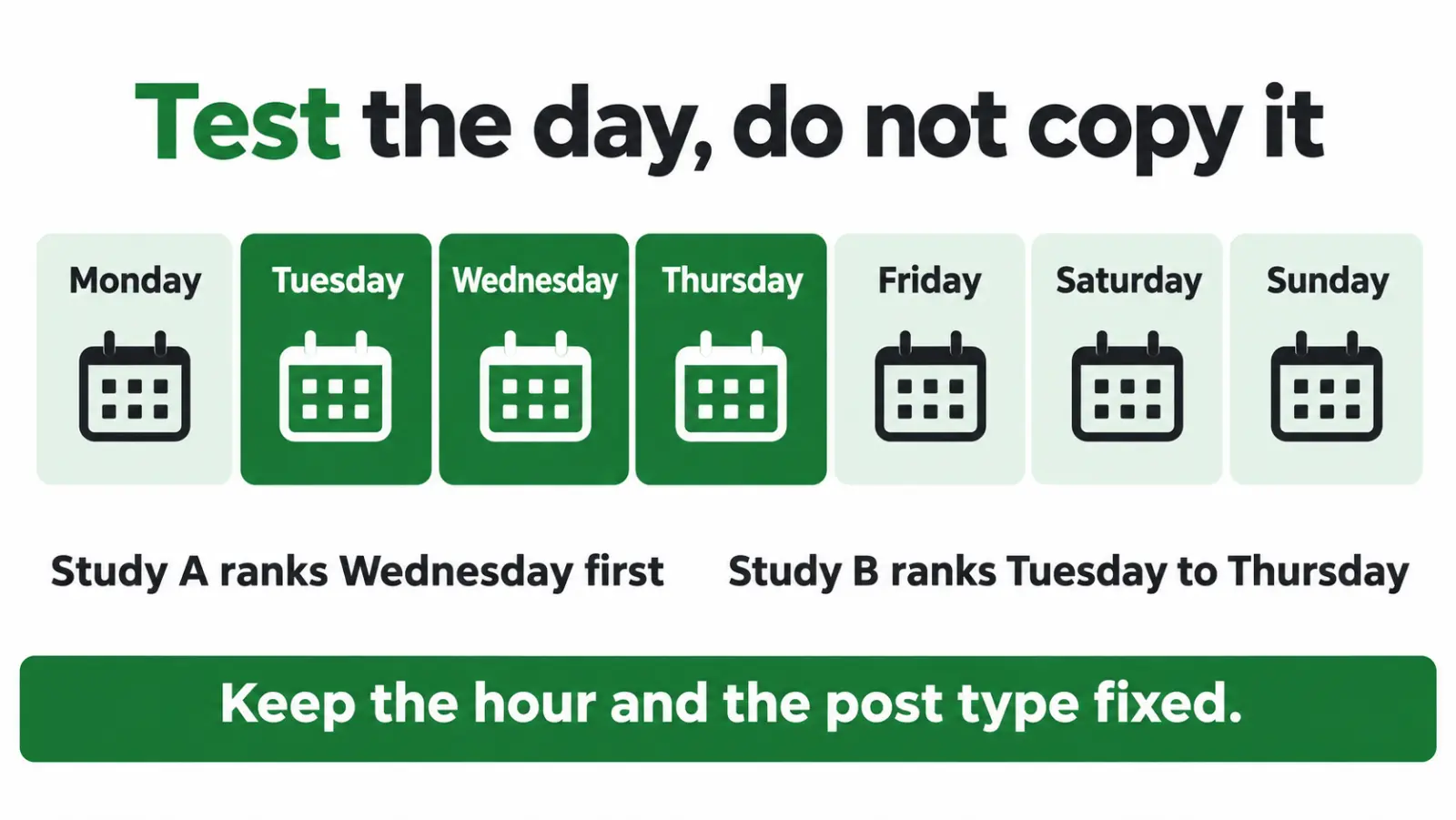
The studies agree on weekdays and disagree on the margins. Buffer's analysis of 8.7 million tweets, published on March 13, 2026, ranks Wednesday as the best day, with Tuesday and Thursday close behind. It says Saturday and Friday see the lowest engagement levels. Buffer's day table gives a best hour for each day, with 9 a.m. the most common first choice.
Sprout Social's 2026 analysis, updated March 31, 2026, reports Tuesdays through Thursdays as its best days. Its summary lists Saturdays and Sundays as the worst days, while its day table gives Sunday 2 to 6 p.m. a moderate rating. Sprout's Monday window is 2 to 3 p.m. and 5 p.m., and its Saturday row says to avoid posting.
Dayrankingsfromthetwo2026studies
Day
Buffer(8.7milliontweets)
SproutSocial(nearly2billionengagements)
Monday
Notinthetopthreedays
Peak,with2to3p.m.and5p.m.windows
Tuesday
Amongthetopthreedays
Peak,12to6p.m.localtime
Wednesday
Bestdayoverall
Peak,12to6p.m.localtime
Thursday
Amongthetopthreedays
Peak,12to6p.m.localtime
Friday
Amongthelowestengagementdays
Moderate,12to6p.m.localtime
Saturday
Worstdayoverall
Lowest,avoidposting
Sunday
Low,9a.m.isitsbesthour
Moderate,2to6p.m.
Read the table carefully. The studies agree that Tuesday, Wednesday and Thursday are strong, and that Saturday is weak. They disagree about Friday and Sunday, and Monday ranks differently in each. Those gaps are the part of the data you should test for yourself.
The two rankings are the primary sources for this article. Buffer's analysis ranks Wednesday first across 8.7 million tweets sent through its tool, and its day table orders the other days. Sprout Social's analysis reports Tuesday to Thursday as its strongest days, with Monday's 2 to 3 p.m. and 5 p.m. windows listed separately, across a sample of about 307,000 profiles. Read both tables from the primary pages, not from a summary, because the day rows are easy to misquote.
Whythestudiesdisagree
Each study answers a slightly different question. Buffer ranks days by the engagement rate of posts sent through its tool, so it reflects that tool's users. Sprout reports engagement across six networks, from about 307,000 profiles, and it splits its results by industry. A ranking built from one sample will not match a ranking built from the other, even when both are carefully made.
Time zones add another difference. Buffer says its recommendations apply to local time in any region, and that no conversion is needed. Sprout lists its times in local time for the recipient. Neither approach can tell you the exact best day for a single city, and a day that looks strong in an average can be weak for an audience in one country.
The sample also differs by industry. Sprout's industry tables give different windows for each sector, and several sectors share the same best days, so a founder who writes for developers and a founder who writes for retailers should not copy the same calendar. The average across all accounts is a starting point, not a plan for your niche.
Aworkeddaytest,withillustrativenumbers
The example below is an illustration, not a real account. A founder wants to know whether Wednesday or Friday is the better day for her weekly build log, and she keeps the hour fixed at 10 a.m. local time. She posts the same type of post on each day for five weeks.
In each week she records the engagement rate of both posts. After five weeks she has five values for each day. The Wednesday median is 1.4 percent and the Friday median is 1.1 percent, and the Wednesday values are higher in four of the five weeks. She concludes that Wednesday is the better day for her account, but she keeps the test running for one more month before she changes the calendar, because five weeks is still a small sample.
The example shows the three rules that make a day test useful. Hold the hour fixed, use the same type of post, and compare medians across several weeks rather than one best post.
Weeks 1 to 5
Post the same type of post on Wednesday, then Friday
Each week
Record the engagement rate of each post
Week 5
Compare medians per day
Weeks 6 to 9
Confirm the winner
Howtoreadadaytablewithoutover-readingit
A day table is a prior, and a prior needs a check. The two tables above look precise, with a rank for every day, but a rank is only as good as the sample behind it. Read each table with three questions in mind before you use it. How many posts sit behind each row? Which accounts are in the sample? And how big is the gap between two neighbouring days?
Neighbouring days often differ by very little. If two days sit within a small margin of each other, the honest reading is a tie, and a tie is a reason to pick the day that fits your routine. A founder who spends a month chasing a difference that small is chasing noise. The same applies to the Friday and Sunday rows, where the two studies disagree. Treat a disagreement between sources as a question for your own data, not as a fact in either direction.
Check the sample before the rank. A study that averages a large number of profiles tells you about that population. Your audience may be smaller, more specific or located somewhere else, and the rank may not transfer. The same caution applies to industry tables. A founder writing for one niche should look for the rows that match that niche, and treat the rest as background.
Write the table into your own log before you use it. One line per day: the study, the rank, and your own question. For example, "Friday moderate in Sprout, weak in Buffer. Question: does Friday hold for my readers?" The line turns a ranking into a question, and the question is what your test answers.
Mistakesthatmakeadaytestuseless
Mistake one: changing the day and the hour together. If you move the post to Wednesday at 9 p.m., you have tested two things at once, and you will not know which one mattered.
Mistake two: comparing a launch day with a normal day. A launch post or a news reaction is time-bound. Keep those out of the day comparison, or the day will look better than it is.
Mistake three: changing the content type between days. A thread on Tuesday and a single image on Thursday are different experiments. Keep the type fixed.
Mistake four: reading the week you just posted. A post from Thursday keeps gaining impressions after the weekend. Wait for the data to settle before you judge it.
Mistake five: copying a rank from a study. A rank from Buffer or Sprout is a prior. Your own medians are the evidence, once you have enough posts to trust them.
Whereweekendpostsstillmakesense
Weekends are weaker on average, but an average is not your audience. A founder whose readers are builders in other time zones may find that Sunday evening is a good window for them. The studies rank Sunday low, and their averages cannot know your readers' habits. Test one weekend day as its own block, with the same content type, and compare it with a weekday.
Weekend posts also have a practical cost. You may need to answer replies on a day you had planned to rest, and a post you cannot answer is a post you should not publish. If you decide to test a weekend day, plan the replies first.
Edgecasesthatchangetheanswer
Holidays. A public holiday in your audience's country can move the whole week. Mark those days in your log and exclude them from the comparison.
Launch weeks. A launch week is a different experiment. Keep the day test separate, and resume it once the launch has settled.
Small accounts. An account with a few hundred impressions a post will see noisy day results. Stretch the test to more weeks, and keep the posts of one type.
Format changes. If you add a new format, such as a thread or a video, the day result may change for reasons that have nothing to do with the day. The links study shows how much format can move engagement rate, so change one thing at a time.
HowtoapplythisinPostMine
I build PostMine, which this article mentions.
PostMine's queue shows Drafts, Scheduled, Posted and Failed in a list or a calendar, so the days of your test sit side by side. You can schedule to your next free slot or a time you pick, and the weekly schedule holds time slots for each day. Keep the hour and the content type fixed in those slots while you test, and turn off the "Make my schedule more natural" option during the test, because it adds up to 5 minutes of variation to each slot.
The timing guide explains how to test the hour after you have chosen the day, and the calendar guide shows how to turn the winning day into a standing slot.
Tyingthedaytesttoyourpostingcalendar
Once a day wins, the question becomes how to keep it. The simplest answer is a standing slot on that day in your weekly grid, with the same hour and the same type of post. A standing slot turns the test result into a habit, and it stops the calendar from drifting back to whatever day felt right that week. The calendar guide shows how to choose the slots and keep them.
Keep the day test running at a lower intensity after it ends. Check the same day every few weeks, with the same type of post, and write the median in the log. A day that stays strong over several checks is worth keeping. A day that slips is a signal to test the next candidate. The studies can change their rankings, and your own numbers can change as your audience changes, so the log is the only record that stays true for your account.
Buffer's 2026 analysis ranks Wednesday first, then Tuesday and Thursday. Sprout Social's 2026 analysis reports Tuesday through Thursday as its strongest days, with Monday's 2 to 3 p.m. and 5 p.m. windows listed separately. Both average many accounts, so test the day on your own account before you rely on either.
Both studies rank Saturday low. Sprout lists Saturday as the day to avoid, and Buffer ranks it the worst. A weekend post can still work for an audience that is active then, so test it rather than ruling it out.
At least four weeks for each day you compare, with the same type of post. A single good Wednesday tells you very little.
Test one at a time. Choose the day first with a fixed hour, then test hours on the winning day. Changing both at once hides which change mattered.
We use cookies for product analytics to improve PostMine. With your consent we also record session replays, including the content you type and view, such as draft posts (passwords excluded), so we can see how the product is used and fix what breaks. Privacy Policy




 Yerkebulan RakhimovNov 9, 202614 min read