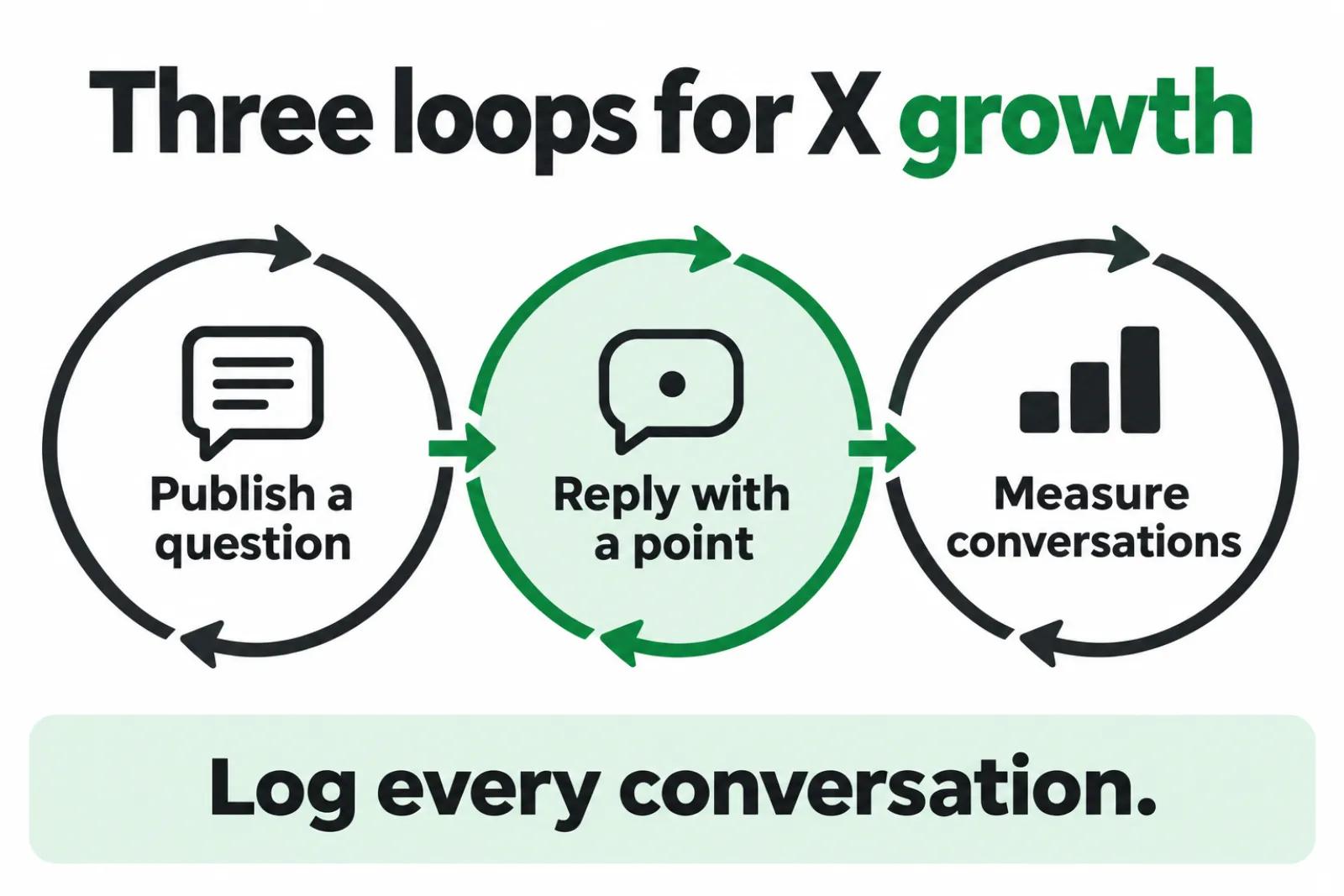
Posts, replies and measurement only grow an audience when they feed each other.
Every post should produce a reply to answer, and every reply should produce a topic for the next post.
Measure the conversations, not the reach, and read the log before you change the plan.
Change one variable per month so the result tells you what caused it.
Most X growth advice treats posting, replying and measuring as three separate jobs. A founder writes posts on Monday, replies on Tuesday and checks the numbers when they remember. The three jobs run in parallel, the results are hard to attribute, and the account grows slowly or not at all.
This article connects them into one system. Each post is written to produce a reply. Each reply produces a topic or a question for the next post. Each month, the log tells you which of the two loops is working and what to change. The strategy is slower than a launch burst, and it is easier to keep for a year.
Whythethreejobsfailwhentheyrunseparately
A post published into silence teaches you nothing, because you do not know who read it or what they thought. A reply sent without a reader in mind has no follow-up, because you did not log which conversation it started. A measurement done once a month shows a total that does not explain its cause. Each job loses value without the others.
Connecting them fixes that. The post gives readers something to answer. The reply gives you the conversation and the language your readers use. The measurement shows which posts and replies produced conversations, so next month's post can start from a real signal.
A post is a question, a reply is a conversation, and a measurement is the record of which one worked.
Thefirstloop:publishapostthatinvitesareply
A post invites a reply when it states one point and one detail the reader can respond to. The point gives the reader something to agree or disagree with. The detail gives them something to add their own experience to. Without both, the post is a statement, and statements get likes.
The format matters less than the point. A short post with one finding often does better than a thread, because the reader can answer the finding in one line. Save threads for results that need several steps to explain. For a deeper look at thread mechanics, read how to plan and write an X thread.
Write the post for one reader from your reader paragraph, and check its length. Free accounts have a 280-character limit per post, and Premium accounts allow up to 25,000 characters, according to X's Premium help page. Links count as 23 characters each, according to X's developer documentation on counting characters.
Thesecondloop:replywithapoint,thenlogit
The reply loop is where the audience comes from in the early months. Find posts your reader already reads, read them in full, and add one point. The method is the same as in how to reply on X without sounding like AI, and the discipline is the same: skip any post where you have nothing to say.
The difference in a growth strategy is the log. Every reply gets a row with the account, the point, the date and what happened next. After two weeks, the log tells you which accounts answer, which topics start conversations and which of your points get a second reply. Those three answers decide the next week's reply list.
Use X's own reply features to make the log easier to read. X's help page on conversations says that when you reply, you can see the participants in the conversation (X Help Center: Conversations). A reply to someone else also shows the label "Replying to" on your post, according to X's help page on mentions and replies. Record the participants next to each row, so the next reply goes to the right person.
Pick the posts. Choose from the ten accounts on your list, plus any post in your feed where a reader asked a question you can answer.
Write one point. Name one detail from the post, then add one thing you know from your own work.
Log it. Record the account, the point, the date and whether the author or anyone else replied.
Answer the answer. When someone replies to you, write a short second reply with a new detail. That second reply often turns a reaction into a conversation.
Thethirdloop:measureconversations,notreach
Measurement is where the strategy stops being guesswork. Measure four things each week: the posts that got a reply from someone who matches your reader, the replies you sent that got an answer, the questions readers asked you, and the accounts that replied to you more than once.
Views are useful as a secondary check. X counts logged-in views on any surface, according to X's help page on view counts, so a view shows that a post was seen, not that anyone cared. Compare views with the replies from your reader. A post with few views and three specific replies is a better signal than a post with many views and none.
X's Post Activity Dashboard gives a per-post view too. It shows impressions, engagements and an earned engagement rate for each post, with the last 28 days by default, according to X's Post Activity Dashboard help page. Use it as the second column of the log, next to the replies, and not as the only column.
At the end of each month, the strategy needs one decision, not a rewrite. Read the log and answer three questions. Which loop produced the most useful conversations? Which post or reply started a thread of more than two exchanges? Which part of the routine did you skip most often?
Then change one variable for the next month. If replies were the strongest loop, add a second reply block. If posts got the conversations, keep the post rhythm and sharpen the point. If the routine was skipped, reduce the number of posts before you reduce the quality of the replies. One change per month is slow, but it is the only way the next month's result will tell you something.
Aworkedmonth,madeup
Here is a made-up month for a founder who builds a tool for freelance designers. The reader paragraph says: a designer with three to ten clients, who sends proposals by email and loses track of which ones were opened.
In week one, the founder writes the reader paragraph, picks ten accounts that designers follow and creates a log with one row per reply. The first post is a finding: "Out of twelve proposals, four were opened within a day. Those four had the project timeline in the first line." It is short and it asks one question: what does the first line of your proposal say?
In week two, the founder replies to five posts a day from the ten accounts. One reply names a detail from a designer's post about slow client approvals and adds a point about a proposal template. That designer replies, the founder answers the reply with a second point, and the log records a conversation of four exchanges. The post from week one also gets two replies from designers who match the reader.
In week three, the log shows the proposal topic is the strongest. The founder writes a post about the timeline line, and a second post about the approval step. Both get replies. The founder does not change the reply list, because the replies from the ten accounts are still producing conversations.
At the end of week four, the review shows one clear pattern: conversations started on proposal timing, and the replies that went nowhere were about general freelance advice. The one change for month two is to narrow the reply list to accounts that talk about proposals and approvals. The numbers in this example are invented. The shape is the point: one topic, a log that names the pattern, and one variable changed at a time.
Commonmistakesinaconnectedstrategy
Running the loops in different tools. A post in one place, replies in another and a log in your head makes the loops impossible to connect.
Measuring the wrong thing. A chart of followers over time does not tell you which post started a conversation.
Replying without a log. A reply you cannot find again is a reply that cannot start a second exchange.
Changing three variables at once. If the posts, the reply list and the time of day all change, you cannot tell what worked.
Expecting a result in week one. The loops need several weeks of entries before a pattern is visible.
Automating engagement to fill the loops. Automated likes are not allowed, and automated replies are allowed only to users who opted in. Read the X automation rules before you connect any tool.
Wheretheadvicedisagrees
Some advice says growth comes from posting more. Some says replies are the only channel that matters on X. Some says measurement distracts from the work. I think each is partly right and partly a trap. Posting more without replies produces a quiet feed. Replies without posts give you no place for a reader to land. Measurement without a plan produces a dashboard nobody uses.
What I would test for a month is the connected version, with a log, and then judge it on the number of real conversations. That is a number you can defend. It is also the number most likely to predict an audience that stays.
HowtoapplythisinPostMine
PostMine covers the three loops with the parts that exist today, and it leaves the decisions and the sending to you.
Queue schedules the posts you wrote, and publishes each one at the time you schedule it. Publish opens a review, and you confirm with Slide to publish.
Feeds builds a feed from up to five keywords or from people lists. In the app you can also build one from your followers, the accounts you follow, repliers or an X list, and you reply inline with the Reply button.
My Replies lists the replies you sent and how each one performs, which is the starting point for the reply log.
Analytics shows account trends, with account overview CSV import for past days and a daily export for your own log.
One reader paragraph, a list of ten accounts your reader follows, a fixed reply block and a log with one row per reply. That is enough to run all three loops.
Track replies from people who match your reader. Reach and followers matter, but a reply tells you that a real person engaged with your point.
Give the system at least four weeks before you judge it. The first two weeks usually show setup problems, and the log needs several entries before a pattern appears.
Start with replies for the first month, because they show you what your readers care about. Add a steady post rhythm once you know which topics produce conversations.
We use cookies for product analytics to improve PostMine. With your consent we also record session replays, including the content you type and view, such as draft posts (passwords excluded), so we can see how the product is used and fix what breaks. Privacy Policy




 Yerkebulan RakhimovNov 9, 202617 min read