Write the bio for a stranger who has just landed on your profile and does not know you.
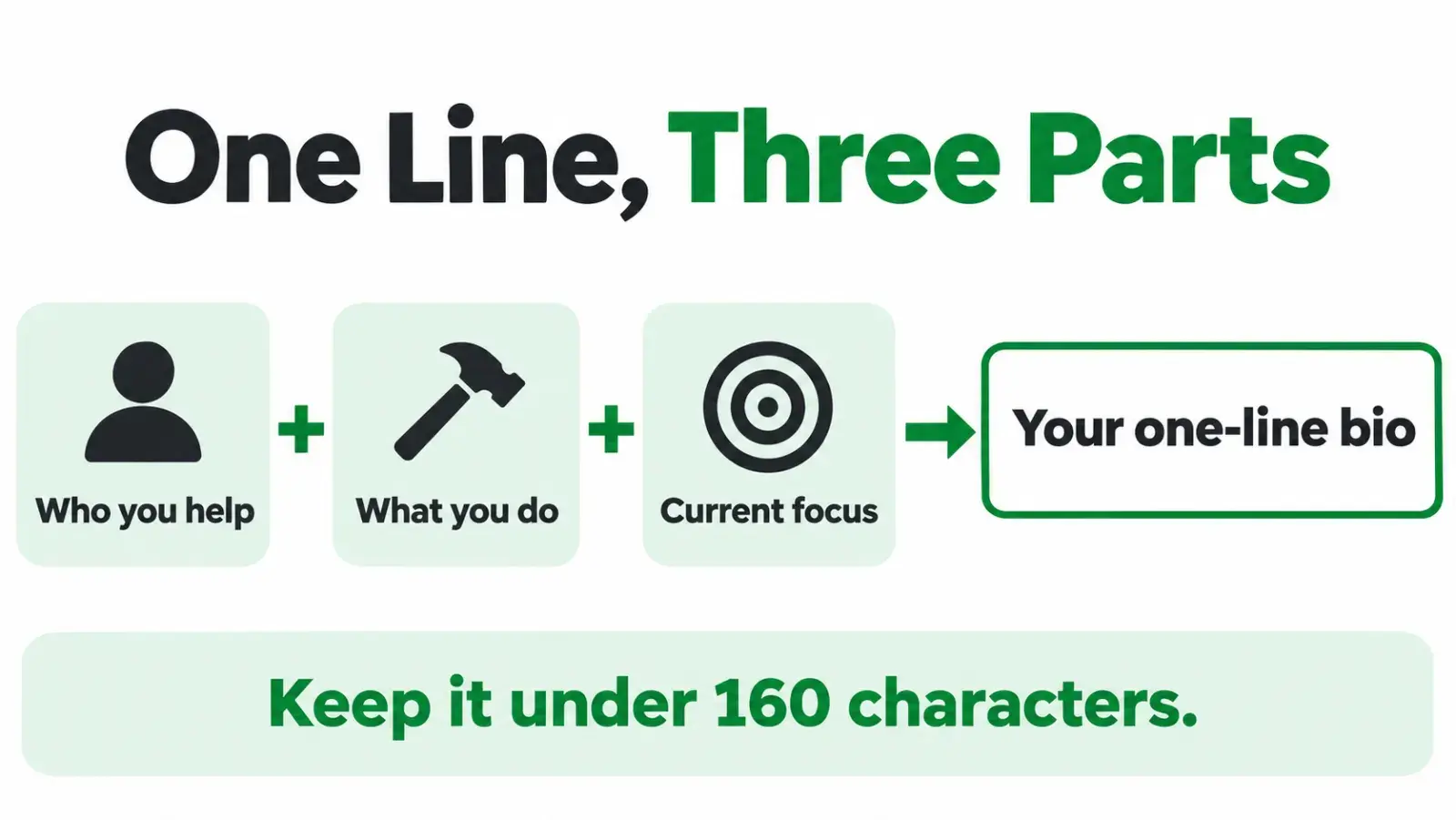
Build the line from three parts: who you help, what you do, and what you are working on now.
X's bio limit is 160 characters. Save only a version that fits.
Match the bio to your pinned post and recent posts, or the first screen will say one thing and the feed another.
A bio is often written about the writer. A better bio is written for the stranger who has just landed on the profile and wants one answer: is this account worth following? The bio is a single line that tells that stranger who you help and what you do. The pinned post and the first few posts have to confirm what the line promises.
This guide covers the 160-character limit, a three-part formula, a checklist for business accounts, draft examples for founders, creators and businesses, and a four-week test. It ends with the points X's pages leave open, so you can tell platform rules from practice.
X's profile help page sets the bio at a maximum of 160 characters (X Help Center: How to customize your profile, checked 2026-11-10). Type the bio in the Edit profile screen and save only a version that fits. Draft the line in a note first, then paste it, because a long draft is hard to edit in the field.
The limit forces a choice. You cannot list every project, tool and past job in 160 characters, so pick the one thing a stranger needs to decide whether to follow. Everything else can wait for the pinned post or the first few posts. Treat the 160 characters as a budget: each word should change the stranger's decision.
Write three versions of the line, each a different length, and read them aloud. The shortest version often works best, because a stranger reads it in one glance. If two versions say the same thing, keep the shorter one.
Emoji and non-Latin text
The help page gives the 160-character limit. It does not say how emoji or non-Latin characters count in the bio field (checked 2026-11-10). Test your exact line in the Edit profile field before you save it. For how character counting works in posts, see X character limit explained.
Buildthelinefromthreeparts
The formula has three parts: a reader, a practice and a current focus. Each part answers one question. A good bio usually includes the first two and sometimes the third.
Thethreepartsofaone-linebio,withtemplatewording
Part
Questionitanswers
Template
Whoyouhelp
Whoisthisfor?
Founderswho...,creatorswho...,teamswho...
Whatyoudo
Whatdoyoumake,writeorteach?
Iwriteabout...,Ibuild...,Itest...
Currentfocus
Whatareyouworkingonnow?
Rightnow:...
These templates are patterns, not finished bios. Fill them with your own words. The examples further down show how the parts fit together.
The third part is optional. Use it only when the focus is clear and stable. "Right now" dates the bio, so if you change focus every month, leave it out.
Writeforonereader
A bio that speaks to three audiences speaks to none of them. Choose the reader you want to keep, not the reader who might like you once in a while.
Picture the stranger who has just seen your best post and wants to know whether to follow. If you cannot picture one person, the bio is not ready. If you can picture three, pick the one whose follow you most want, and let the pinned post reach for the others.
Avoidthewordsthatdonothing
A bio fails when its words could describe anyone. Labels like visionary or guru, and phrases like sharing my journey, tell a reader nothing about what they will get. Check each word: if a stranger would not miss it, cut it.
Works
Names who the bio is for
Says what you do in plain words
Includes one proof point or your current focus
Avoid
Visionary, ninja or guru as the main label
Thought leader in a field without saying what you teach
Sharing my journey, with no journey described
Labels that claim status, such as visionary, guru or thought leader, go first. Phrases that describe the writer's attitude, such as passionate about growth or mindset, come next. Both make a bio sound like every other bio in the niche.
A proof point helps when it is true and checkable: a number from your own work, a product you shipped, or a result shown in the pinned post. Without one, the current focus is the honest substitute.
Matchthebiotowhatyoupost
A visitor reads the photo, the bio and the pinned post, then the timeline. If the bio says you write about small tools and the pinned post is about something else, the reader leaves before they see the timeline. Describe the posts you intend to keep writing for the next three months, not only what you wrote last year.
Read your last ten posts and write down the topic they share, even if you did not plan it.
Name that topic in the bio, in plain words, and check it against the reader you chose.
Pin a post that shows the topic in action, with a result or a clear example.
Rewrite the bio when your posts drift from it. This is a practice, not an X rule.
Draftexamplesbypersona
Every example in this section is a draft written for this guide. None comes from a real account, and none has been tested with an audience. Use them as structures. Replace the words with your own, and check the line against the 160-character field.
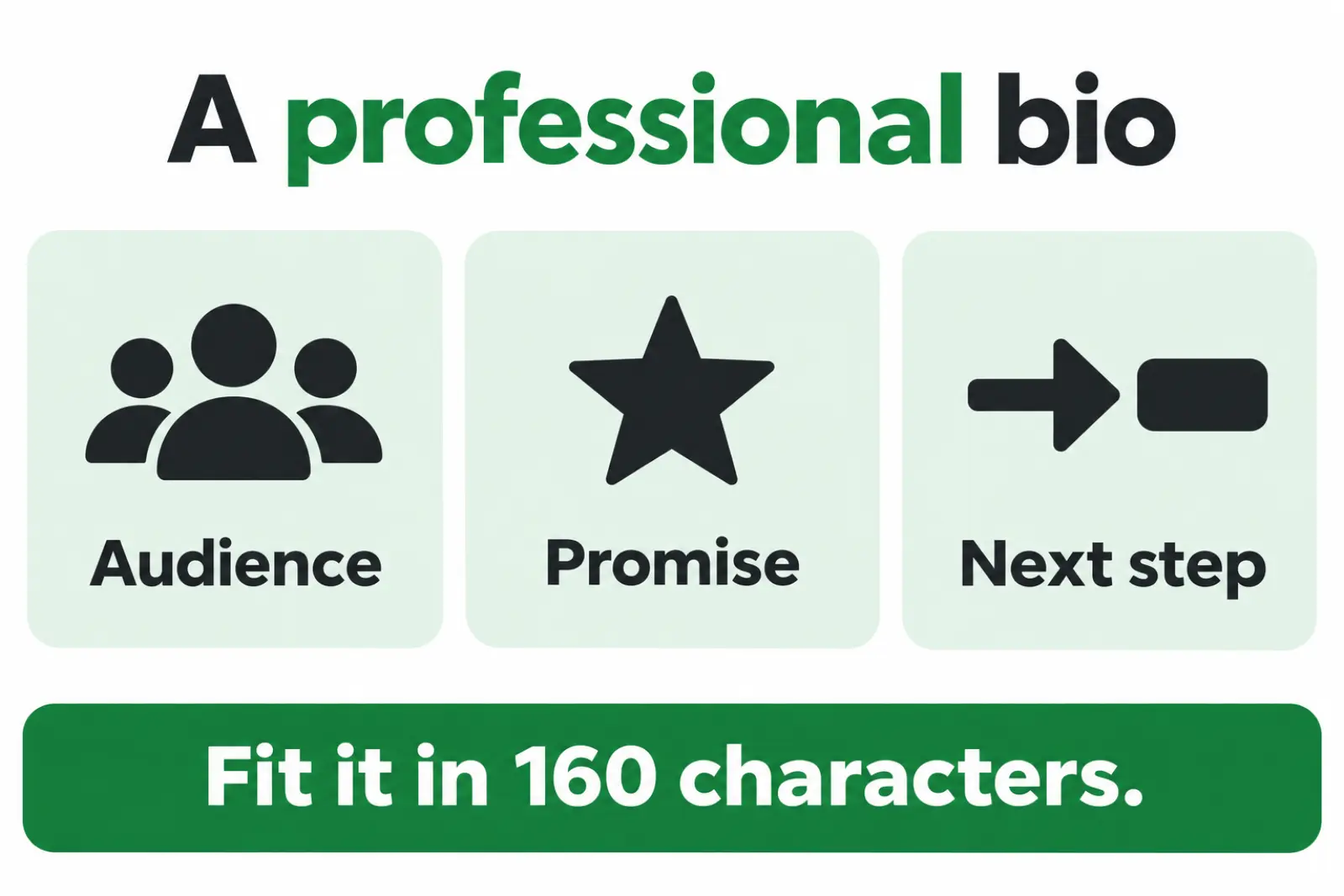
A business bio has to name the audience, the promise and the next step, and it has to match the company's real offer. The business drafts above are structures, not claims about any product. Run this checklist before a business account saves a bio. Each item is a yes or no, and any no sends the bio back to draft.
Audience. Does the bio name one reader in a few words?
Promise. Does it say what the reader will get, in concrete words rather than a label?
Proof. Does the pinned post show the promise, with a result or a clear example?
Next step. Does the bio name one action, and does the website field go to the page that matches it?
Fit. Does the bio describe the posts the account will write for the next three months?
Length. Does it fit within 160 characters, in the field itself (checked 2026-11-10 against the X Help Center page)?
Write the audience in three words. If you cannot, the reader is not defined yet.
Write the promise in one concrete sentence. Remove any word a competitor could use without changing its meaning.
Name the next step in plain words, such as book a call or read the guide.
Point the website field at the page that matches the next step.
Pin the post that proves the promise, and check that the last ten posts fit the bio.
A business bio should not promise a result it cannot show. Growth or revenue claims without a proof point lose a stranger who has seen many such claims. Labels such as leader, expert or visionary also fail, because they describe the writer and say nothing about the reader's problem. If the bio promises reach, name the practice you use, such as the format or the reply habit, and do not promise a platform outcome.
For a business, the next step is the test that matters. Count visitors who reach the website, booking page or newsletter with the link's own analytics or your own tools. Profile clicks alone do not show that step.
Keepthelinkandthelocationoutofthebio
The bio is for words. The Edit profile screen has a separate website field, so the link does not use up the bio's 160 characters (X Help Center: How to customize your profile, checked 2026-11-10). Include a location only when it tells a reader something useful about the work, such as a local market.
A bio change is hard to measure, and a bio alone rarely shows up in post numbers. Keep the bio fixed for a set period, then compare post numbers before and after, for posts of the same type. Read profile clicks and follows per post, and compare weeks, not single days.
Day 0
Save the new bio and write the date in your notes
Week 2
Read profile clicks for posts of the same format
Week 4
Compare follows from posts against the weeks before the change
Read the change over at least four weeks. One week of flat numbers means little, because posts vary from week to week. Four weeks is a practical window, not an X rule.
X's Post Activity Dashboard defines follows as the total number of times someone began following you directly from your post. It defines user profile clicks as clicks on the name, @handle or profile photo of the post's author (X Business Help: Post and Video Activity Dashboards, checked 2026-11-10). Use those two numbers, per post, for the comparison.
If the numbers stay flat, the bio may still be right and the posts may need work. If they fall, check whether your posts changed at the same time before you blame the bio. Write the date of the change down, so the comparison has a clear before and after.
WhereXstayssilent
The X pages checked for this guide on 2026-11-10 describe the bio's length, the profile fields and the dashboard definitions. None says how a bio affects reach, follows or who sees a post. Any claim here about what works is practice. This guide does not use third-party bio conversion figures, because their methods are not shown.
WhichbiorulescomefromX,andwhicharepractice
X's help page on customizing the profile sets the bio at 160 characters and gives the recommended sizes: 1500x500 pixels for the header and 400x400 pixels for the profile photo (checked 2026-11-10). It lists the fields you can edit: header photo, profile photo, name, bio, location, website and birth date. You edit them from the Edit profile button on your profile. The same page describes pinning a post and gives no refresh schedule for it.
Everything else in this article is practice: the three-part formula, the rule against labels, the four-week test and the idea that a bio should follow the work. The text labels each one as practice.
Checkthebioagainstthepoststhatfollowit
The bio is a promise, and the posts that follow it are the evidence. X's dashboard gives post-level numbers for each post, including profile clicks and follows (X Business Help: Post and Video Activity Dashboards, checked 2026-11-10).
Use the same check on a fixed schedule. Read the last ten posts against the bio line, and mark any post that does not serve the promise. This guide uses three or more misses out of ten as a practice threshold for fixing the bio or the posts. Keep the pinned post matched to whichever you keep. Write the date of each check in your notes, so the next read has a clear window.
HowPostMinehelps
PostMine's onboarding has a Profile step. It asks for your site link, reads the site, and fills in what your product does, who it is for and the problem it solves. Context, under Settings, holds About You and the Style Guide, which steer the drafts PostMine writes.
The practical point is consistency. The bio is the first sentence a stranger reads. If About You describes a different person, the drafts drift away from the first screen. Keep the bio, About You and the pinned post saying the same thing.
Three situations break the basic formula, and each needs a different fix.
A bilingual founder has to pick a language for the bio. A practical rule is to use the language of most posts, because a stranger reads the bio in the language of the first post they see. The pinned post can be in the other language. Two languages inside 160 characters halve the room for the reader.
A stealth project cannot name the product yet. Do not invent a claim to fill the line. Write the reader and the practice, and leave the product name out. "Founders testing small B2B ideas in public. Notes on the experiments, the numbers and what they stopped" says enough without revealing the product. Once you can name the product, add it to the current focus, and check that the pinned post still matches.
A team account, where several people post under one handle, needs a different voice. A bio that says "we" can describe a company, but it cannot describe a person's practice. If one founder signs the posts, write the bio as that founder. If the posts belong to a company, name the company, its reader and its practice, and say in the pinned post who writes the posts.
Each case passes the stranger test when the reader is named, the work is named and the rest of the profile confirms the line. If one fails, the fix is usually the reader, not the wording.
Whatastrangerseesataglance
A stranger sees the photo, the name, the handle and the first words of the bio before deciding whether to read on. The first few words carry the most weight, so put the reader or the practice at the front.
To test this, cover the rest of the line and read only the first half. If it says who the account is for or what it does, the line works even when a stranger stops early. If it is a label or a mood, move the practice to the front, even when the sentence reads awkwardly in full.
The display name is part of that glance too. A name with a clear job in it can work. A name stuffed with keywords makes the bio look like an advertisement.
Bioversionsfordifferentgoals
The same person may want different things from the profile. A founder who wants peers to follow needs a line about the work. A founder who wants project inquiries needs a line that says what kind of project they take, and the website field must lead to the page where that happens. A founder who wants a hiring manager to find them needs the role in the words a hiring manager searches for.
160 characters cannot hold every goal. Write for the goal the posts already serve. If most posts teach, name the reader who wants to learn. If most posts sell a product, name the buyer and point the website field at the product page. Pick one goal, run the test for four weeks, and change it only when the posts change. A bio that tries to serve every goal reads like a list, and a list gives the stranger nothing to decide on.
Commonmistakes
Writing the bio for yourself. The reader is the stranger, not your past self, so the bio should answer the stranger's question.
Using labels as the main claim. A label tells the reader what you think of yourself, and it does not tell them what they will get.
Saving a bio that does not fit. A cut version is always better than a bio that gets clipped in the field.
Changing the bio every week. Changes that come every week leave no clear result to read.
Keeping an old focus. A bio that describes a project you stopped can make a visitor leave.
X allows a maximum of 160 characters. Shorter is fine if the line still says who you help and what you do.
Put the link in the website field on the Edit profile screen, not in the bio text. That keeps the bio for words.
Only if the title tells a reader what you do. A title that needs explaining does not help the stranger.
When your focus changes, not on a calendar. Keep a new bio fixed for at least four weeks before you judge it. Four weeks is a practical window, not an X rule.
We use cookies for product analytics to improve PostMine. With your consent we also record session replays, including the content you type and view, such as draft posts (passwords excluded), so we can see how the product is used and fix what breaks. Privacy Policy




 Yerkebulan RakhimovNov 5, 202613 min read