X's developer guidelines name specific actions. Check each one before you automate it.
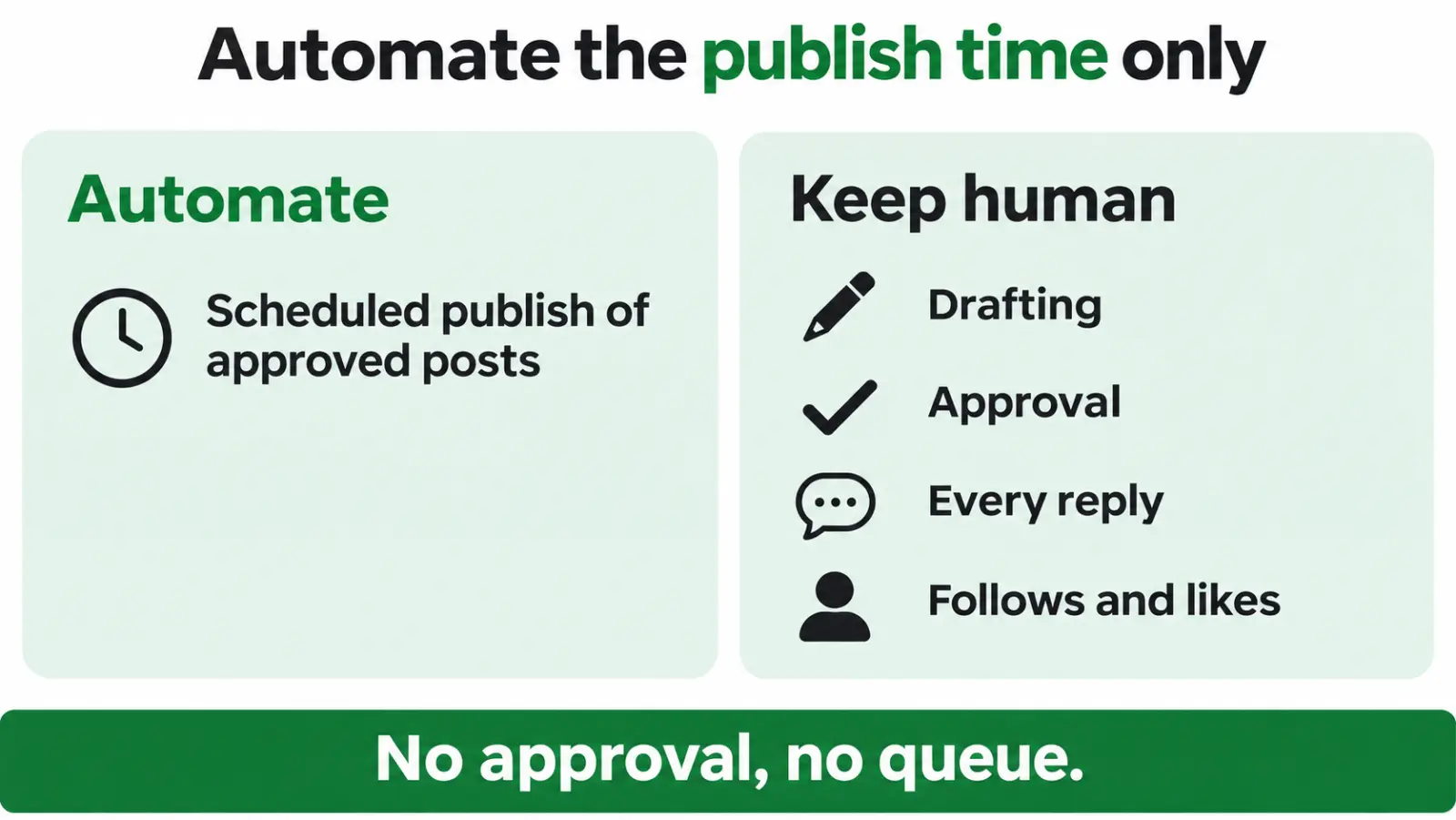
Automate the publish time of posts you already approved.
Keep replies, follows and likes human. X restricts all three when they are automated.
Keep the approval step in front of every post, even a scheduled one.
Automation on X is not forbidden. It is restricted in specific ways, and the restrictions matter more than any tool's feature list. Automate the timing, keep the judgment. That one rule covers most of what I would tell a founder, and the rest of this guide is the detail behind it.
The reason to be strict is practical. A tool that does one thing you did not expect, such as liking a post or following an account on your behalf, can change how your account looks to X and to readers before you notice. The cost of a wrong automation is not a bad afternoon. It can be a suspended account, so the boundary is worth learning once.
Start with the table, then check the two rules it does not cover. X's authenticity rules cover account manipulation and impersonation, which matter once automation touches your account. X's terms say you cannot scrape the Services without express written permission, so anything outside the official interfaces is a separate decision.
The rules name specific actions, so check each one. X's developer guidelines list allowed and prohibited behavior for automated accounts, and they apply to any app that uses the X API, not only to bots. The table summarizes the parts that matter for a founder who wants to automate some of the work.
The guidelines also warn that violations can lead to app suspension, revoked API access or permanent account bans. Read the current version before you connect any tool to your account, because the guidelines are a living document and a summary, including this one, can fall out of date.
Thesix-questioncheck
Run every automation through the same six questions. The developer guidelines close with a short quick check. It is the fastest test to run before any tool gets access to your account.
Did the user explicitly request it? For interactions, a user action must come first.
Is the purpose and behavior clear to users? Automated accounts must be labeled.
Can users easily opt out? Any ongoing interaction needs an exit.
Does it provide real value beyond self-promotion?
Is it only using the official API? Scraping and browser automation are out.
Is it within rate limits and usage policies?
If an automation fails any one of the six, do not run it on your account. The automation rules say that automated activity should honor users' expectations. The same test works for a reply: if a reader would feel handled, the automation is wrong.
Automatethetiming,notthejudgment
Automate the publish time, keep the write-and-check step. Publishing at a set time saves you from being online at the wrong hour. Writing a post and checking it is the part that makes it yours. Keep those two steps apart. Drafting and review happen when you choose.
This split also protects you when something changes. If a post needs a fix at the last minute, a human check catches it. A fully automatic loop does not. The scheduled post that went out on Tuesday may be wrong on Tuesday because a price changed on Monday, and only a person reading the queue will notice.
Keep a written check for every scheduled post. Three questions cover most problems: is the fact still true, does the link open, and would I still stand behind this if a stranger quoted it? A tool cannot answer those for you.
Anexampleofthesplit,stepbystep
The following example is an illustration of a week, not a real account. A founder drafts four posts on Sunday, reads each one aloud on Monday and cuts two of them. The two that pass go into the queue for Tuesday and Thursday, at the times the founder chose. On Wednesday the founder reads the replies to Tuesday's post by hand and answers two of them.
In that week, the tool did the one job it is good at, which is publishing a post at a set time. Every decision that touches a person, from the choice of post to the reply, stayed with the founder. If the tool had written the replies, or liked the posts of people who mentioned a keyword, the week would look the same from the queue and completely different to the people reading it.
WhatIwouldautomate
Automate the boring parts, not the relationships. Some automation saves real time without touching your account's behavior. The pros column below lists the safe kind. The cons column lists the common tools that X restricts or that look like spam.
Works
Publish posts you have already approved at set times
Draft from your own notes, then review each draft
Put a weekly reminder to review your numbers
Avoid
Auto-like posts that match a keyword
Auto-follow people who follow you
Auto-DM new followers with a welcome message
Auto-reply to anyone who uses a keyword
Each con maps to a rule. Auto-liking is prohibited. Automated following is not allowed. Automated direct messages are allowed only after the user writes to you first. Automated replies based on keyword searches alone are not permitted, and the guidelines allow an automated reply only when the user engaged first, with one reply per interaction. If a tool offers any of these as a feature, leave it off.
For a solo founder, the safest default is to automate only the publish step and read every other interaction yourself.
Some founders ask whether a tool that drafts replies is safe. My test is simple. If the tool sends the reply without you reading it first, that is automation of the reply itself, and the guidelines treat AI-generated replies as something that needs prior approval from X. If you read, edit and send it yourself, the tool is only helping you write.
Whattokeephuman
Replies are the part that must sound like you. The guidelines allow an automated reply only when the user engaged first, and limit it to one reply per interaction. For AI-generated replies, they require prior approval from X before deployment. Even with approval, the reply should come from a decision you made, not from a rule that fires on a keyword.
Likes and follows follow the same logic. They are your decisions about who you value and what you endorse. If a tool makes them for you, the decision is no longer yours, and the guidelines already prohibit the bulk versions.
Direct messages are the most sensitive. The guidelines allow a direct message only after the user writes to you first, and they require an easy opt-out. An automated welcome message to new followers is on the prohibited side, even though the followers did opt in to following you, because it is unsolicited contact.
Atoolaudit,workedthroughthreetools
The following audit is an illustration with three made-up tools, not real products. It shows how the six-question check works in practice, because a single feature list can mix allowed and prohibited features.
Tool A passes because the user approved each post and the publish time is the only automated step. Tool B fails on the first question, because the like is automated and keyword-based, which the guidelines prohibit. Tool C fails for the same reason as a direct message: the new follower did not write to you first, so the welcome message is unsolicited contact.
The useful habit is to audit a tool feature by feature. A tool that is fine for publishing can still be unsafe because of one switch you did not read. Turn off every feature that fails, and check the setting again after each update.
Some cases are gray, and the guidelines admit it. The developer guidelines include an accordion called gray areas, which covers affiliate links, AI-generated content, multiple accounts and customer support. The short version is that each gray area depends on the user taking the first step and on the content staying honest.
A few examples, as I read them. A bot that posts city weather on a schedule from several location accounts is allowed when each account serves a different location and the content differs. The same bot posting identical text from several accounts is prohibited. A support tool that answers a user who messaged first is allowed when there is an opt-out. The same tool replying to everyone who mentions a product is not. Each one is my reading of the guidelines, so check the current text before you rely on it.
When a case is unclear, I would not automate it. A manual step costs a few minutes. A suspended account costs far more.
Edgecasestocheckbeforeyouconnectatool
Access tokens and disconnections. When a connection expires, a scheduled post can fail silently. Check the failed view or log in your tool, and make a habit of reading it in the weekly review.
Shared accounts. If a team member can publish from the account, the approval step has to hold for them too. A tool that lets anyone publish without approval has moved the judgment somewhere you cannot see.
Cross-posting. Posting the same text to several X accounts at once is the pattern the guidelines name as identical cross-posting. Adapt each post for its place, or post it once.
A tool that changes behavior after an update. Re-read the tool's settings after a major update. A feature that was off can switch on, and an automated like is the kind of change you would not notice until it had run for a week.
WherePostMinedrawstheline
I build PostMine, which this article mentions.
PostMine keeps approval in front of every post. PostMine publishes only after you slide to publish or set a schedule you chose. It never automates direct messages, comments, follows or engagement, and connected publishing uses X's official API, never browser automation.
Post Studio can draft batches of posts for you to review, and nothing publishes unless you approve it or set a schedule. That is the drafting side of the split. The publish side is the schedule you set yourself. The scheduling guide covers how to test that schedule before you build a routine on it, and the reply guide covers the part of the work that should stay human.
Scheduling your own approved post is a publish-time choice. The developer guidelines give scheduled informational content from an automated account as an allowed example. Read the rules that match your setup before you connect a tool.
The guidelines allow an automated reply only when the user engaged first, one reply per interaction, and they require prior approval from X before an AI-generated reply runs.
Skip it. The guidelines state that automated, bulk or keyword-based liking is prohibited, and that selling likes is prohibited too.
Only if it is an automated account. The guidelines require the Automated profile label, a bio disclosure and a link to a human-managed account for bots that use the API.
We use cookies for product analytics to improve PostMine. With your consent we also record session replays, including the content you type and view, such as draft posts (passwords excluded), so we can see how the product is used and fix what breaks. Privacy Policy




 Yerkebulan RakhimovNov 9, 202610 min read