A list is worth following when its members post on the topic often and reply to each other, not when it is long.
Read the members' recent posts before you follow. The list description is the owner's claim, not evidence.
Follow a list for a week, then decide. A list you never open is noise, however well it is named.
Lists can also be searched through the developer search, which lets you read posts from a list's members directly.
A good list saves an hour a week. A bad list is a second timeline you do not need. The difference is rarely the number of members. It is whether the accounts on the list post about the topic, reply to each other, and stay active. Public lists made by other people are a good way to find those accounts, and they are also a common source of noise, because a list is only as careful as the person who made it.
This guide covers how to judge a public list before you follow it: what to read first, how to check the members, what a healthy list looks like, and how to tell when a list has gone stale. It assumes you already know how lists work. If you do not, start with how to create and manage X lists, which covers the basics and the Help Center's list settings.
Startwiththedescription,thendistrustitalittle
The description tells you what the owner intended. Read it first, because it tells you the topic and the kind of member the owner had in mind. A description that is specific, such as "founders who explain how they changed their onboarding", is a better sign than one that is vague, such as "tips for growth". A specific description forces the owner to choose members, and a vague one usually means the list was built by adding accounts without a rule.
Then distrust the description a little. A description is written once, and a list changes over time. An owner may have stopped maintaining the list, or the accounts may have changed topic. The description tells you the plan. The members tell you what the list is now.
Readthemembers,notthecount
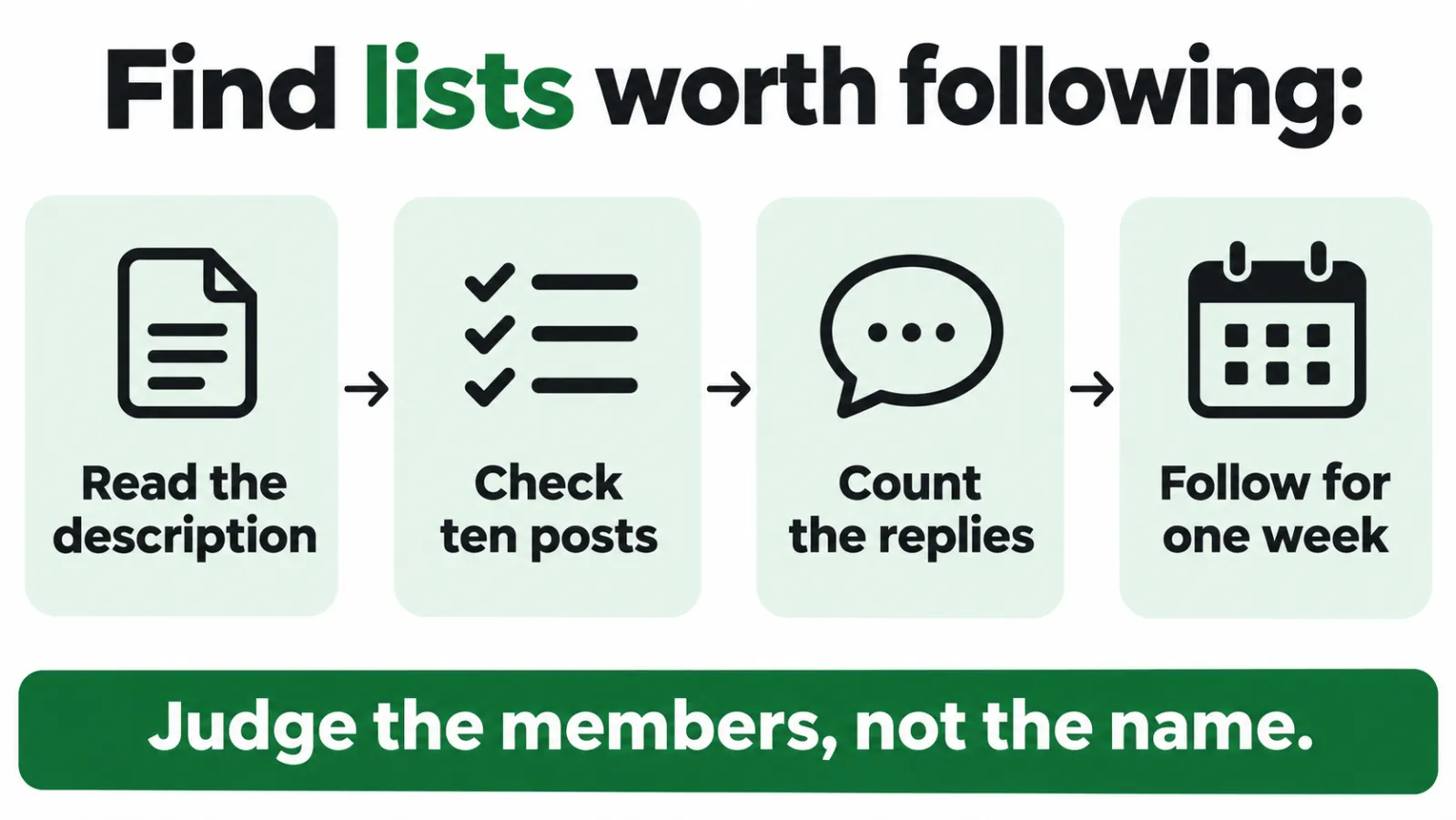
Open the list and read the members' recent posts. Pick five or six members, and read the last ten posts from each one. Ask three questions of each member. Do they post on the topic? Do they post often enough to be worth following? And do they reply to other people in the topic, rather than only broadcasting?
An account that posts on the topic every few days and replies to others in the same conversations is a strong member. An account that posts on the topic once a quarter is a weak member, even if it is famous. An account that posts about something else entirely is a mismatch, and a list with several of them is a list you will leave.
The member count is the weakest signal. A list of forty members can be better than a list of four hundred, because the forty are checked and the four hundred are a collection. Judge the list by the sample you read, not by how many accounts it names.
Signalsonapubliclist,andwhateachonesuggests
Signal
Goodsign
Warningsign
Description
Namesatopicandakindofmember
Vaguewordssuchastips,growthorinspiration
Recentposts
Memberspostedonthetopicinthelastfewweeks
Mostmembershavenotpostedinmonths
Replies
Membersreplytoeachotheronthetopic
Membersonlybroadcast,withnoreplies
Topicfit
Mostmembersmatchthedescription
Severalmemberspostaboutunrelatedthings
Owner
Theownerpostsaboutthetopicandkeepsthelisttidy
Theownerhasnottouchedthelistinalongtime
Size
Smallenoughtoreadinonesitting
Solargethatmostmembersareneverread
The table gives you signals, not a score. A list with two warning signs can still be worth following if the members you read are excellent. The point is to make the judgment explicit, so you know what you are trading off.
Checkwhetherthelistisstillactive
A list can look active because its members are old. Check the dates on the recent posts, not the number of posts over time. If the newest post from most members is more than a few months old, the list has gone quiet. Follow it only if you want an archive, and not as a live source.
The most useful single test is the last week. Find the members who posted in the last seven days. If several did, the list is alive. If almost none did, the list is a memory of a topic, and you will read it for nothing.
Aworkedexample:judgingalist(illustration)
This is an illustration, made up for this guide. Suppose a list is called "small SaaS founders" and has twenty-two members. The description says it covers founders who write about their products. You read the last ten posts of six members. Four post about their product every few days and reply to readers. One posts mostly about travel. One has not posted since spring.
The list has four good members in a sample of six. That is enough to follow for a week. You remove the travel account from your own view by not reading its posts, and you note the silent account for the next review. After a week you check whether the four strong members kept posting, and whether they replied to anyone you care about. If they did, the list is worth keeping. If they did not, you unfollow it, and nothing is lost.
Followforaweek,thendecide
The simplest test of a list is to follow it for a week and see what it does to your reading. Do you open it, and do you find a post you would reply to or save? If yes, the list is useful. If you forget it exists, it is noise, even if its members are respectable.
Write the decision down. A one-line note with the date, the list name and the verdict is enough. After a month, the notes show you which kinds of lists you keep, and which ones you drop. That pattern is more useful than any single list.
Usethedevelopersearchforresearch
There is one route to a list's posts that does not depend on following the list. The X developer documentation lists a list operator, list:, which matches posts from members of a specific list, and it takes the list's numeric ID. The operator is standalone, so it can sit alone in a query, and the documentation lists it under the list operator section.
This route is for developers, and it needs API access. It is useful for research, because it lets you read the recent posts from a set of members in one query, rather than opening each account. If you are not building a tool, the simpler route is to read the list in the app, or to read the members directly. Either way, the research question stays the same: are these members worth reading on this topic?
Commonmistakeswhenchoosinglists
Following a list because of its name. Read the members, not the title.
Judging by member count. A long list is often less useful than a short one with strong members.
Trusting an old list. Check the dates. A list with silent members is a memory of a topic.
Following many lists at once. Three lists you read beat ten you skim.
Never reviewing. A list you followed in the spring may have changed by the autumn. Review it monthly.
Copying a list's members into outreach without reading them. A member list is a starting point, not a contact list.
Edgecasesthatneedacloserlook
Some lists are curated by a company, and their members are accounts the company wants to promote. A company-curated list can still be good, but read its members for signs of an agenda, and ask whether the list reflects the topic or the company's product.
A list of journalists or public figures can be valuable for a topic, and it can also be a list of people who are not reading the replies you send. Judge them by the posts they make, not by their status.
A list in a language you do not read can be useful, but you will need a second check. Read a few posts in the language, or use a translation you trust for the purpose, and check the results against a native reader if the topic is technical.
A list is only useful if its members still post about the topic it names. Before you follow a list, read its most recent posts and check three things: whether most members post on the topic, whether each member has a clear reason to be there, and whether the posts are recent. The X Help Center guide to lists describes a list as a set of accounts whose posts appear in one timeline, so a list is only as current as its members. An account that has stopped posting on the topic stays on the list until someone removes it.
Search gives a second view. The developer documentation for search operators describes a list operator, which restricts a query to the members of a list. You can run that query with a date range and see what the members said about the topic over a period. The advanced search guide lists the fields the search form offers, including dates. If the list produces only a few posts on the topic, the list is probably a name rather than a source.
Keep one caution in mind. The X search policies say that repeated or near-duplicate posts can be removed from search, so a member who posted may not appear in a search result. Read the account's own timeline before you judge a member by search alone, and write down the date you checked, because the list will change over time.
Decide what the list is for before you follow it. A list for news, a list for research and a list for replies call for different members and different checks. A list that does not match its purpose is a source of noise, even when every member is credible on their own topic.
The bookmarks guide gives a plain definition that is useful when you filter lists: lists are "comprised of posts from other accounts by group, topic, or interest, and are discoverable." A list that was built around a group, a topic or an interest is worth checking. A list whose name says nothing about its purpose tells you little until you read its members, and its members are the only evidence you need to decide.
Read the X privacy policy before you save or share a list you found. The policy describes how X handles the information you provide when you use its services, and it is the reference for what the platform does with that information.
WherePostMinefits
PostMine's Feeds page shows real posts from X with a reply box under each one. A list you follow is a source of conversations, and the feed is another source. Use the list for the accounts you judged worth reading, and the feed for posts from the keywords or people lists you set.
The product does not decide which lists are good, and it does not judge the members. That judgment stays with you, and it is the part of the process that matters most.
Open the account's profile, tap the more icon, then View Lists, according to the Help Center's list page. Check the current path in your own app, because menus change, and read the description and members before you follow.
Not by default. A long list is often a mix of strong and weak members. Read a sample of the members' recent posts before you decide, and check whether the list is still active.
The X developer search has a list operator that matches posts from the members of a list, when you have the list's ID. That is a research route for developers, and it does not change who can see the list.
Once a month is a reasonable interval to review a list. Check the last ten posts of a sample of members, and unfollow the list if it no longer matches the topic you care about.
We use cookies for product analytics to improve PostMine. With your consent we also record session replays, including the content you type and view, such as draft posts (passwords excluded), so we can see how the product is used and fix what breaks. Privacy Policy




 Yerkebulan RakhimovNov 9, 202610 min read