Analyze why a competitor's post works for its readers, not what the post says.
Use the replies under a competitor's posts to learn what its audience wants.
Write down your own version of the lesson before you write any post.
Never copy wording, formats or reply patterns that another account built for its own readers.
Competitor research on X has a common failure. The founder opens a larger account, reads its best posts, notices the format and writes something similar. The result looks like the competitor's post with a different topic. It rarely works, because the competitor's reader is not your reader, and the format worked for reasons the copy does not carry.
This article describes a method that uses competitor accounts as a source of lessons about readers, not as a template for posts. The method asks why a post worked for the people who replied to it. It keeps your own point, your own wording and your own reader in view. It also names the limits, because some things should not be copied at all.
What you can and cannot learn about another X account, and which tools claim to show it, is covered in analyze another X account: tools.
Whycopyingfails
A post works in a context. It works because the author has a specific reader, a history with that reader and a point that fits what the reader already believes. Copy the surface and you keep none of that. A stranger who copies a founder's thread may get the same shape and none of the trust.
There is also a practical problem. A copied post is easy to spot for the readers who already follow the original author. That damages your credibility with the same community you are trying to join. The better use of a competitor is to learn something you can say in your own voice.
Analyze the reader, then write your own point. The competitor's post is evidence about its readers, not a draft for yours.
Choosethreetofiveaccounts
Pick accounts that write for a reader close to yours, not accounts that simply have large numbers. A smaller account in your niche often shows more about the reader than a famous account in a neighbouring niche. Choose three to five accounts and review them once a week. More than five creates a reading load that you will not turn into decisions.
X's help page on Lists says you can create Lists of other accounts "by group, topic or interest" (X Help Center: Lists), which is a simple place to keep your three to five accounts. X's advanced search filters posts by words, people, places and dates when you are logged in (X Help Center: Advanced search), so you can pull up one competitor's posts on one subject and read them in order.
Write down why each account is on the list. "Replies from people who build small tools" is a reason. "Big account" is not.
Thefour-questionmethod
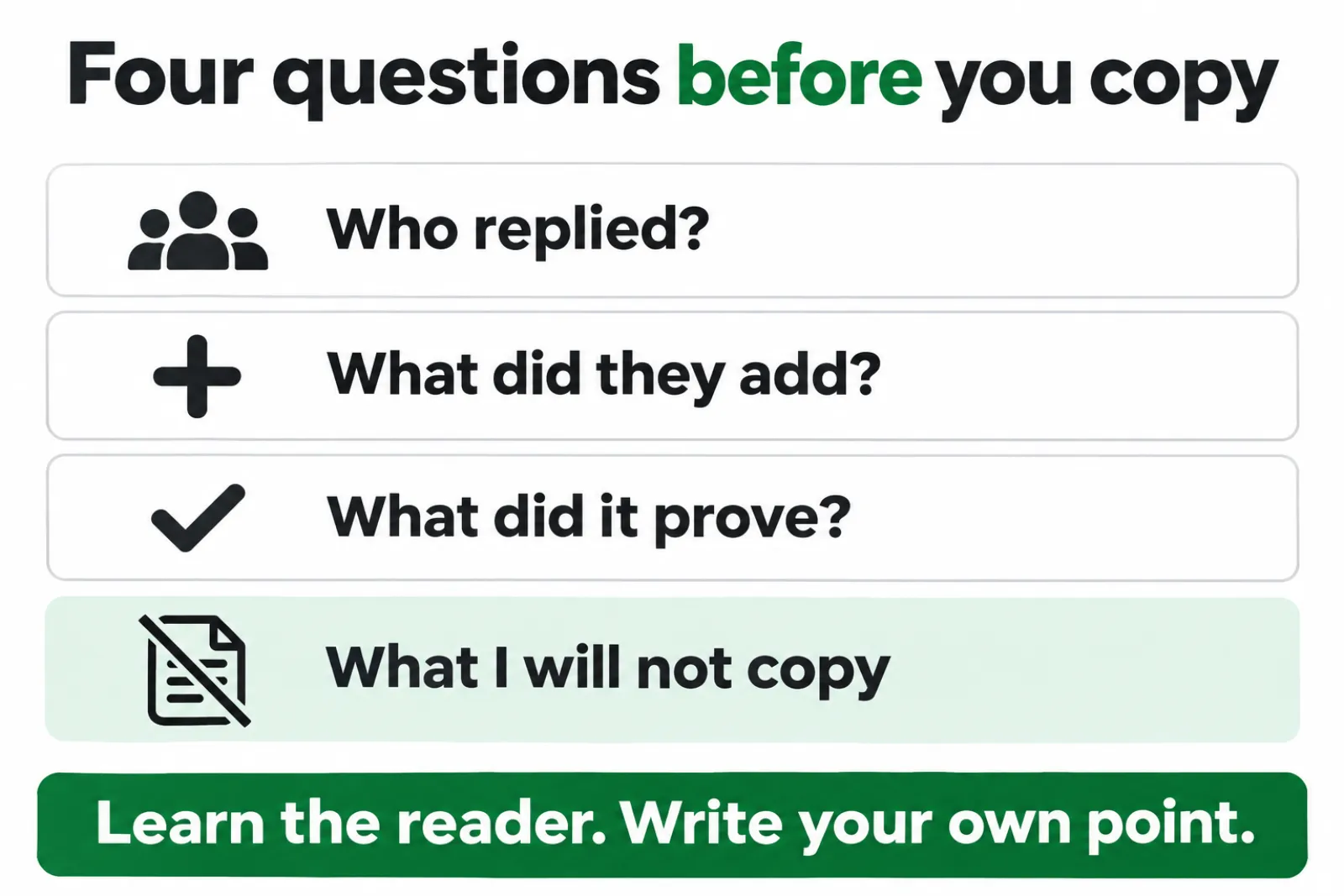
For each post you read, answer four questions in a note. Keep the answers short. The point is to make the reader visible.
Who replied? Note the kind of person who answered: a founder, a customer, a peer, a critic. The replies show who the post reached.
What did they add? Read the replies for the detail or the experience the replier added. The added detail often shows what the reader already knows.
What did the post prove? Name the claim the post made, and whether the readers accepted it. A claim the readers challenged is useful too.
What will I not copy? Write one thing you will not take, such as the wording, the format or the reply pattern. This line keeps the analysis honest.
Read the replies first. They tell you what the readers cared about before you read the post as a writer.
Find the added detail. Look for a reply that names a number, a tool or an experience the post did not mention.
Name the reader in one sentence. For example: "a freelancer with three clients who loses track of proposals."
Write your own lesson. One sentence in your voice, about your reader, that you could test with your own post.
Here is a made-up example. A competitor posts a short note that says most users cancel in the second week. The replies include a founder who says the cancellations happen after the first invoice is sent, and a customer who says the setup was too long. The reader lesson is that the second week is about the first real use, not the setup. Your own lesson might be: check whether your users send their first invoice in week one. You can test that in your own product, and it has nothing to do with the competitor's wording.
Usetherepliesasaresearchpanel
The replies under a competitor's posts are a free panel of people who already care about the topic. Read them for three things: the questions readers ask the author, the disagreements between readers and the detail people add without being asked. The questions show you what the market is still unsure about. The disagreements show you where an honest point would be welcome. The added details often show a problem the author has not solved.
X's help page on conversations says that when you reply to a post, you can see the full list of participant usernames in the conversation by tapping the prompt above the post (X Help Center: Conversations). That list answers the first of the four questions, who replied, without guessing from the profile photos.
Log these in the same way you log your own replies. A competitor's reader who writes a clear problem is a lead for your next post, and a reader who asks a question the author did not answer is a reply you can give, with a real point.
Whattotakefromacompetitor,andwhattoleave
Takethis
Leavethis
Thereader'sproblem,intheirwords
Theauthor'sexactwordingorsentencestructure
Thequestionsreaderskeepasking
Theformat,ifitonlyworksforthatauthor'saudience
Thedisagreement,andwhateachsidebelieves
Hooksthatpromisearesultthepostdoesnotdeliver
Thedetailareaderaddsthattheauthormissed
Replypatternsthatrepeatthesamelineundermanyposts
Trackthepattern,notthepost
One post rarely teaches much. Look at ten posts from the same account and ask which kinds of post get real replies. You may find that the account's best conversations come from its findings, not its opinions, or from its replies to other people's questions. That pattern is the lesson. A single post is a data point, and ten posts are a pattern you can compare with your own log.
Keep the comparison side by side. Put your own posts and replies in one column and the competitor's pattern in another. The difference is what you change next, and the change should be one thing at a time.
Wheretheadvicedisagrees
Some advice says to study the top accounts in your niche and copy what works. Some says to ignore competitors entirely, because their readers are not yours. Some says a competitor's worst posts are more useful than its best, because failures show the reader's limits. I do not think any of these is complete. My view is that the top accounts show you the reader's expectations, while smaller accounts show you what a reader is willing to reply to. Study both, and keep the lesson in your own words.
Limitstorespect
Do not copy wording. Reusing another author's sentences is copying, even when the topic is different.
Do not copy reply patterns. A reply template that works for one account is a template for spam when someone else uses it.
Do not scrape. X's Terms of Service prohibit scraping. The terms say that "except as required by applicable law, you cannot scrape the Services without X's express written permission." Read posts by hand, in the app, and keep notes in your log.
Do not use the analysis to contact the author in bulk. A short, specific reply is fine. A bulk message is not.
The risk is not theoretical. An r/aiagents post with a score of 111 describes a bot that built a "template library with 10 helpful response types" and posted the replies automatically. X's authenticity rules say that you may not share or post content "in a bulk, duplicative, irrelevant or unsolicited manner that disrupts people's experience." A copied reply pattern used at scale is that case.
Aworkedanalysis,madeup
Here is a made-up analysis of a competitor that sells invoicing software to small agencies. The account posts four times a week, mostly short notes about cash flow, and it has a steady group of replies from agency owners.
Step one is the replies. Across ten posts, the same three agency owners reply again and again, and they all describe late payment from one large client type. Step two is the added detail. One reply says the agency fixed the problem by sending the invoice before the project ends, a detail the competitor's post did not mention. Step three is the claim. The competitor's post argued that early invoices make clients angry, and two replies disagreed with that point from their own experience. Step four is the rule you will not copy. The competitor uses a fixed phrase at the end of every post, and that phrase is theirs.
The lesson the analyst writes down is about the reader, not the product: agency owners worry about clients who delay the final payment, and they will argue about timing in public. The analyst's own version is a test in the analyst's own product. Send the invoice at a different point in the project for four weeks, and log the replies from agencies. The competitor's post did not decide anything. It only showed where a real disagreement lives.
Notice what the analysis did not produce: a list of the competitor's best phrases, a schedule copied from their feed, or a reply template for agency owners. Those would have been copies. The method leaves you with a question you can test, which is the only part of a competitor's account worth taking.
Whatagoodanalysisleavesbehind
A good analysis leaves three things in the log, and they should be easy to read in a month. The first is a reader sentence: one line that describes the person who replies, in their words, with the date and the post it came from. The second is a test: one thing you will change in your own account, with the reason and the way you will measure it. The third is a boundary: one thing you saw and decided not to take, with the reason. The boundary matters as much as the lesson, because it keeps the next analysis honest.
Review the analyses once a quarter. Read the reader sentences together and look for a pattern across accounts. [INFERENCE] If three competitors' replies describe the same worry, the worry may be real for your market, and it deserves a post of your own. If the lessons contradict each other, the readers are split, and a post that takes a clear side may start a useful argument.
Share the lesson only in your own words. A post that says "I noticed my readers worry about timing, and here is what I tested" is a good use of the analysis. A post that quotes a competitor, names them, or repeats their framing is not, and it can damage the relationship you need with the same readers.
Readingreactionswithoutchasingthem
Competitor reactions are noisy, and a reaction can mislead. Nikita Bier, posting on X, wrote on July 18, 2026 that a product builder is not moving fast enough "unless: You can no longer keep track of which subcommunity hates you." The line is a joke, but it is also a warning: a loud subcommunity is not the whole market.
The practical rule is to count how many different readers raise the same point, not how loudly they raise it. Three replies from three different people across two months are a signal. Thirty replies from one thread are a debate. Record the number of distinct accounts in the log next to each lesson, so the analysis does not reward the loudest voice.
Keep the reaction in context as well. A competitor's post that drew angry replies may have been aimed at a different buyer than yours. Before you treat the anger as a warning for your own product, ask whether your readers would have reacted the same way, and write that answer down.
HowtoapplythisinPostMine
PostMine helps you read the conversations and keep your own record. It does not analyze competitors for you, and it does not send replies without your action.
Feeds builds a feed from up to five keywords or from people lists. In the app you can also build one from your followers, the accounts you follow, repliers or an X list, so you can read the posts your readers read.
My Replies lists the replies you sent and how each one performs, so your own log sits next to the lessons you took from others.
Analytics shows your own account trends, which is the comparison that matters most.
Yes. Public posts and replies are meant to be read. The line is copying wording or reusing their reply patterns, which is a different thing from learning from their audience.
Three to five is enough for a small account. More than that creates a reading load that is hard to turn into decisions.
Write one lesson about the reader, one lesson about the format and one thing you will not copy. The third line keeps the analysis honest.
Reading public posts by hand is allowed. X's terms prohibit scraping, so do not use tools that collect posts automatically. Do the interpretation yourself, from the replies.
We use cookies for product analytics to improve PostMine. With your consent we also record session replays, including the content you type and view, such as draft posts (passwords excluded), so we can see how the product is used and fix what breaks. Privacy Policy




 Yerkebulan RakhimovNov 9, 202616 min read