Follower quality is about whether the people who follow you can use your posts, not about how large the count is.
Sample the followers you have, read their profiles and replies, and count the share that fits your goal.
The native analytics cannot verify whether an account is real, so do not claim a bot audit it cannot support.
Track quality as a share, over time, next to the growth count, so one good week does not hide a shift.
Follower count is easy to check and easy to misread. It rises when a post goes wide, and it falls when a post misses, and neither move says much about whether the people who follow you are the ones your goal needs. A vanity metric is a number that looks like progress and does not change the next decision. The follower count is often one of them.
This article gives a practical audit of follower quality. By my estimate it takes about an hour. It is built from what X's native numbers show and what they do not, and it leaves out claims that need a bot-detection method X does not publish.
50
Recent followers in the monthly sample, my practice
A vanity metric is a count that rises without changing the outcome. The follower total is a common example. Impressions can be one too, when they rise on posts that reach people who never engage. Likes are a third, because they are a reflex and not a decision.
The metrics that matter are the ones tied to your goal. If the goal is to find clients, the share of followers who work in the buyer's role is the metric. If the goal is to build a peer network, the share of followers who reply and follow back is the metric. Write the goal first, and the vanity metrics become easy to spot.
X's own definitions make the gap clear. The dashboard defines follows from a post as the total number of times someone began following you directly from the post (X Business Help: Post and Video Activity Dashboards). That is a count of decisions, not a count of fit. A follow can come from a reader who will never engage again.
Runthesampleaudit
The audit is a sample, not a census. You read a set of recent followers and count the share that fits the goal. The sample tells you the shape of the audience, and the share over several months tells you the direction.
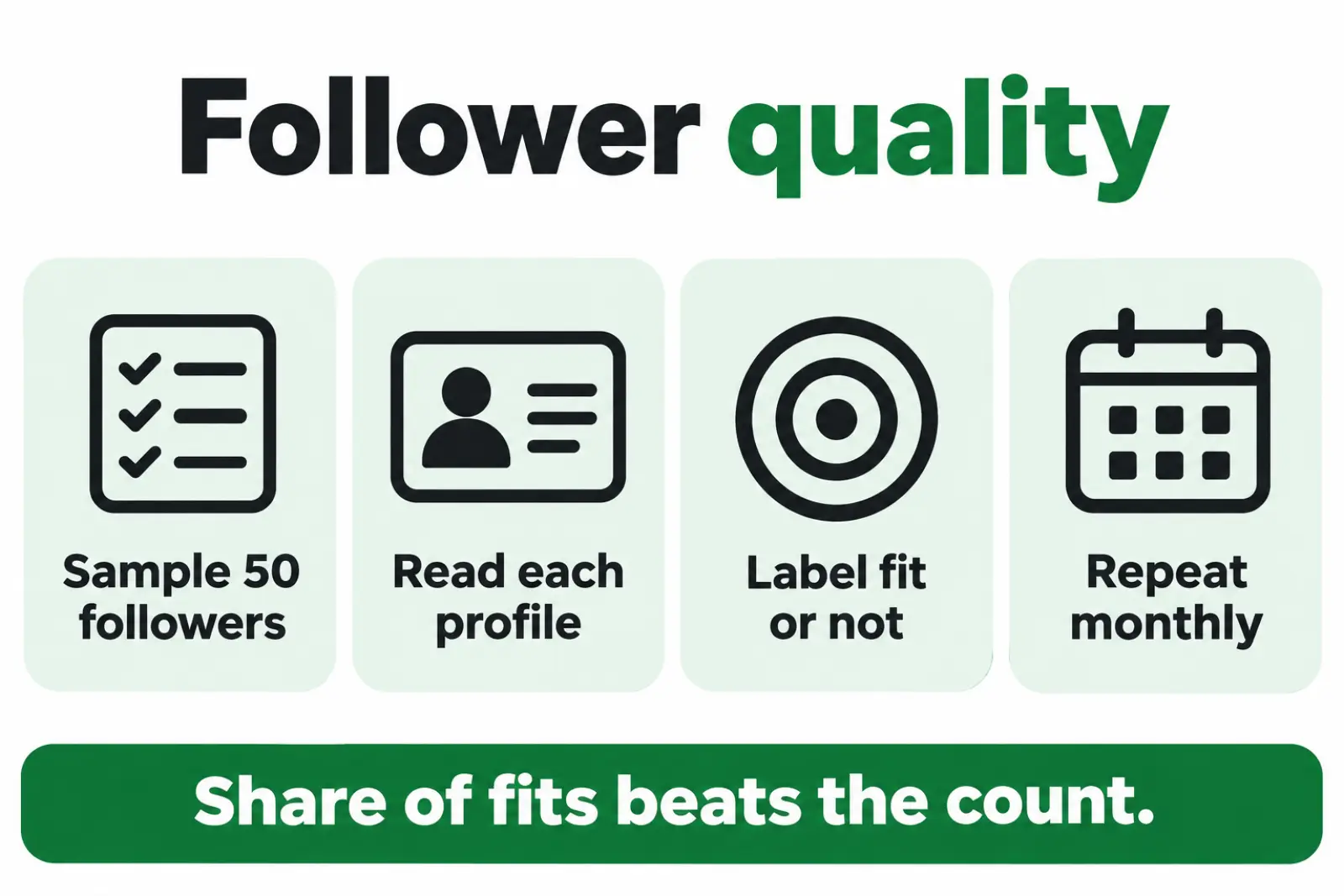
Take the most recent fifty followers. Read each profile for the topic, the role and whether the account is active, and record one of three labels: fits the goal, partly fits, or does not fit. Keep the label rule fixed, so the next month uses the same test. Count the share that fits, and the share that does not.
Write the goal in one line. The label rule follows the goal, so write it first.
Pull the most recent fifty followers. Use the followers list on your account, sorted by recent follow, and note the date you sampled.
Read each profile for the topic and the role. Ignore the follower count, and read the bio and the last few posts.
Label each account as fits, partly fits or does not fit, using the same rule every month.
Compute the share that fits and write it beside the total follower count and the date.
This method is slow on purpose. It forces you to read the people, which the dashboard cannot do. The result is a share, and a share is easier to compare across months than a list of impressions.
Whatthenativenumberscanandcannotshow
The native numbers show follows that came from a post, and they show how those posts performed. They do not show whether a follower is real, active or in your target market. X's pages I checked do not describe a native quality score, and I did not find a bot-detection method in them.
So do not claim a bot audit from the native view. If a tool gives you a bot score, treat it as that tool's estimate, and check how it defines the score before you act on it. The quality audit above does not need a bot score. It needs your goal and a fair read of fifty profiles.
Readthequalitysharewiththegrowthcount
Quality on its own can be misleading. A high share of fits on a shrinking account is a different situation from a high share on a growing one. So read the quality share next to the growth count from the same weeks.
Share rising, count rising. The growth is adding the right people. Keep the format that produced it.
Share rising, count flat. The audience is getting closer to the goal, but the reach is not growing. Look at the reach, not the quality.
Share falling, count rising. The posts reach people who do not fit. The growth is real, but it is the wrong growth.
Share falling, count falling. Something changed in the topic or the profile. Check the audit first.
The growth reading is covered in how to track X follower growth. Use the same weekly record for both, so the two numbers share a date.
Commonmistakes
Reading the count as quality. A large count can contain the wrong people.
Changing the label rule each month. The share then compares two different tests.
Sampling only the newest followers. One week of new followers can be a viral spike, so keep the sample in the same weekly frame.
Trusting a bot score without its method. Check what the score measures before you act on it.
Ignoring the goal. Without the goal, every label is a matter of taste.
Works
A share of fits, not a count
A sample of fifty read by hand
The same label rule every month
The share read next to growth
Avoid
A follower total as the quality measure
A bot score without its method
A label rule that changes each month
A sample from one viral week
Aworkedexample,labelledasanillustration
The example below is made up and does not come from any account. A founder whose goal is to reach other founders samples fifty followers in March and labels twenty of them as fitting the goal. In April the sample has thirty fitting labels out of fifty. The follower total grew by 200 in the same month, but the share of fits rose from 40 percent to 60 percent. The founder reads April as a quality gain. The next question is whether the reach of the posts is still reaching founders, which the funnel article covers in the metrics by funnel stage.
ComparethesamplewithX'saudienceview,ifyouhaveit
X Subscriptions announced an analytics update in December 2024 (X Subscriptions), and the update it quoted from @ZachWarunek listed a follows-over-time widget (@ZachWarunek's update). I could not confirm how far back that widget reaches, so check it on your own account before you use it as a follower history. Replies are a second sample to compare against, because X's replies and mentions page says you join conversations by replying to others and by mentioning them (X Help Center: About replies and mentions).
A monthly sample of fifty profiles is a hand-read method, and it is useful because it does not depend on any X score. X's marketing page describes an audience insights view that covers your followers and the people who have engaged with your posts, with demographics and interests drawn from several data sources (X Marketing: Measure results). If that view is open to your account, compare its audience picture with your sample, once a quarter.
The comparison tests two things. If the audience view says most of your followers are in your target role and your sample says otherwise, the sample method or the label rule needs a check. If both agree, the quality read is more reliable. I could not open the audience insights view in the pages I checked, so the comparison is a step to take when you have access, not a claim I have verified.
A follower who never engages is a different kind of reader from one who replies, so your quality label should say which group a profile came from.
Unfollows change the quality read too. X's authenticity rules name "follow churn", meaning following and then unfollowing large numbers of accounts to inflate a follower count, as a behavior they cover (X Help Center: Authenticity). The pages I could open do not give a native unfollow count. A month where the share of fits rises while unfollows also rise can mean the audience is narrowing rather than improving, so read the share and the count of departures together.
Whichnumbersaresafetouseinaqualityread
A quality read is only as sound as the numbers beside it, and X's pages give some numbers clearer definitions than others. The follows that came from a post are defined by the Post Activity Dashboard as the total number of times someone began following you directly from the post (X Business Help: Post and Video Activity Dashboards). That is a precise count of a decision tied to one post, so it is the number to rely on most for a quality read.
Other numbers are less precise for quality. Impressions are defined in ad terms on the dashboard, so they say how far a post was served, not who saw it. Views are logged-in loads, and repeat views count, so they say nothing about who the people are (X Help Center: View counts). For a quality read, use follows from posts as the decision count and the sample as the people count, and keep impressions and views out of the share.
Keep one export for the whole read, so a follow count comes from the same source each month. Pick the view you can export each month, and label the quality read with that view's name. Write the date range beside each number as well, so a later read compares the same window and not a different one. A read that changes its source halfway through the year cannot show a trend, so start a new series rather than splicing two.
Buildthelabelrulefromyourgoal,notfromX
X's pages do not define a follower quality score, so the label rule is yours, and it should come from the goal you wrote at the start of the audit. The dashboard can show which posts brought follows, and the marketing page describes audience insights for followers and engagers (X Business Help: Post and Video Activity Dashboards, X Marketing: Measure results). Neither one labels a follower as a fit or a misfit. That judgment is the audit's own, and it should be written in one sentence before the first profile is read.
A workable label rule names three tests. The profile should show a topic near yours, the recent posts should be about that topic, and the account should be active enough that a follow could lead to a reply. Each test is a yes or no, and a follower who passes two of three is partly a fit. The rule is not a claim about X's systems, and it should change only when the goal changes, not when the month's numbers disappoint.
Write the rule in the audit sheet beside the share, so a reader can see what a fit meant in each month. Without the rule, two months of shares cannot be compared, and the audit becomes a feeling about the audience rather than a measurement of it.
WherePostMinefits
PostMine's Feeds, under Engage, builds feeds from up to five keywords or from people lists, and My Replies lists the replies you sent and how each one performs (PostMine quickstart). Those views can help you find the people who fit your goal and track the conversations with them. PostMine does not give a follower quality score, and this article does not claim one.
Take a sample of recent followers, read their profiles, and count the share that matches the reader your goal needs. Repeat the sample each month and compare the shares.
Not in the native pages I checked. Any tool that claims a bot score is using its own method, and you should treat the score as an estimate, not an X fact.
No. A large count can contain the right people. The test is the share that fits the goal, not the size of the count.
Fifty recent followers is enough for a monthly read in my practice. A smaller sample swings too much from one week to the next.
We use cookies for product analytics to improve PostMine. With your consent we also record session replays, including the content you type and view, such as draft posts (passwords excluded), so we can see how the product is used and fix what breaks. Privacy Policy




 Yerkebulan RakhimovNov 9, 202610 min read